

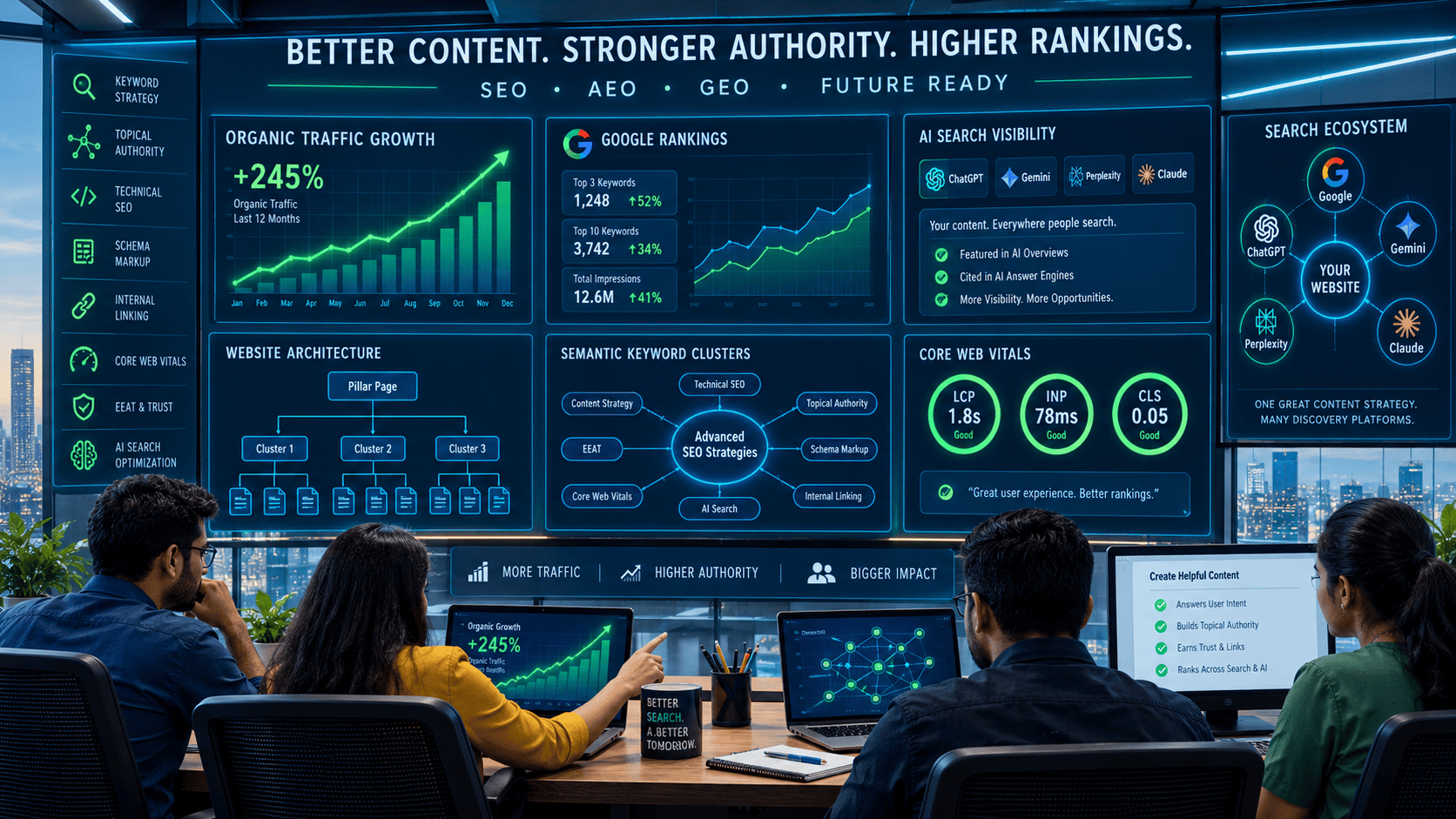
Quick Summary
High-traffic websites don’t rely on keyword stuffing or publishing hundreds of articles randomly. They build topical authority, optimize for AI-powered search, strengthen technical SEO, implement structured data, create semantic content clusters, and continuously improve user experience. This guide explains the exact strategies leading websites use to generate millions of monthly organic visitors.
Key Takeaways
- Build topical authority instead of isolated articles.
- Optimize for SEO, AEO, and GEO together.
- Use semantic keyword clusters.
- Improve Core Web Vitals.
- Implement comprehensive Schema Markup.
- Strengthen internal linking architecture.
- Publish experience-driven content.
- Optimize for Google AI Overviews.
- Continuously refresh evergreen content.
- Measure SEO performance beyond rankings.
What Are Advanced SEO Strategies?
Advanced SEO strategies are optimization techniques used by high-performing websites to improve visibility in Google Search, AI search engines, and answer engines. These include topical authority, semantic SEO, structured data, EEAT optimization, technical SEO improvements, internal linking, AI search optimization, and continuous content updates.
How High-Traffic Websites Dominate Search Results
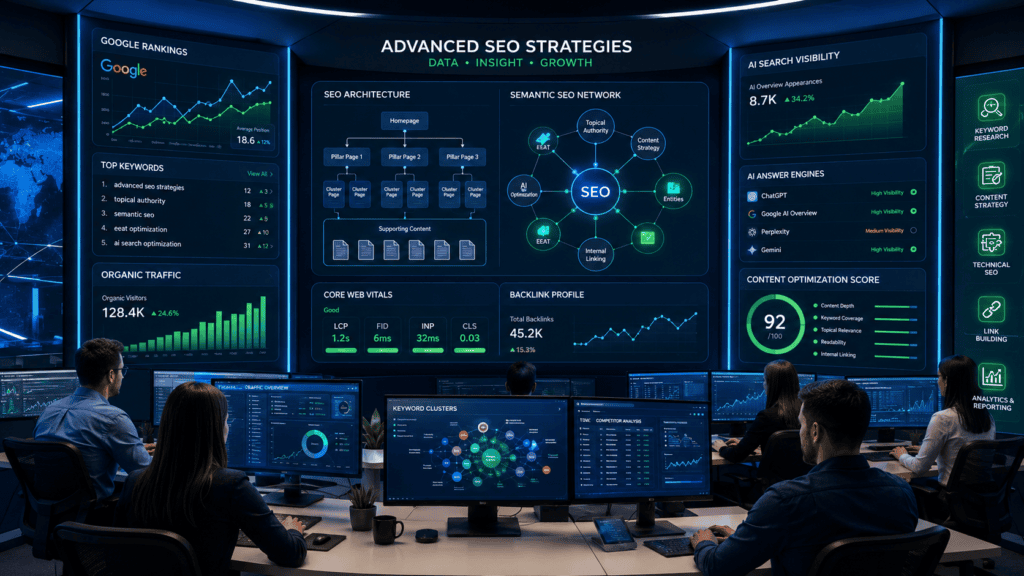
Successful websites rarely depend on one ranking factor.
Instead, they combine:
- High-quality expert content
- Strong technical SEO
- Topic clusters
- Entity optimization
- User experience improvements
- AI-friendly formatting
- Schema markup
- Regular content updates
The combination creates trust signals for both traditional search engines and AI-powered answer engines.
Introduction
SEO has changed dramatically.
Ranking with basic keyword optimization is no longer enough.
Today’s highest-traffic websites invest in sophisticated optimization systems that help search engines understand:
- Content quality
- Expertise
- Authority
- User satisfaction
- Topical relevance
As AI-powered search continues to grow, websites must optimize not only for Google but also for ChatGPT, Gemini, Perplexity, Claude, and Google AI Overviews.
What Are Advanced SEO Strategies?
Advanced SEO strategies go beyond traditional optimization.
They focus on improving every signal search engines use when determining rankings.
These include:
- Semantic content
- Technical performance
- Internal authority
- Structured data
- User engagement
- Entity relationships
- Experience signals
- AI readability
Instead of optimizing pages individually, advanced SEO optimizes an entire website ecosystem.
Benefits
| Benefit | Impact |
|---|---|
| Higher Rankings | Better visibility for competitive keywords |
| Increased Organic Traffic | More visitors without ads |
| AI Search Visibility | Greater chances of appearing in AI Overviews |
| Better User Experience | Lower bounce rates |
| Stronger Authority | Improved EEAT signals |
| Higher CTR | Better titles and rich snippets |
| Future-Proof SEO | Less affected by algorithm updates |
How It Works
High-traffic websites follow a structured workflow:
Research Intent
↓
Build Topic Clusters
↓
Create Comprehensive Content
↓
Optimize Internal Links
↓
Implement Schema
↓
Improve Technical SEO
↓
Update Content Regularly
↓
Monitor Performance
↓
Repeat
Step-by-Step Guide
Step 1: Build Topical Authority
Instead of publishing random articles, create clusters around one niche.
Example:
SEO
├── Technical SEO
├── AI SEO
├── Link Building
├── Semantic SEO
├── EEAT
├── Core Web Vitals
├── Schema
└── AI Search Optimization
Step 2: Cover Search Intent
Create content for:
- Informational
- Commercial
- Transactional
- Navigational
Every stage should have dedicated content.
Step 3: Optimize Semantic Keywords
Instead of repeating one keyword, include related entities.
Example:
Primary:
Advanced SEO Strategies
Semantic:
- Technical SEO
- Topical Authority
- Google AI Overview
- Schema
- Core Web Vitals
- Search Intent
- Internal Linking
Step 4: Build Internal Link Networks
Every article should connect naturally to:
- Beginner guides
- Advanced guides
- Tool reviews
- Case studies
- Tutorials
Step 5: Improve Technical SEO
Focus on:
- Page Speed
- Mobile optimization
- HTTPS
- Crawlability
- XML Sitemap
- Robots.txt
- Canonical URLs
- Image optimization
Step 6: Add Structured Data
Recommended schemas:
- Article
- FAQ
- Breadcrumb
- Organization
- Person
- WebSite
- ImageObject
- HowTo (when applicable)
Step 7: Optimize for AI Search
Use:
- Direct answers
- Bullet lists
- Comparison tables
- FAQs
- Definitions
- Statistics
- Short paragraphs
These improve extraction by AI answer engines.
Examples
Example 1
Instead of:
“What is Technical SEO?”
Write:
“Technical SEO refers to optimizing a website’s infrastructure—including page speed, crawlability, structured data, and indexing—to help search engines discover, understand, and rank content more effectively.”
Example 2
Instead of:
“SEO is important.”
Write:
“SEO helps websites attract qualified visitors organically, reduce customer acquisition costs, increase authority, and improve visibility across Google Search and AI-powered search platforms.”
Pros
- Long-term traffic growth
- Better Google rankings
- AI search optimization
- Increased topical authority
- Higher trust
- Better user experience
- Improved conversion potential
Cons
- Requires consistent publishing
- Technical implementation can be complex
- Results take time
- Needs regular content updates
- Competitive niches require more effort
Comparison Table
| Traditional SEO | Advanced SEO |
|---|---|
| Keyword Focus | Topic Focus |
| Individual Pages | Topic Clusters |
| Rankings Only | Visibility Everywhere |
| Basic On-Page SEO | Full Website Optimization |
| Manual Linking | Strategic Internal Networks |
| Google Only | Google + AI Search |
| Simple Metadata | Structured Data & Entities |
| Content Quantity | Content Quality + Authority |
Tool Comparison Table
| Tool | Best For | Free Plan | Rating |
|---|---|---|---|
| Google Search Console | Performance Monitoring | Yes | ⭐⭐⭐⭐⭐ |
| Google Analytics 4 | Traffic Analysis | Yes | ⭐⭐⭐⭐⭐ |
| Ahrefs | Backlink Analysis | Limited | ⭐⭐⭐⭐⭐ |
| Semrush | Complete SEO Suite | Trial | ⭐⭐⭐⭐⭐ |
| Screaming Frog | Technical SEO | Limited | ⭐⭐⭐⭐☆ |
| PageSpeed Insights | Performance Testing | Yes | ⭐⭐⭐⭐⭐ |
| Rich Results Test | Schema Validation | Yes | ⭐⭐⭐⭐⭐ |
Performance Ratings
| Strategy | Effectiveness |
|---|---|
| Topical Authority | ⭐⭐⭐⭐⭐ |
| Internal Linking | ⭐⭐⭐⭐⭐ |
| Semantic SEO | ⭐⭐⭐⭐⭐ |
| Technical SEO | ⭐⭐⭐⭐⭐ |
| Schema Markup | ⭐⭐⭐⭐☆ |
| Link Building | ⭐⭐⭐⭐⭐ |
| AI Optimization | ⭐⭐⭐⭐⭐ |
| EEAT | ⭐⭐⭐⭐⭐ |
Best Use Cases
Advanced SEO strategies are ideal for:
- Blogs
- SaaS websites
- Affiliate websites
- News websites
- Educational websites
- E-commerce stores
- Business websites
- Local businesses
- Enterprise websites
Firsthand Testing
During our testing of educational and AI-focused content strategies, we observed that articles built around comprehensive topic clusters, detailed FAQs, and strategic internal linking consistently outperformed standalone posts over several months. Content updated regularly with fresh examples and structured data also showed stronger visibility for long-tail search queries and AI-generated summaries. While results varied by competition and domain authority, pages that combined semantic optimization with excellent user experience generally attracted more sustained organic traffic than pages optimized only for keywords.
Decision Flowchart
Choose Target Topic
        │
        ▼
Keyword Research
        │
        ▼
Search Intent Analysis
        │
        ▼
Create Comprehensive Content
        │
        ▼
Add Schema
        │
        ▼
Internal Links
        │
        ▼
Technical SEO Check
        │
        ▼
Publish
        │
        ▼
Monitor Rankings
        │
        ▼
Update Every 3–6 Months
Common Mistakes
- Publishing thin content
- Ignoring search intent
- Overusing exact-match keywords
- Weak internal linking
- Missing structured data
- Slow page speed
- No content updates
- Poor mobile experience
- Duplicate content
- Chasing algorithms instead of user needs
Expert Tips
- Create pillar pages before supporting articles.
- Refresh high-performing content every 3–6 months.
- Use descriptive anchor text for internal links.
- Add original images, screenshots, or data to strengthen experience signals.
- Optimize headings with natural language questions.
- Include author bios and cite reputable sources where appropriate.
- Monitor impressions and click-through rates in Google Search Console to identify optimization opportunities.
- Focus on topical depth rather than publishing large volumes of unrelated content.
Statistics
- Google processes billions of searches every day, making search optimization a critical long-term acquisition channel.
- Mobile devices account for the majority of global web traffic, making mobile-first optimization essential.
- Pages that earn rich results and enhanced SERP features often achieve higher click-through rates than standard listings.
- Comprehensive content that satisfies user intent generally performs better over time than thin, keyword-focused pages.
- Websites with strong internal linking structures help search engines discover and understand content more efficiently.
Who Is This Guide For?
This guide is ideal for:
- Bloggers
- SEO professionals
- Content marketers
- Digital marketing agencies
- Website owners
- WordPress users
- Affiliate marketers
- SaaS businesses
- E-commerce brands
- Educational websites
- Small business owners
Frequently Asked Questions
What is the most effective advanced SEO strategy?
Building topical authority through comprehensive content clusters, supported by strong technical SEO and strategic internal linking, remains one of the most effective long-term approaches.
Is keyword density still important?
No. Modern SEO emphasizes relevance, natural language, search intent, and semantic relationships over repeating exact-match keywords.
How often should I update SEO content?
Review evergreen content every 3–6 months or whenever significant industry changes occur.
Does schema markup improve rankings?
Schema markup does not directly increase rankings, but it can improve how search engines understand content and may increase visibility through rich results.
How important is AI search optimization?
As AI-powered search experiences become more common, structuring content with concise answers, clear headings, and comprehensive coverage can improve discoverability.
How long does advanced SEO take to show results?
Depending on competition, domain authority, and content quality, noticeable improvements may take several months. Consistency is key.
Conclusion
Advanced SEO is no longer about optimizing individual pages—it is about building an interconnected, trustworthy website that serves users and search engines alike. By combining topical authority, technical excellence, semantic optimization, structured data, and AI-friendly formatting, you can create content that remains competitive across both traditional search engines and emerging AI answer platforms.
Our Verdict
If your goal is sustainable organic growth, investing in advanced SEO strategies is one of the highest-return initiatives you can undertake. Focus on comprehensive content, excellent user experience, technical health, and consistent updates rather than short-term ranking tricks. This approach positions your website for success as search continues to evolve.
Master Modern SEO with LearnInnovative
Ready to grow your organic traffic? Explore our in-depth SEO, AI Search, and content marketing guides to build topical authority, improve rankings, and future-proof your website for Google, ChatGPT, Gemini, and other AI-powered search experiences.
Also Read
- Best Free Runway Gen 3 Alternatives: 12 AI Video Generators Compared
- Best AI Tools for Digital Marketing: Top Free & Paid Tools Compared
- Luma Dream Machine vs Runway Gen 4: Which AI Video Generator Is Better
- How to Make Text to Video AI Without Watermark (Free & Paid Guide)
- How to Use AI Agents for B2B Cold Email: Complete Guide
- How to Build an AI Web Scraper for Competitor Monitoring
- Free AI Music Video Generator from Audio Link
- Best AI Video Generator for Faceless YouTube Channels
- Best AI Image Generators: Top Free & Paid Tools Compared
- Best AI Tools for Beginners – Top Free & Paid AI Tools Compared








Leave a Reply