

Good habits are the foundation of personal growth, productivity, health, and long-term success. Whether you want to exercise regularly, read more books, save money, or improve your skills, building lasting habits can transform your life. However, many people struggle to maintain new routines because they rely on motivation alone. The truth is that sustainable habits are built through consistency, strategy, and patience.
In this article, we’ll explore practical ways to build good habits that last and create positive changes that stick.
Why Habits Matter
Habits are actions we perform automatically with little conscious effort. They shape our daily lives and determine many of our outcomes. Small positive habits may seem insignificant at first, but over time they compound into remarkable results.
For example:
- Reading 10 pages a day can lead to dozens of books read each year.
- Saving a small amount daily can grow into a substantial financial reserve.
- Exercising for 20 minutes a day can significantly improve health and fitness.
Success is often the result of consistent habits rather than occasional bursts of effort.
Start with a Clear Goal
Before building a habit, identify exactly what you want to achieve. Vague goals often lead to inconsistent actions.
Instead of saying:
- “I want to get fit.”
Try:
- “I will walk for 30 minutes every morning.”
Specific goals make it easier to take action and measure progress.
SMART Goal Framework
Your habit goal should be:
- Specific
- Measurable
- Achievable
- Relevant
- Time-bound
For example:
“I will drink eight glasses of water every day for the next 30 days.”
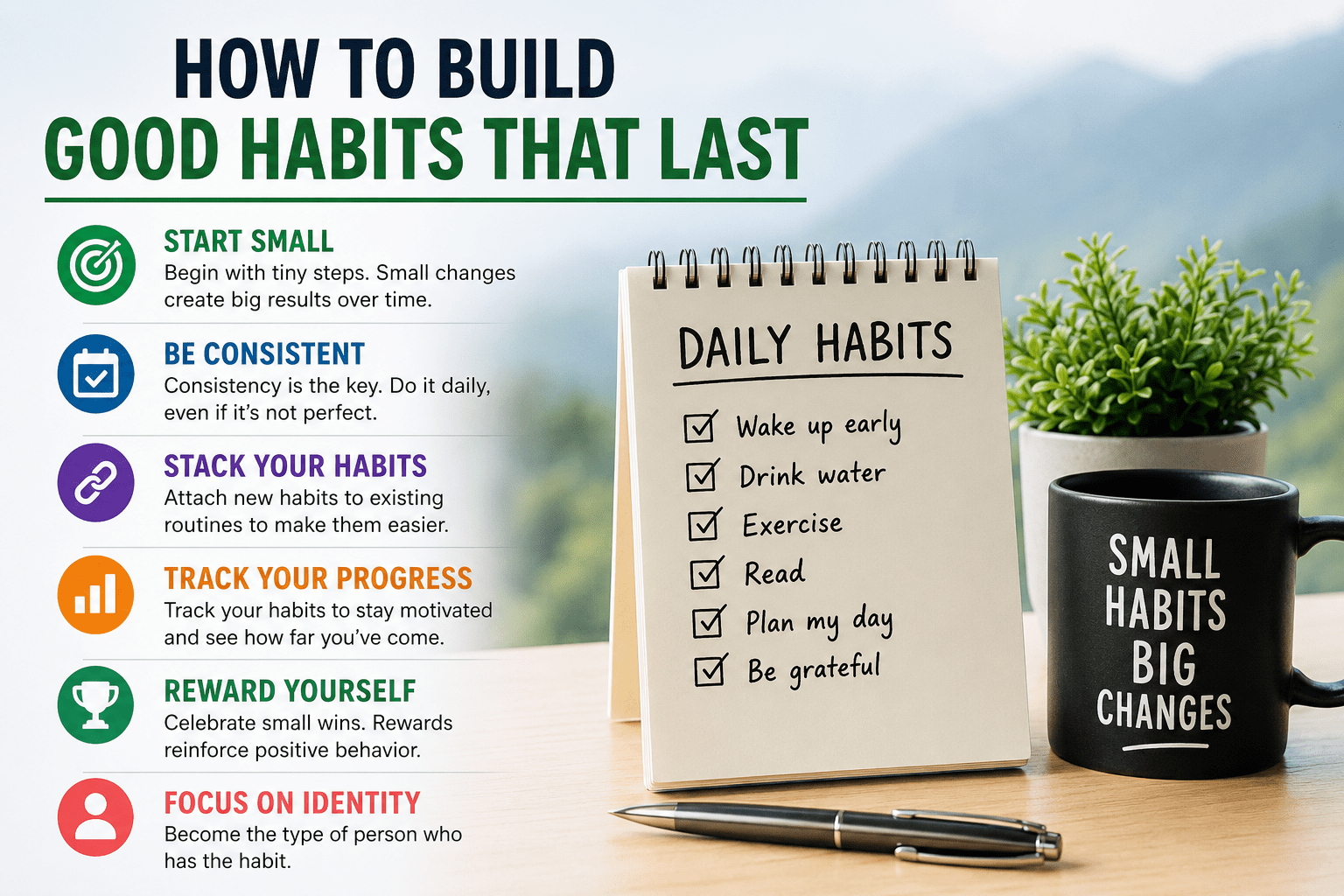
Start Small and Simple
One of the biggest mistakes people make is trying to change too much at once.
When building a new habit, start with an action so small that it feels easy to accomplish.
Examples:
- Read one page instead of an entire chapter.
- Do five push-ups instead of a full workout.
- Write for five minutes instead of an hour.
Small wins create momentum and reduce resistance.
Focus on Consistency, Not Perfection
Many people abandon habits after missing a day or making a mistake. The key to long-term success is consistency, not perfection.
Missing one day won’t ruin your progress. The important thing is getting back on track immediately.
A useful rule is:
Never miss twice.
If you skip a workout today, make sure you exercise tomorrow.
Use Habit Stacking
Habit stacking is a powerful technique where you attach a new habit to an existing routine.
Formula:
After [current habit], I will [new habit].
Examples:
- After brushing my teeth, I will meditate for two minutes.
- After making coffee, I will read one page of a book.
- After dinner, I will take a 10-minute walk.
This method uses existing routines as reminders.
Design Your Environment for Success
Your environment plays a major role in your behavior.
Make good habits easy and bad habits difficult.
For Positive Habits
- Keep healthy snacks visible.
- Place workout clothes where you can see them.
- Keep books on your desk.
- Use reminders and planners.
For Negative Habits
- Remove distractions.
- Keep junk food out of the house.
- Turn off unnecessary notifications.
- Limit access to time-wasting apps.
Your surroundings should support your goals rather than challenge them.
Track Your Progress
Monitoring your habits increases accountability and motivation.
Ways to track habits:
- Habit-tracking apps
- Journals
- Calendars
- Checklists
Seeing your progress visually can encourage you to continue.
Even a simple checkmark on a calendar can be surprisingly motivating.
Reward Yourself
Positive reinforcement helps habits stick.
After completing a habit, reward yourself in a healthy way.
Examples:
- Enjoy a favorite activity.
- Watch an episode of a show.
- Spend time on a hobby.
- Celebrate milestones.
Rewards train your brain to associate the habit with positive feelings.
Build an Identity-Based Habit
Instead of focusing solely on outcomes, focus on becoming the type of person who performs the habit naturally.
Rather than saying:
- “I want to run a marathon.”
Say:
- “I am a runner.”
Rather than:
- “I want to read more.”
Say:
- “I am a reader.”
When habits become part of your identity, maintaining them becomes easier.
Prepare for Obstacles
Challenges are inevitable. Planning for them in advance increases your chances of success.
Ask yourself:
- What might prevent me from performing this habit?
- What will I do if that happens?
For example:
“If I can’t go to the gym, I’ll do a 15-minute home workout.”
Having a backup plan keeps momentum alive.
Stay Patient with the Process
Habits take time to become automatic. While some habits develop quickly, others may require weeks or months of consistent practice.
Avoid expecting instant results.
Remember:
- Small improvements add up.
- Progress may be slow at first.
- Consistency creates long-term transformation.
Trust the process and keep showing up.
Common Mistakes to Avoid
Trying Too Much Too Soon
Focus on one or two habits at a time instead of changing your entire lifestyle overnight.
Relying on Motivation
Motivation fluctuates. Systems and routines are more reliable.
Ignoring Your Environment
Your surroundings significantly influence your behavior.
Giving Up After Setbacks
Mistakes are part of the journey. Learn from them and continue moving forward.
Benefits of Building Good Habits
Developing positive habits can lead to:
- Better physical health
- Increased productivity
- Improved mental well-being
- Greater self-confidence
- Financial stability
- Enhanced personal growth
- Long-term success
The cumulative effect of small daily actions can be life-changing.
Final Thoughts
Learning how to build good habits that last is one of the most valuable skills you can develop. Lasting habits are not created through willpower alone but through small, consistent actions repeated over time. By starting small, staying consistent, tracking progress, and designing an environment that supports your goals, you can create habits that become a natural part of your daily life.
Remember that success is rarely the result of a single action. It is the product of positive habits practiced day after day. Start with one small habit today, stay committed, and watch how it transforms your life over time.
Also read How Social Media Affects Our Daily Lives











Leave a Reply