

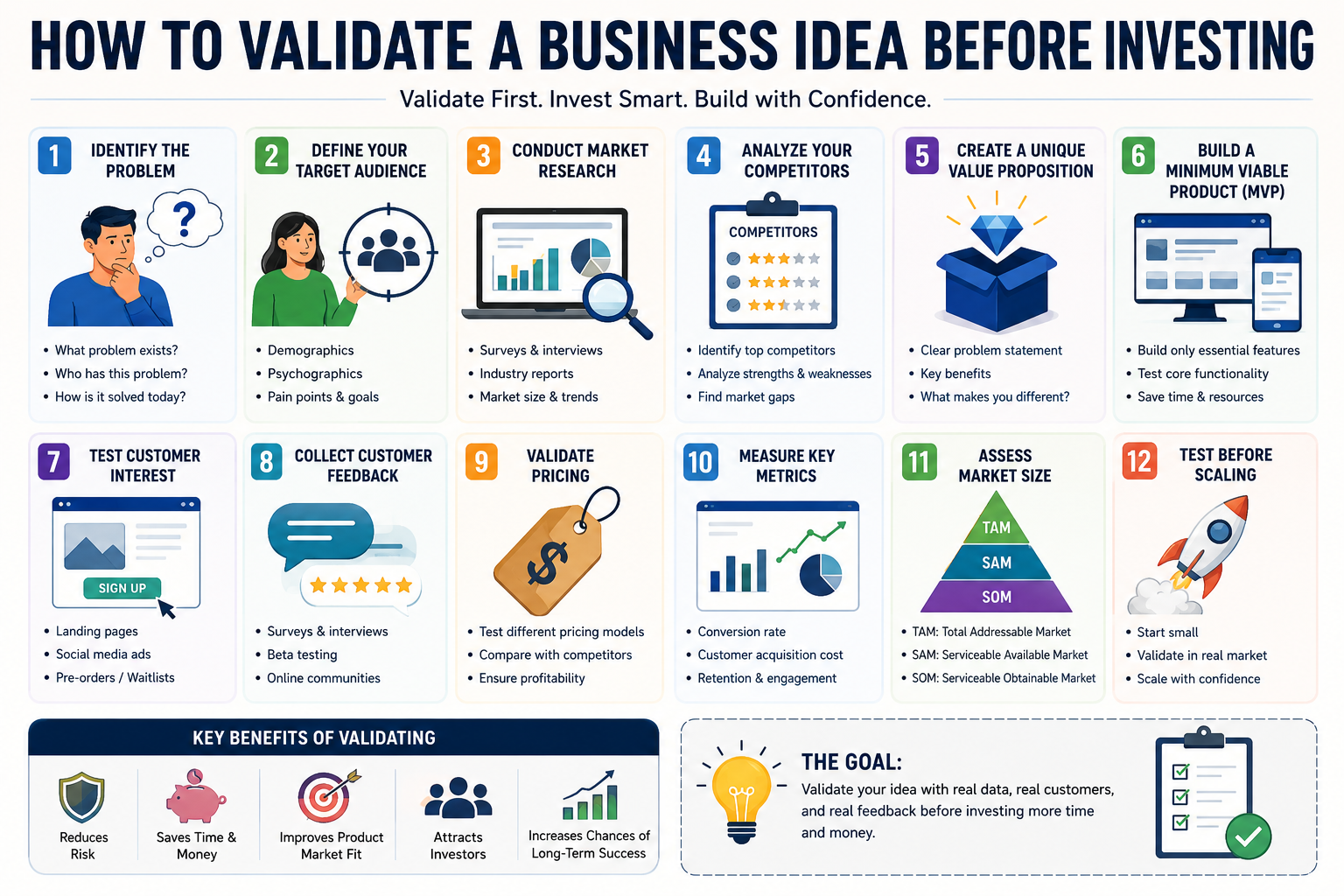
Launching a new business can be exciting, but investing money into an untested idea can be risky. Many startups fail not because the founders lack passion or skills, but because there is insufficient market demand for their products or services. That’s why business idea validation is a critical step before making significant financial commitments.
Validating a business idea helps entrepreneurs determine whether their concept solves a real problem, attracts potential customers, and has the potential to generate profits. By testing assumptions early, you can avoid costly mistakes and increase your chances of building a successful business.
In this guide, you’ll learn practical strategies for validating a business idea before investing substantial time, effort, and money.
What Is Business Idea Validation?
Business idea validation is the process of testing whether your business concept has genuine market demand before fully launching it.
The goal is to answer important questions such as:
- Do customers actually need this solution?
- Are people willing to pay for it?
- Is the market large enough?
- Can the business become profitable?
- How strong is the competition?
Validation allows entrepreneurs to make data-driven decisions instead of relying solely on assumptions.
Why Validating a Business Idea Matters
Many entrepreneurs become emotionally attached to their ideas. However, customer demand—not personal enthusiasm—determines business success.
Benefits of Business Validation
- Reduces financial risk
- Identifies potential problems early
- Saves time and resources
- Improves product-market fit
- Attracts investors more easily
- Increases chances of long-term success
Validating before investing can prevent costly failures and provide valuable insights for growth.
Step 1: Identify the Problem You’re Solving
Successful businesses solve real problems.
Before evaluating your idea, clearly define:
- What problem exists?
- Who experiences this problem?
- How often does it occur?
- Why hasn’t it been solved effectively?
The more painful and frequent the problem, the more likely customers will pay for a solution.
Example
Instead of saying:
“We sell fitness coaching.”
Define the problem:
“Busy professionals struggle to maintain healthy lifestyles due to lack of time.”
This creates a clearer value proposition.
Step 2: Define Your Target Audience
Not everyone is your customer.
Identify your ideal customer by considering:
Demographics
- Age
- Gender
- Income level
- Education
- Occupation
Psychographics
- Interests
- Goals
- Challenges
- Buying habits
Creating detailed customer personas helps ensure your solution meets real needs.
Step 3: Conduct Market Research
Market research provides valuable information about customer demand and industry trends.
Primary Research
Gather information directly from potential customers through:
- Surveys
- Interviews
- Focus groups
- Online questionnaires
Ask questions like:
- What challenges do you face?
- How do you currently solve this problem?
- Would you pay for a better solution?
Secondary Research
Analyze existing data such as:
- Industry reports
- Market statistics
- Government publications
- Business journals
This helps estimate market size and growth potential.
Step 4: Analyze Your Competitors
Competition is often a positive sign because it indicates market demand.
Research competitors to understand:
- Their products and services
- Pricing strategies
- Customer reviews
- Strengths and weaknesses
Competitor Analysis Questions
- What are they doing well?
- Where are customers dissatisfied?
- What gaps exist in the market?
- How can your solution be different?
Finding an underserved niche can create a competitive advantage.
Step 5: Create a Unique Value Proposition
A unique value proposition (UVP) explains why customers should choose your business.
Your UVP should clearly communicate:
- The problem you solve
- The benefits you provide
- What makes you different
Example
Instead of:
“We sell project management software.”
Try:
“We help remote teams complete projects 30% faster through AI-powered task automation.”
A strong UVP improves customer interest and conversion rates.
Step 6: Build a Minimum Viable Product (MVP)
An MVP is a basic version of your product with only essential features.
The purpose is to test demand without investing heavily in development.
Benefits of an MVP
- Faster launch
- Lower costs
- Early customer feedback
- Reduced risk
Popular MVP formats include:
- Landing pages
- Prototype designs
- Demo videos
- Simple apps
- Pilot services
Focus on solving the core problem rather than building a perfect product.
Step 7: Test Customer Interest
Before investing significantly, determine whether customers are genuinely interested.
Effective Testing Methods
Landing Page Validation
Create a simple website describing your product.
Measure:
- Visitor traffic
- Sign-ups
- Email subscriptions
- Pre-orders
Social Media Campaigns
Run targeted advertisements to evaluate engagement.
Monitor:
- Click-through rates
- Comments
- Shares
- Lead generation
Crowdfunding Platforms
Platforms like crowdfunding websites can help gauge public interest while raising initial funds.
Strong support indicates potential market demand.
Step 8: Collect Customer Feedback
Customer feedback is one of the most valuable validation tools.
Ask potential customers:
- What do they like?
- What concerns do they have?
- What features matter most?
- What would make them buy?
Feedback Sources
- Surveys
- Interviews
- Beta testers
- Online communities
- Social media groups
Listen carefully and adjust your idea based on recurring patterns.
Step 9: Validate Pricing
Even if customers love your product, they must be willing to pay a profitable price.
Test different pricing models such as:
- One-time purchases
- Monthly subscriptions
- Freemium plans
- Tiered pricing
Questions to ask:
- What would customers expect to pay?
- How much are competitors charging?
- Does pricing support profitability?
Pricing validation ensures your business model is sustainable.
Step 10: Measure Key Validation Metrics
Track measurable data rather than relying on opinions.
Important Metrics
- Customer acquisition cost (CAC)
- Conversion rate
- Website traffic
- Email sign-up rate
- Pre-orders
- Customer retention
- Engagement rate
Strong metrics provide evidence that your business idea has potential.
Step 11: Assess Market Size
A great idea still needs a large enough market to support growth.
Evaluate:
Total Addressable Market (TAM)
The total demand for your product or service.
Serviceable Available Market (SAM)
The segment you can realistically target.
Serviceable Obtainable Market (SOM)
The portion you can realistically capture.
Understanding market size helps determine future revenue potential.
Step 12: Test Before Scaling
Many startups fail because they scale too quickly.
Before investing heavily:
- Test small markets
- Launch limited campaigns
- Pilot your service
- Refine operations
Gradual expansion reduces risk and improves efficiency.
Common Business Validation Mistakes
Avoid these common errors:
Ignoring Negative Feedback
Constructive criticism often reveals important weaknesses.
Building Before Testing
Creating a full product before validating demand can waste significant resources.
Surveying Friends and Family Only
Friends and family may provide biased feedback.
Focusing on Features Instead of Problems
Customers buy solutions, not features.
Assuming Demand Exists
Always verify demand with real data.
Signs Your Business Idea Is Validated
Your idea may be ready for larger investment if:
- Customers actively seek your solution.
- People are willing to pay.
- Feedback is consistently positive.
- Marketing campaigns generate leads.
- Early sales occur naturally.
- Retention rates are strong.
- Market demand is growing.
These indicators suggest a strong product-market fit.
The Lean Startup Approach to Validation
Many successful entrepreneurs follow the Lean Startup methodology:
Build
Create a basic version of the product.
Measure
Collect customer data and feedback.
Learn
Use insights to improve the product.
This cycle helps businesses continuously validate assumptions while minimizing waste.
Conclusion
Learning how to validate a business idea before investing is one of the smartest steps any entrepreneur can take. Validation reduces uncertainty, protects your finances, and ensures that your business solves a genuine customer problem.
By conducting market research, analyzing competitors, building an MVP, gathering customer feedback, and testing demand, you can make informed decisions based on real-world data rather than assumptions.
The more thoroughly you validate your business idea before investing, the greater your chances of building a profitable, sustainable, and successful company.
Also read Bootstrapping vs Venture Capital: Which Is Better?









Leave a Reply