

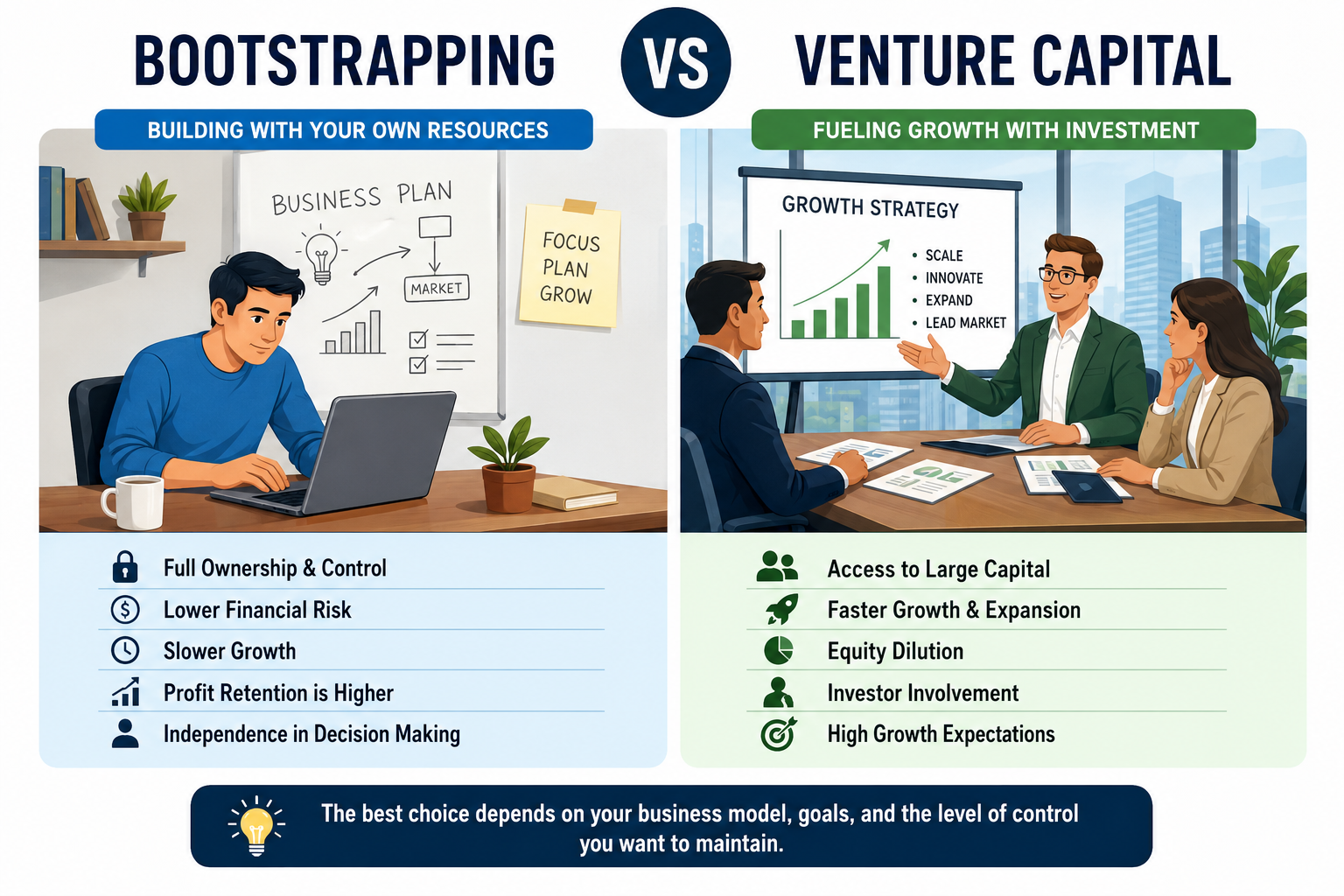
Starting a business is an exciting journey, but one of the biggest decisions entrepreneurs face is how to fund their startup. Two of the most common funding methods are bootstrapping and venture capital (VC). Each approach has its own benefits, risks, and impact on the future of a business.
The choice between bootstrapping and venture capital can significantly influence how quickly your company grows, how much control you maintain, and the level of financial risk involved. Understanding the differences between these funding strategies can help entrepreneurs make informed decisions that align with their business goals.
In this article, we’ll explore bootstrapping and venture capital in detail, compare their pros and cons, and help you determine which option may be better for your startup.
What Is Bootstrapping?
Bootstrapping refers to building and growing a business using personal savings, business revenue, or limited external resources rather than seeking large investments from outside investors.
Entrepreneurs who bootstrap rely on their own funds and reinvest profits back into the business to support growth.
Examples of Bootstrapped Companies
Several successful companies started without venture capital funding, including:
- Mailchimp
- Basecamp
- Shutterstock
- GitHub (initially bootstrapped)
These companies focused on sustainable growth and profitability before seeking any external funding.
Advantages of Bootstrapping
1. Full Ownership and Control
One of the biggest benefits of bootstrapping is maintaining complete control over business decisions. Founders do not have to answer to investors or give up equity.
2. Greater Financial Discipline
Since resources are limited, bootstrapped businesses often become more efficient and careful with spending. This encourages sustainable business practices.
3. No Investor Pressure
Venture capital investors usually expect rapid growth and high returns. Bootstrapped entrepreneurs can focus on long-term goals without pressure to meet aggressive targets.
4. Higher Future Rewards
Since founders retain ownership, they enjoy a larger share of profits and potential exit proceeds if the company becomes successful.
5. Flexibility in Decision-Making
Without investor oversight, founders can pivot strategies, launch products, or enter new markets based on their vision.
Disadvantages of Bootstrapping
1. Limited Capital
Growth may be slower due to restricted financial resources.
2. Personal Financial Risk
Founders often invest personal savings, which increases financial exposure if the business fails.
3. Slower Expansion
Limited funding can make it difficult to hire talent, develop products, or scale operations quickly.
4. Increased Workload
Entrepreneurs may need to handle multiple roles due to budget constraints.
5. Competitive Challenges
Competing against well-funded startups can be difficult, especially in technology-driven industries.
What Is Venture Capital?
Venture capital is a form of financing where investors provide funds to startups with high growth potential in exchange for equity ownership.
VC firms typically invest in innovative companies that can generate substantial returns over time.
How Venture Capital Works
The venture capital process generally involves:
- Startup pitches business idea.
- Investors conduct due diligence.
- Funding agreement is finalized.
- Investors receive equity.
- Business uses capital to scale rapidly.
VC funding often occurs in stages such as Seed, Series A, Series B, and beyond.
Advantages of Venture Capital
1. Access to Significant Funding
Venture capital provides substantial financial resources that can accelerate growth.
2. Faster Scaling Opportunities
Companies can invest heavily in product development, marketing, and expansion.
3. Industry Expertise
VC investors often bring valuable business experience and strategic guidance.
4. Networking Opportunities
Investors provide access to potential partners, customers, and industry connections.
5. Enhanced Credibility
Receiving venture capital funding can improve a startup’s reputation and attract additional opportunities.
Disadvantages of Venture Capital
1. Loss of Ownership
Founders must give up a percentage of their company in exchange for funding.
2. Reduced Decision-Making Authority
Investors often influence strategic decisions and may hold board seats.
3. High Growth Expectations
VC-backed startups face pressure to grow quickly and deliver strong returns.
4. Time-Consuming Fundraising Process
Securing venture capital can take months of pitching, negotiations, and due diligence.
5. Potential Founder Conflicts
Differences between founders and investors can create challenges regarding company direction.
Bootstrapping vs Venture Capital: Key Differences
| Factor | Bootstrapping | Venture Capital |
|---|---|---|
| Ownership | Full ownership | Shared ownership |
| Funding Source | Personal funds and revenue | External investors |
| Growth Speed | Slower | Faster |
| Risk | Personal financial risk | Equity dilution |
| Control | Complete control | Shared control |
| Decision Making | Founder-driven | Investor-influenced |
| Profit Retention | Higher | Shared with investors |
| Scalability | Limited by cash flow | High scalability |
| Pressure | Lower | Higher growth pressure |
When Bootstrapping Is the Better Choice
Bootstrapping may be ideal if:
- You want full ownership.
- Your business can become profitable quickly.
- Growth does not require massive upfront investment.
- You prefer long-term sustainability over rapid expansion.
- You want complete strategic freedom.
Service-based businesses, consulting firms, and niche SaaS companies often benefit from bootstrapping.
When Venture Capital Is the Better Choice
Venture capital may be the right option if:
- Your industry requires significant capital.
- Speed is critical for market success.
- You need to scale rapidly.
- Competition is intense.
- Your business has strong growth potential.
Technology startups, biotech companies, and innovative software businesses often seek VC funding due to high development costs.
Hybrid Approach: Combining Both Strategies
Many successful startups use a hybrid funding strategy.
They begin by bootstrapping to validate their business model and gain customers. Once traction is established, they seek venture capital to accelerate growth.
Benefits of this approach include:
- Stronger negotiating position.
- Higher company valuation.
- Reduced equity dilution.
- Proven market demand before fundraising.
This method allows founders to enjoy some benefits of both funding models.
Questions to Ask Before Choosing
Before deciding between bootstrapping and venture capital, consider:
- How much capital does your business need?
- How quickly do you need to grow?
- Are you comfortable giving up ownership?
- Can your business generate early revenue?
- What are your long-term goals?
- Do you value independence or accelerated growth more?
Your answers can help identify the most suitable funding path.
Common Startup Funding Mistakes
Entrepreneurs should avoid these common errors:
Seeking Funding Too Early
Raising capital before validating a business idea can lead to unnecessary equity dilution.
Underestimating Costs
Poor financial planning can create cash flow problems.
Choosing the Wrong Investors
Not all investors share the same vision or values.
Ignoring Profitability
Focusing solely on growth without sustainable revenue can be risky.
Overexpansion
Growing too quickly can strain operations and finances.
The Future of Startup Funding
The startup funding landscape continues to evolve with new alternatives such as:
- Crowdfunding
- Angel investing
- Revenue-based financing
- Startup accelerators
- Online fundraising platforms
These options provide entrepreneurs with greater flexibility beyond traditional bootstrapping and venture capital.
Conclusion
The debate between bootstrapping vs venture capital does not have a one-size-fits-all answer. The best choice depends on your business model, industry, growth ambitions, and personal preferences.
Bootstrapping offers independence, full ownership, and sustainable growth, while venture capital provides access to substantial funding, expert guidance, and rapid expansion opportunities.
Entrepreneurs should carefully evaluate their goals, financial needs, and risk tolerance before choosing a funding strategy. In many cases, combining both approaches can provide the ideal balance between control and growth.
Ultimately, the right funding path is the one that aligns with your vision for building a successful and sustainable business.
Also read Common Startup Mistakes First-Time Founders Make (And How to Avoid Them)










Leave a Reply