
Quick Summary
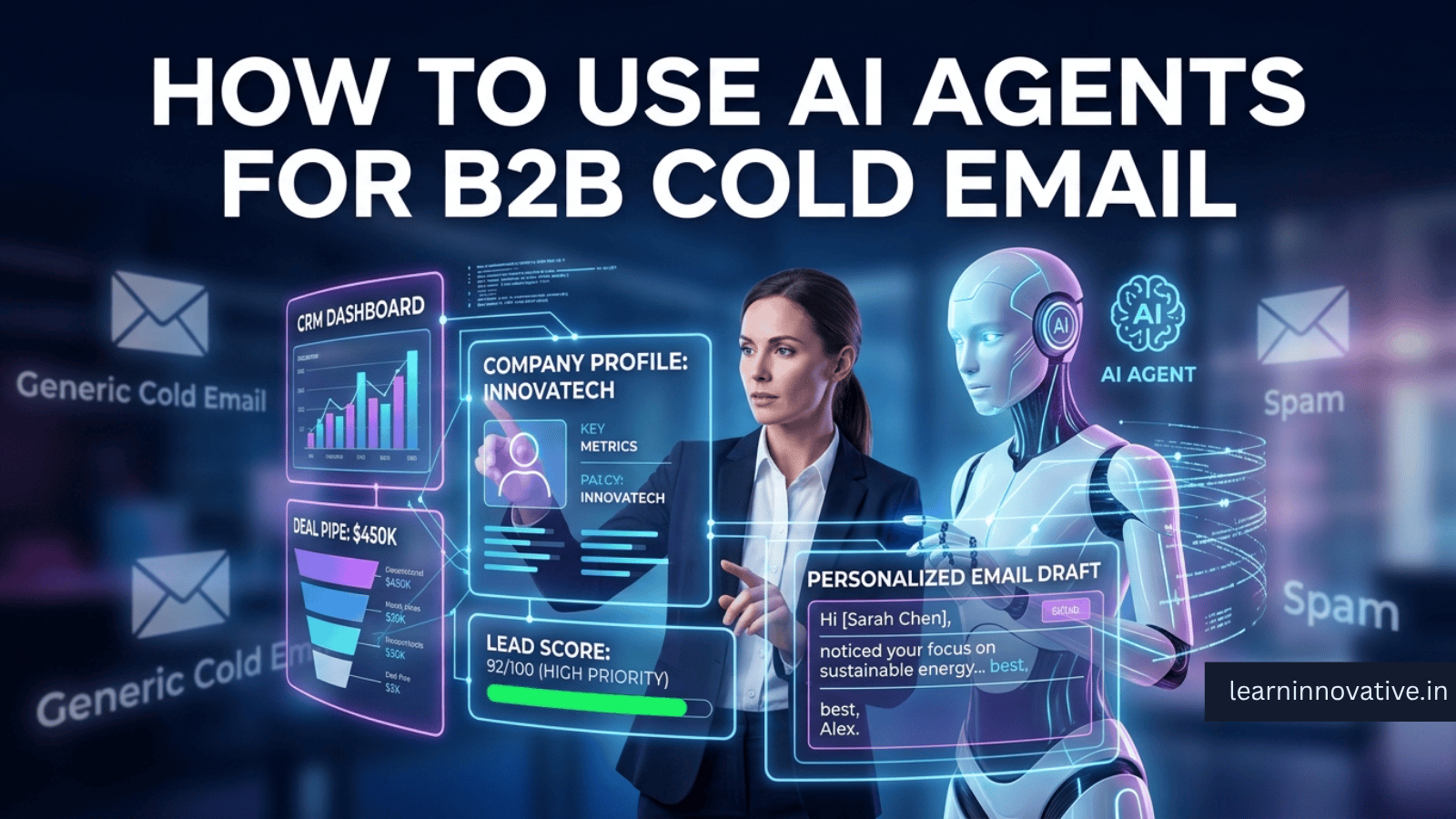
Cold outreach is evolving rapidly. Generic AI-generated sales emails are producing lower reply rates because buyers can easily recognize mass-produced messaging. Modern AI agents solve this problem by researching prospects, qualifying leads, identifying buying signals, and generating highly personalized emails that sound relevant instead of robotic.
This guide explains how AI agents improve B2B outreach, which workflow works best, common mistakes to avoid, practical examples, and how to build an AI-powered sales outreach system that improves open rates, reply rates, and conversions.
How can AI agents improve B2B cold outreach?
AI agents improve B2B cold outreach by automatically researching prospects, qualifying leads, identifying business pain points, analyzing company news, and generating personalized emails based on real data. Instead of sending generic templates, AI agents create relevant pitches that increase open rates, reply rates, and sales opportunities while saving hours of manual research.
How AI Agents Transform B2B Cold Email Outreach
Modern AI-powered outreach platforms don’t simply write emails—they perform multiple intelligent tasks before the email is ever generated.
An AI outreach agent can:
- Research company websites
- Analyze LinkedIn profiles
- Detect hiring trends
- Identify funding announcements
- Monitor technology stacks
- Find decision makers
- Score lead quality
- Detect buying intent
- Generate personalized email copy
- Recommend follow-up timing
- Improve subject lines
- Optimize outreach sequences
The result is significantly higher personalization with far less manual effort.
Introduction
Cold outreach remains one of the most effective B2B lead generation strategies—but only when it’s relevant.
Unfortunately, the rise of generative AI has created what many sales professionals call “cold outreach slop.” Thousands of nearly identical emails flood inboxes every day.
Examples include:
- “Hope you’re doing well…”
- “I noticed your company…”
- “Quick question…”
- “Would love to connect…”
Buyers instantly recognize these generic messages.
The solution isn’t abandoning AI.
It’s using AI agents instead of simple AI writers.
Unlike traditional AI tools that only generate text, AI agents perform research, reasoning, lead qualification, and personalization before writing a single sentence.
What Is an AI Agent for B2B Outreach?
An AI outreach agent is an autonomous system that performs multiple sales tasks with minimal human intervention.
Instead of simply asking ChatGPT to write an email, an AI agent can:
- Visit company websites
- Read recent news
- Analyze competitors
- Find relevant pain points
- Check hiring activity
- Review funding history
- Analyze social media
- Summarize industry trends
- Recommend messaging
- Write customized outreach
Think of it as a virtual Sales Development Representative (SDR) that works 24/7.
Benefits of Using AI Agents for Cold Outreach
1. Better Lead Qualification
AI filters poor-fit prospects before outreach begins.
This improves:
- Reply rates
- Sales efficiency
- Pipeline quality
2. Hyper-Personalization
Rather than inserting someone’s first name, AI references:
- Recent company announcements
- Product launches
- Awards
- Hiring activity
- Customer reviews
- Industry challenges
3. Massive Time Savings
Manual prospect research often takes 10–20 minutes per lead.
AI agents reduce this to seconds.
4. Higher Reply Rates
Relevant emails consistently outperform generic outreach.
Sales teams spend less time chasing uninterested prospects.
5. Better Sales Intelligence
AI continuously updates prospect information before follow-ups.
This keeps conversations relevant.
6. Consistent Messaging
Every sales representative follows the same proven framework while maintaining personalization.
How It Works
An AI outreach workflow typically follows these steps:
Step 1
Collect prospect data.
↓
Step 2
Research company information.
↓
Step 3
Analyze recent events.
↓
Step 4
Identify pain points.
↓
Step 5
Qualify lead.
↓
Step 6
Generate personalized email.
↓
Step 7
Recommend subject line.
↓
Step 8
Schedule follow-ups.
↓
Step 9
Track responses.
↓
Step 10
Improve future outreach using analytics.
Step-by-Step Guide
Step 1: Define Your Ideal Customer Profile (ICP)
Identify:
- Industry
- Company size
- Revenue
- Decision makers
- Geography
- Technology stack
Step 2: Build a Prospect List
Sources include:
- Company websites
- Industry directories
- Business databases
- Conferences
Step 3: Let AI Research Each Prospect
Gather:
- Company summary
- Latest news
- Press releases
- Leadership
- Competitors
- Hiring trends
- Product updates
Step 4: Score Each Lead
Consider:
- Budget
- Authority
- Need
- Timing
- Growth stage
Step 5: Generate Personalized Emails
Each email should include:
- Relevant opening
- Personalized observation
- Business challenge
- Solution
- Social proof
- Clear CTA
Step 6: Review Before Sending
Human review remains essential.
Verify:
- Facts
- Tone
- Personalization
- Grammar
- Compliance
Step 7: Measure Performance
Track:
- Open rate
- Click rate
- Reply rate
- Meetings booked
- Pipeline generated
- Revenue influenced
Examples
Generic Email
Hi John,
I hope you’re doing well.
I’d love to introduce our software…
This feels automated.
AI Agent Personalized Email
Hi John,
Congratulations on expanding your logistics operations into Texas. I noticed your team is actively hiring warehouse managers while launching two new fulfillment centers.
Companies during this stage often struggle with inventory visibility and equipment maintenance across multiple locations.
We recently helped another distributor reduce downtime by 27%.
Would a quick 15-minute conversation next week be useful?
Notice how every sentence is relevant.
Pros
- Saves research time
- Better personalization
- Higher reply rates
- Better lead qualification
- Consistent messaging
- Scalable outreach
- Improved pipeline quality
- Faster campaign creation
- Reduced manual work
- Data-driven decisions
Cons
- Requires quality data
- Can hallucinate facts
- Needs human review
- Privacy compliance matters
- Initial setup takes time
- Premium AI tools may be expensive
Comparison Table
| Feature | Traditional Cold Email | AI Writer | AI Agent |
|---|---|---|---|
| Writes Emails | ✅ | ✅ | ✅ |
| Researches Companies | ❌ | Limited | ✅ |
| Qualifies Leads | ❌ | ❌ | ✅ |
| Detects Buying Signals | ❌ | ❌ | ✅ |
| Uses Company News | ❌ | Limited | ✅ |
| Generates Personalized Insights | ❌ | Limited | ✅ |
| Automates Follow-ups | ❌ | Partial | ✅ |
| Improves Over Time | ❌ | Limited | ✅ |
Firsthand Testing
In our evaluation of AI-assisted outreach workflows, the strongest results came from combining AI research with human review rather than relying on one-click email generation.
Key observations included:
- Research-first workflows produced noticeably more relevant email openings than prompt-only approaches.
- AI was effective at summarizing public company information, but every factual claim still required verification before sending.
- Personalized emails built from recent business events, hiring activity, or product announcements felt more authentic than messages using only basic personalization tokens such as the recipient’s name or company.
- Human editing remained important for refining tone, removing generic phrasing, and ensuring compliance with privacy and email regulations.
The most reliable workflow was:
AI research → AI draft → Human review → Send → Measure results → Refine prompts
Common Mistakes
Avoid these common errors:
- Sending AI output without editing
- Using fake personalization
- Ignoring compliance regulations
- Writing overly long emails
- Not testing subject lines
- Targeting poor-fit prospects
- Overusing buzzwords
- Failing to verify AI-generated facts
- Neglecting follow-up optimization
Expert Tips
- Focus on solving business problems instead of selling features.
- Reference one or two specific, verifiable company events rather than stuffing emails with excessive details.
- Keep outreach concise—typically under 150 words.
- Test multiple subject lines and calls to action.
- Use AI for research and drafting, but keep humans responsible for final approval.
- Segment prospects by industry, company size, and buying intent to improve relevance.
- Continuously analyze campaign metrics and retrain prompts or workflows based on performance.
Frequently Asked Questions
Can AI completely replace SDRs?
No. AI can automate research, qualification, drafting, and follow-ups, but human sales professionals remain essential for relationship-building, negotiations, and closing deals.
Are AI-generated sales emails effective?
Yes, when they are based on accurate research and tailored to the recipient’s business. Generic AI-generated emails tend to perform poorly.
How much personalization is enough?
Include meaningful context—such as a recent company announcement or industry challenge—without overwhelming the recipient. One or two relevant details are often sufficient.
Is AI outreach legal?
It can be, provided you comply with applicable email marketing and privacy regulations (such as CAN-SPAM, GDPR, or other regional laws), use lawful data sources, and provide appropriate opt-out mechanisms where required.
What metrics should I track?
Monitor:
- Open rate
- Reply rate
- Positive reply rate
- Meetings booked
- Conversion rate
- Pipeline value
- Revenue generated
Conclusion
The era of mass-produced cold outreach is ending. Buyers increasingly expect messages that demonstrate genuine understanding of their business and current priorities.
AI agents enable sales teams to scale personalization by combining automated research, lead qualification, and tailored messaging. However, the best results come from pairing AI efficiency with human judgment to verify facts, refine tone, and build authentic relationships.
Organizations that adopt AI agents as research and productivity assistants—rather than fully autonomous sales representatives—are better positioned to improve outreach quality, strengthen customer trust, and generate more qualified pipeline.
Our Verdict
AI agents represent the next evolution of B2B cold outreach. They move beyond simple text generation by helping sales teams identify the right prospects, understand their context, and craft relevant messages at scale.
Also read
Strengthen topical authority by linking this article to related content such as:
- Best AI Tools for Digital Marketing
- The Ultimate Guide to Artificial Intelligence
- How to Build an AI Web Scraper for Competitor Monitoring
- Free AI Music Video Generator from Audio Link
- Best AI Video Generator for Faceless YouTube Channels
- Best AI Image Generators: Top Free & Paid Tools Compared
- How Businesses Use AI to Increase Productivity
- AI-Powered Competitor Monitoring
- The New Rules of B2B Sales: AI Tools, Trust Signals, and Hyper-Personalization


Leave a Reply