

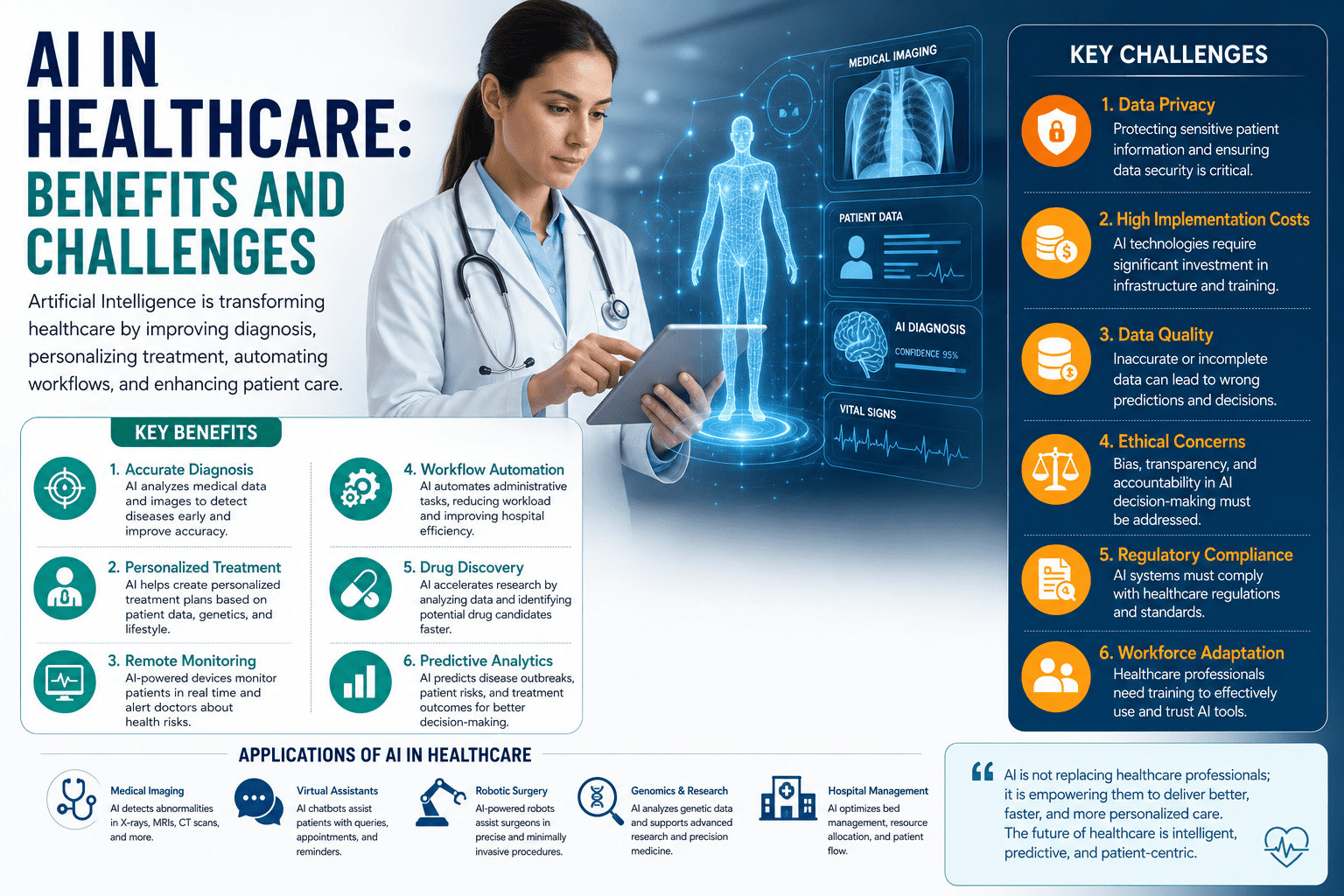
Artificial Intelligence (AI) is revolutionizing healthcare by improving patient outcomes, streamlining hospital operations, and enabling medical professionals to make faster, data-driven decisions. From diagnosing diseases with greater accuracy to automating administrative tasks, AI is becoming an essential part of modern healthcare systems.
As healthcare organizations adopt AI technologies, they are experiencing significant improvements in efficiency, cost savings, and patient care. However, the widespread use of AI also introduces challenges related to privacy, ethics, data security, and implementation costs.
This guide explores how AI is transforming healthcare, its key benefits, major challenges, real-world applications, and what the future holds for AI-powered medicine.
What Is AI in Healthcare?
AI in healthcare refers to the use of artificial intelligence technologies—including machine learning, natural language processing (NLP), computer vision, and predictive analytics—to assist healthcare professionals in diagnosing diseases, managing patient data, recommending treatments, and improving operational efficiency.
Rather than replacing doctors, AI acts as an intelligent assistant that enhances clinical decision-making and supports better patient outcomes.
Why AI Matters in Healthcare
Healthcare systems generate enormous amounts of medical data every day. AI can process and analyze this information much faster than humans, helping healthcare providers:
- Detect diseases earlier
- Improve diagnosis accuracy
- Personalize treatments
- Reduce administrative workloads
- Enhance patient monitoring
- Optimize hospital operations
- Accelerate medical research
With growing patient populations and increasing healthcare demands, AI helps deliver quality care more efficiently.
Key Benefits of AI in Healthcare
1. Faster and More Accurate Diagnosis
AI-powered diagnostic systems analyze medical images, laboratory reports, and patient histories to detect diseases quickly.
Examples include:
- Early cancer detection
- Heart disease diagnosis
- Stroke identification
- Lung disease screening
- Eye disease detection
AI reduces diagnostic errors while helping physicians identify conditions at earlier stages.
2. Personalized Treatment Plans
Every patient responds differently to treatments.
AI analyzes:
- Medical history
- Genetic information
- Lifestyle factors
- Existing medications
- Laboratory results
This enables healthcare providers to develop personalized treatment plans that improve effectiveness and reduce side effects.
3. Improved Medical Imaging
Computer vision algorithms help radiologists interpret:
- X-rays
- MRI scans
- CT scans
- Mammograms
- Ultrasounds
AI highlights abnormalities that may be difficult to detect manually, improving diagnostic confidence.
4. Remote Patient Monitoring
Wearable devices and smart sensors continuously collect health data such as:
- Heart rate
- Blood pressure
- Blood oxygen levels
- Glucose levels
- Sleep patterns
AI analyzes this data in real time and alerts healthcare providers if abnormal patterns are detected, enabling early intervention.
5. Virtual Health Assistants
AI-powered virtual assistants help patients by:
- Scheduling appointments
- Answering common medical questions
- Sending medication reminders
- Monitoring symptoms
- Providing wellness advice
These tools improve patient engagement while reducing administrative workloads.
6. Drug Discovery and Research
Developing new medicines traditionally takes years.
AI accelerates research by:
- Identifying promising drug compounds
- Predicting treatment effectiveness
- Simulating clinical trials
- Analyzing scientific literature
This speeds up pharmaceutical innovation while reducing research costs.
7. Hospital Workflow Automation
Hospitals use AI to automate repetitive administrative tasks such as:
- Patient registration
- Medical coding
- Insurance claims processing
- Appointment scheduling
- Billing
- Resource allocation
Automation improves efficiency and allows healthcare staff to focus more on patient care.
8. Predictive Analytics
AI predicts potential health risks by analyzing patient data.
Healthcare providers can identify individuals at higher risk for:
- Diabetes
- Heart disease
- Kidney failure
- Hospital readmission
- Infectious diseases
Early detection enables preventive care and better long-term outcomes.
Real-World Applications of AI in Healthcare
AI is already being used across multiple healthcare settings.
Hospitals
- Clinical decision support
- Bed management
- Emergency room optimization
- Resource planning
Diagnostic Centers
- Medical image analysis
- Laboratory result interpretation
- Disease screening
Telemedicine
- Virtual consultations
- AI symptom checkers
- Remote patient monitoring
Pharmacies
- Medication management
- Prescription verification
- Drug interaction analysis
Medical Research
- Clinical trial optimization
- Genomic analysis
- Disease modeling
Challenges of AI in Healthcare
While AI offers numerous advantages, healthcare providers must address several important challenges.
1. Data Privacy and Security
Healthcare data contains sensitive personal information.
Organizations must ensure:
- Secure data storage
- Encryption
- Regulatory compliance
- Protection against cyberattacks
Maintaining patient trust is critical.
2. High Implementation Costs
Building AI infrastructure requires investments in:
- Software
- Hardware
- Cloud computing
- Staff training
- System integration
Smaller healthcare providers may face budget constraints.
3. Data Quality Issues
AI systems rely on accurate, complete, and unbiased data.
Poor-quality data may lead to:
- Incorrect diagnoses
- Inaccurate predictions
- Reduced model performance
Healthcare organizations must continuously improve data quality.
4. Ethical Concerns
Important ethical questions include:
- Who is responsible for AI errors?
- Can AI decisions be fully explained?
- How can bias be minimized?
- Should AI make life-critical decisions?
Healthcare providers must ensure transparency and human oversight.
5. Regulatory Compliance
Governments continue developing regulations governing AI in healthcare.
Organizations must comply with laws regarding:
- Patient privacy
- Medical device approvals
- AI safety standards
- Clinical validation
6. Workforce Adaptation
Healthcare professionals need training to effectively use AI-powered systems.
AI should support—not replace—medical expertise.
Successful adoption depends on collaboration between clinicians and technology.
Best Practices for Implementing AI in Healthcare
Healthcare organizations should:
- Start with clearly defined use cases.
- Invest in secure and high-quality data management.
- Ensure human oversight for clinical decisions.
- Regularly evaluate AI system performance.
- Train healthcare professionals on AI tools.
- Maintain transparency with patients.
- Follow ethical and regulatory guidelines.
Future of AI in Healthcare
The future of AI promises even greater innovation.
Emerging developments include:
- AI-assisted robotic surgery
- Digital twins for personalized treatment
- Predictive disease prevention
- AI-powered precision medicine
- Advanced genomics analysis
- Intelligent hospital management
- Faster vaccine and drug development
As AI technologies continue to evolve, healthcare will become more personalized, efficient, and accessible worldwide.
Frequently Asked Questions
How is AI used in healthcare?
AI is used for disease diagnosis, medical imaging, personalized treatment, remote patient monitoring, hospital management, drug discovery, and virtual health assistants.
What are the benefits of AI in healthcare?
Key benefits include faster diagnosis, improved accuracy, personalized care, reduced administrative work, enhanced patient monitoring, and lower healthcare costs.
What challenges does AI face in healthcare?
Major challenges include data privacy, cybersecurity, ethical concerns, implementation costs, regulatory compliance, and ensuring unbiased AI models.
Can AI replace doctors?
No. AI is designed to assist healthcare professionals by providing data-driven insights and automating repetitive tasks. Human expertise remains essential for diagnosis, treatment decisions, and patient care.
What is the future of AI in healthcare?
AI will continue advancing through predictive medicine, robotic surgery, personalized healthcare, intelligent diagnostics, and accelerated medical research.
Conclusion
Artificial Intelligence is transforming healthcare by making medical services more accurate, efficient, and patient-centered. From improving disease diagnosis and accelerating drug discovery to automating hospital workflows and enabling personalized treatment, AI offers enormous potential for improving global healthcare.
Despite challenges related to privacy, ethics, and implementation, AI is expected to become an indispensable partner for healthcare professionals. Organizations that adopt AI responsibly and strategically will be better equipped to deliver high-quality care, improve patient outcomes, and meet the evolving demands of modern medicine.






Leave a Reply