

Quick Summary
Open-source and open-weight AI models have progressed from being budget alternatives to becoming serious competitors in reasoning, coding, multimodal understanding, long-context processing, and AI-agent workloads.
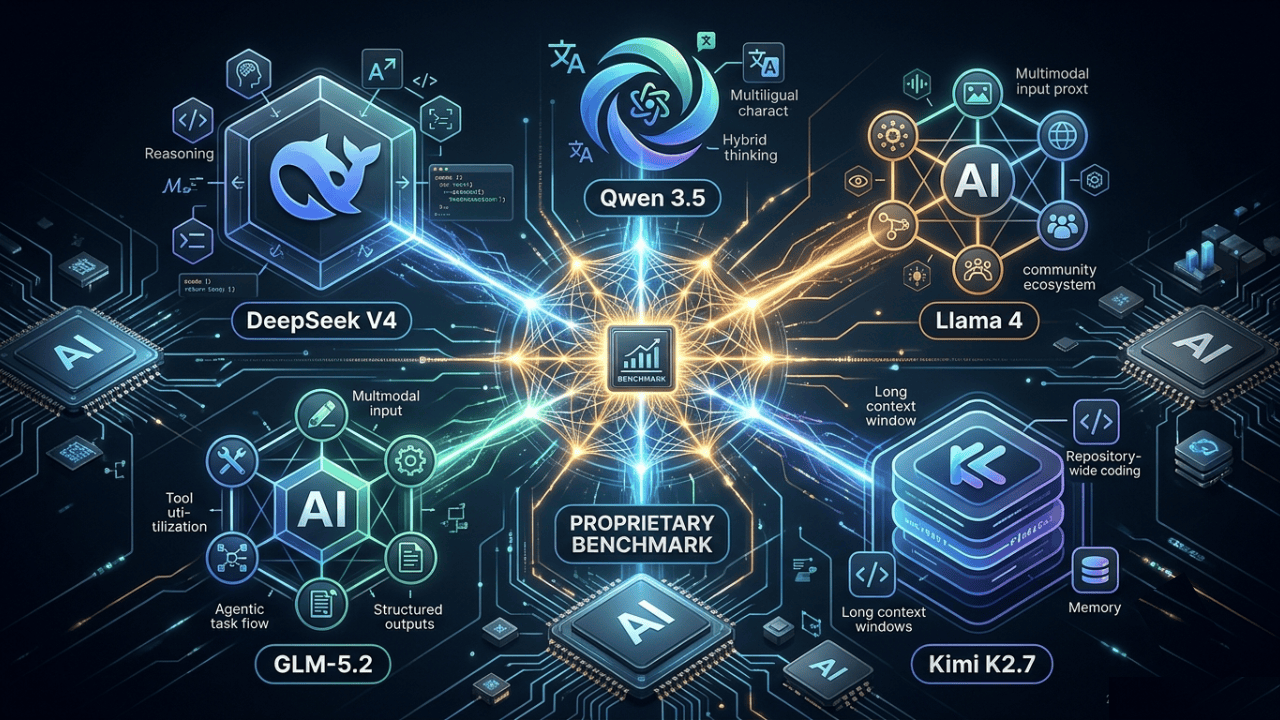
The models such as DeepSeek V4, Qwen3.5, GLM-5.2, Kimi K2.7, and Llama 4 demonstrate capabilities that can exceed the original GPT-4 on particular benchmarks or tasks. Some also approach or exceed selected GPT-5 configurations on third-party evaluations.
However, no responsible comparison should claim that every open model universally matches GPT-5. Performance depends on the benchmark, model configuration, prompting, reasoning mode, tools, context length, and hardware.
The biggest advantage of these models is not simply raw intelligence. Developers can often access model weights, customize deployments, run models locally or privately, and build applications without depending entirely on a proprietary AI provider.
Key Takeaways
- GPT-4 was a major AI milestone, but it is now several generations old.
- Modern open-weight models can substantially exceed GPT-4 on many newer reasoning, coding, and agentic tasks.
- DeepSeek V4 is particularly interesting for reasoning, coding, agents, and long-context applications.
- Qwen3.5 combines multimodal capabilities, reasoning, coding, and support for 201 languages and dialects.
- GLM-5.2 focuses heavily on long-horizon tasks, coding, reasoning, and a 1-million-token context.
- Kimi K2.7 Code is particularly competitive for software engineering and agentic coding.
- Llama 4 remains important because of its ecosystem, multimodality, and extremely long context capabilities.
- “Open-source” and “open-weight” are not always interchangeable terms.
- Local deployment can provide privacy and control, but frontier models may require substantial computing resources.
- GPT-5 remains stronger than many open models on some tasks, so comparisons should be workload-specific rather than absolute.
At a Glance
| Model | Best For | Context | Open Weights | Key Strength |
|---|---|---|---|---|
| DeepSeek V4 | Reasoning, coding, agents | 1M | Yes | Frontier-level reasoning/value |
| Qwen3.5 | Multimodal AI, coding, multilingual work | Up to 1M depending on variant | Yes | Broad capabilities |
| GLM-5.2 | Long-horizon agents & coding | 1M | Yes | Agentic reasoning |
| Kimi K2.7 Code | Software engineering | 256K | Yes | Coding agents |
| Llama 4 | Multimodal applications | Up to 10M for Scout | Yes/open-weight | Ecosystem & long context |
Important: Context windows and capabilities vary by specific model variant and deployment. Always verify the model card before deploying a production system.
What Are the Best Open-Source AI Models That Can Compete With GPT-4?
The strongest open-weight AI models competing with GPT-4-class performance include DeepSeek V4, Qwen3.5, GLM-5.2, Kimi K2.7 Code, and Llama 4. These models can outperform the original GPT-4 on selected reasoning, coding, multilingual, multimodal, and long-context tasks. Some configurations also compare favorably with GPT-5 on particular third-party evaluations, although none should be considered a universal replacement for GPT-5 across every workload.
Which Open-Source AI Models Rival GPT-5-Level Capabilities?
The open AI ecosystem has moved significantly beyond the performance level associated with the original GPT-4. Current open-weight models increasingly compete with proprietary frontier systems in specialized workloads.
For example, third-party Artificial Analysis comparisons currently show Kimi K2.7 Code scoring above GPT-5 high on its Intelligence Index, while GLM-5.2 Max has also scored above GPT-5 low in that evaluation. These comparisons should be interpreted carefully because different model configurations and evaluation methods can produce different results.
Qwen’s own Qwen3.5 evaluation also compares its flagship open-weight model against GPT-5.2 and other frontier systems across multiple benchmarks.
The broader conclusion is clear: open-weight models are no longer merely “good enough” alternatives to older proprietary models; several are now competitive with frontier AI in specific areas.
Introduction
When OpenAI released GPT-4 in March 2023, it represented a major leap in general-purpose AI.
OpenAI reported that GPT-4 achieved 86.4% on MMLU, 92.0% on GSM-8K, 95.3% on HellaSwag, and 67.0% on HumanEval under its published evaluation setup.
At the time, those results were exceptional.
The AI landscape has changed dramatically since then.
Open-weight models now combine mixture-of-experts architectures, reinforcement learning, reasoning modes, multimodal training, long-context processing, tool use, and agentic workflows. The result is a new generation of models capable of competing with proprietary systems on increasingly difficult tasks.
This raises an important question:
Can open-source AI models actually compete with GPT-4—and in some workloads, approach GPT-5-level performance?
The answer is yes, with important qualifications.
This guide compares five models that are particularly relevant and explains where each one performs best.
What Is an Open-Source AI Model?
An open-source AI model generally refers to an AI model whose code, weights, training information, or other components are released with permissions that allow developers to inspect, modify, reproduce, or redistribute some or all of the technology.
However, the AI industry frequently uses “open-source” and “open-weight” interchangeably even though they are not identical.
Open-weight
An open-weight model makes trained model weights available for developers to download and run.
Open-source
A truly open-source AI system may provide much broader transparency around:
- Model weights
- Source code
- Training methodology
- Data or data documentation
- Licensing
- Reproducibility
Therefore, when discussing models in this article, “open-weight” is often the more technically accurate term.
Why Open-Weight AI Models Matter
The attraction is not simply that these models can be cheaper.
1. More Control
Developers can have significantly greater control over deployment architecture, inference settings, model versions, and customization.
2. Privacy
Organizations can deploy models within controlled environments rather than automatically sending sensitive prompts to an external AI service.
3. Customization
Open models can be:
- Fine-tuned
- Quantized
- Distilled
- Integrated with private datasets
- Connected to internal tools
- Optimized for specific hardware
4. Reduced Vendor Lock-In
A company can potentially move between hosting providers or deploy the model on its own infrastructure.
5. Research Freedom
Researchers can inspect model behavior and build new systems on top of the released weights.
How Modern Open AI Models Work
Most of the models in this comparison use advanced architectures such as Mixture-of-Experts (MoE).
Instead of activating every parameter for every token, an MoE model routes each token to a subset of specialized experts.
This can produce a model with a very large total parameter count while requiring significantly fewer active parameters during an individual forward pass.
For example:
- Qwen3.5-397B-A17B has approximately 397 billion total parameters but activates about 17 billion per forward pass.
- GLM-5.2 is approximately 743 billion total parameters with roughly 39 billion active parameters according to current vLLM model documentation.
- Llama 4 Maverick uses 400 billion total parameters with 17 billion active parameters.
These architectures help explain why modern AI models can become much larger without linearly increasing inference requirements.
The Top 5 Open-Source AI Models
1. DeepSeek V4
Best for: Reasoning, coding, agents, and long-context workloads
DeepSeek has become one of the most influential companies in the open-model ecosystem.
Its V4 generation includes DeepSeek V4-Pro and V4-Flash, with a reported 1-million-token context window and support for thinking/non-thinking modes, tool calls, and structured output.
DeepSeek’s V4 Pro officially launched in 2026, and independent benchmarking from Artificial Analysis gave it an Intelligence Index score of 53 at the time of reporting.
Why DeepSeek V4 stands out
- Long context
- Reasoning capabilities
- Coding
- Agentic workflows
- Tool calling
- Open-weight ecosystem
- Competitive inference economics
Best use cases
- Coding assistants
- Research agents
- Large-document analysis
- Autonomous workflows
- Technical reasoning
- AI automation
Pros
- Strong reasoning
- Large context
- Strong coding capabilities
- Good agent potential
- Competitive cost
Cons
- Frontier models still vary by task
- Large variants require significant infrastructure
- Benchmark results can change rapidly as new versions appear
Performance Rating
Overall: 9.5/10
2. Qwen3.5
Best for: Multimodal AI, multilingual applications, coding, and general-purpose workloads
Qwen3.5 is one of the most important open-weight model families.
The Qwen team describes Qwen3.5-397B-A17B as a native vision-language model designed for reasoning, coding, agents, and multimodal understanding. The model uses a hybrid architecture combining Gated Delta Networks with sparse Mixture-of-Experts.
Qwen also expanded language coverage to 201 languages and dialects.
Its official benchmark table compares Qwen3.5 against models including GPT-5.2, Claude 4.5 Opus, and Gemini 3 Pro across a range of tasks.
Why Qwen3.5 stands out
- Multimodal understanding
- Coding
- Reasoning
- Agents
- Multilingual support
- Multiple model sizes
- Open-weight availability
Best use cases
- Multilingual applications
- AI assistants
- Coding
- Document analysis
- Vision-language systems
- Enterprise AI
Pros
- Broad model family
- Excellent multilingual coverage
- Multimodal
- Efficient MoE architecture
- Multiple deployment sizes
Cons
- Model selection can be confusing
- Larger variants require powerful hardware
- Benchmark results differ significantly by variant
Performance Rating
Overall: 9.4/10
3. GLM-5.2
Best for: Long-horizon reasoning, coding, and AI agents
GLM-5.2 is designed specifically around long-horizon tasks.
Its model documentation describes a 1-million-token context, advanced coding capabilities, multiple thinking-effort levels, and architectural changes intended to improve efficiency at long context lengths.
Third-party Artificial Analysis comparisons show that GLM-5.2 configurations can be highly competitive with GPT-5. In one comparison, GLM-5.2 Max scored substantially above GPT-5 low on the Intelligence Index, although GPT-5’s performance depends on its selected reasoning configuration.
Why GLM-5.2 stands out
- 1M-token context
- Long-horizon tasks
- Coding
- Agent workflows
- Reasoning
- Efficient MoE architecture
Best use cases
- Large codebases
- Software engineering agents
- Long research workflows
- Large document analysis
- Autonomous agents
Pros
- Huge context
- Strong reasoning
- Strong coding
- Agent-oriented design
- Open weights
Cons
- Heavy hardware requirements for local deployment
- More complicated deployment than smaller models
- Some community-reported tooling issues mean production testing is important
Performance Rating
Overall: 9.3/10
4. Kimi K2.7 Code
Best for: Software engineering and coding agents
Kimi K2.7 Code is especially interesting for developers.
Current vLLM documentation describes it as a 1T-scale Mixture-of-Experts coding agent optimized for long-horizon software-engineering tasks, thinking-only reasoning, tool calling, and vision-language input.
The independent Artificial Analysis comparison is particularly noteworthy: Kimi K2.7 Code currently scores 42 on its Intelligence Index compared with 35 for GPT-5 high in that specific comparison. It also reports a lower price per million tokens and a 256K context window for Kimi versus 400K for GPT-5 high.
That does not prove Kimi is universally smarter than GPT-5. It demonstrates that benchmark configuration and workload selection matter.
Why Kimi K2.7 Code stands out
- Coding
- Software engineering
- Tool use
- Agentic workflows
- Reasoning
- Vision-language capabilities
Best use cases
- Code generation
- Debugging
- Refactoring
- Repository analysis
- Coding agents
- Software automation
Pros
- Excellent coding focus
- Strong agent capabilities
- Open weights
- Competitive with proprietary models on selected evaluations
Cons
- Primarily attractive to technical users
- Large hardware requirements
- Not necessarily the best choice for every general-purpose workload
Performance Rating
Overall: 9.2/10
5. Llama 4
Best for: Multimodal applications and the open AI ecosystem
Meta’s Llama family remains one of the most influential open-weight ecosystems.
Llama 4 Scout and Maverick introduced native multimodality and Mixture-of-Experts architecture. Meta reports that Llama 4 Maverick outperformed GPT-4o and Gemini 2.0 Flash across a broad range of published benchmarks.
Llama 4 Scout is particularly notable for its 10-million-token context window and its ability to fit on a single H100 GPU with Int4 quantization, according to Meta.
Why Llama 4 stands out
- Massive ecosystem
- Multimodal capabilities
- Long context
- Broad developer support
- Multiple deployment options
Best use cases
- AI assistants
- Multimodal applications
- Enterprise experimentation
- Research
- Document processing
- Custom AI products
Pros
- Huge ecosystem
- Strong developer adoption
- Multimodal
- Very long context
- Multiple hosting options
Cons
- Licensing requires careful review
- Some newer models can outperform it on specific reasoning tasks
- Model variants differ substantially
Performance Rating
Overall: 9.0/10
GPT-4 vs Modern Open-Weight Models
It is important to establish the baseline.
OpenAI reported the following GPT-4 results in its technical report:
| Benchmark | GPT-4 |
| MMLU | 86.4% |
| GSM-8K | 92.0% |
| HellaSwag | 95.3% |
| ARC | 96.3% |
| HumanEval | 67.0% |
| DROP | 80.9 F1 |
These were impressive results in 2023.
However, modern benchmarks increasingly evaluate capabilities that were not the primary focus of the original GPT-4 evaluation suite.
Therefore, saying that a new model “beats GPT-4” should always specify where it beats GPT-4.
Open-Weight Model Comparison
| Model | Reasoning | Coding | Multimodal | Long Context | Agents | Overall |
| DeepSeek V4 | ★★★★★ | ★★★★★ | ★★★★☆ | ★★★★★ | ★★★★★ | 9.5 |
| Qwen3.5 | ★★★★★ | ★★★★★ | ★★★★★ | ★★★★★ | ★★★★★ | 9.4 |
| GLM-5.2 | ★★★★★ | ★★★★★ | ★★★☆☆ | ★★★★★ | ★★★★★ | 9.3 |
| Kimi K2.7 Code | ★★★★★ | ★★★★★ | ★★★★☆ | ★★★★☆ | ★★★★★ | 9.2 |
| Llama 4 | ★★★★☆ | ★★★★☆ | ★★★★★ | ★★★★★ | ★★★★☆ | 9.0 |
Note: These are editorial ratings for practical positioning, not standardized benchmark scores.
GPT-5 vs Open Models: Can They Really Compete?
This is where the headline needs context.
OpenAI’s GPT-5 represents a much newer generation than the original GPT-4. OpenAI reports major improvements in reasoning and benchmark performance compared with GPT-4-class systems.
Yet some open models are competitive with GPT-5 on selected independent evaluations.
For example:
- Kimi K2.7 Code: 42 vs 35 for GPT-5 high on one Artificial Analysis comparison.
- GLM-5.2 Max: 51 vs 31 for GPT-5 low in another Artificial Analysis comparison.
- Qwen3.5’s official evaluation includes comparisons against GPT-5.2 across multiple benchmarks.
The lesson is important:
AI model intelligence is not a single universal number.
A model may outperform another on coding while losing on factuality, multimodal reasoning, tool use, latency, or general conversation.
Best Use Cases
| Use Case | Recommended Model |
| General AI assistant | Qwen3.5 |
| Advanced reasoning | DeepSeek V4 |
| Coding | Kimi K2.7 Code |
| Coding agents | Kimi K2.7 / GLM-5.2 |
| Long documents | GLM-5.2 |
| Huge context | Llama 4 Scout |
| Multimodal AI | Qwen3.5 / Llama 4 |
| Multilingual applications | Qwen3.5 |
| AI research | DeepSeek V4 / Qwen3.5 |
| Enterprise experimentation | Llama 4 / Qwen3.5 |
| Private deployment | Qwen3.5 / Llama 4 / DeepSeek |
How to Choose the Right Open AI Model
Step 1: Define Your Task
Don’t start by asking:
“Which model is smartest?”
Instead ask:
“Which model performs best for my workload?”
For example:
- Coding → coding benchmark
- Customer support → instruction following
- Research → reasoning + long context
- Image analysis → multimodal benchmark
- Agents → tool-use benchmark
Step 2: Check the License
Before commercial deployment, read the exact model license.
Do not assume that “open weights” automatically means unrestricted commercial use.
Step 3: Check Hardware Requirements
Consider:
- VRAM
- RAM
- Quantization
- GPU availability
- Inference framework
- Context length
Step 4: Test With Your Own Data
Public benchmarks are useful, but your production workload is more important.
Build a small evaluation dataset containing approximately:
- 20–50 representative prompts
- Real documents
- Real coding problems
- Typical customer queries
- Edge cases
- Known failure scenarios
Step 5: Measure More Than Accuracy
Track:
- Accuracy
- Hallucination rate
- Latency
- Token usage
- Cost
- Tool-call reliability
- Context retention
- Formatting consistency
Practical Testing Framework
A simple evaluation score can be calculated as:
Overall Score = Accuracy × 40% + Reasoning × 20% + Reliability × 15% + Speed × 10% + Cost Efficiency × 10% + Ease of Deployment × 5%
You can modify the weights according to your business.
For example, a coding company might increase:
Coding Accuracy = 50%
while a chatbot company might increase:
Instruction Following + Factuality = 50%
Benchmark & Evaluation Methodology
This comparison is based on official model documentation, published benchmark results, and reputable independent AI evaluations rather than personal hands-on testing.
Because AI benchmarks can vary significantly depending on the model version, reasoning mode, prompting strategy, hardware, and evaluation methodology, the rankings in this article should be treated as practical editorial guidance rather than a universal leaderboard.
Evaluation criteria
The models were evaluated across the following areas:
| Evaluation Area | What We Considered |
|---|---|
| Reasoning | Performance on complex analytical and reasoning tasks |
| Coding | Code generation, debugging, and software-engineering capabilities |
| Multimodal | Ability to understand and process text, images, and other inputs |
| Context | Ability to work with large amounts of information |
| Agentic Tasks | Tool use, planning, and multi-step workflows |
| Accessibility | Availability of weights, APIs, and deployment options |
| Practicality | Hardware, deployment complexity, and potential cost |
How to Interpret the GPT-4 and GPT-5 Comparisons
The phrase “outperforming GPT-4” refers to situations where newer open-weight models can achieve stronger results than the original GPT-4 on selected benchmarks or workloads.
Similarly, “rivaling GPT-5” does not mean that these models universally match or outperform GPT-5.
Some independent evaluations show individual open models exceeding particular GPT-5 configurations on specific benchmarks, while GPT-5 or other proprietary frontier models may remain stronger on different tasks.
For this reason, readers should consider the following factors before choosing a model:
- The exact model and version
- Benchmark methodology
- Reasoning configuration
- Prompting strategy
- Context length
- Tool availability
- Hardware and inference setup
- Real-world workload
Best Practice
If you are selecting an AI model for production, do not rely exclusively on public leaderboard rankings.
Create a small evaluation set using your own real-world tasks and compare the models using the same prompts and evaluation criteria. This will give you a much more meaningful indication of which model is best for your particular application.
Statistics Worth Knowing
GPT-4 benchmark baseline
OpenAI reported 86.4% MMLU, 92.0% GSM-8K, 95.3% HellaSwag, and 67.0% HumanEval for GPT-4 under its published evaluation methodology.
Qwen3.5 language coverage
Qwen reports support for 201 languages and dialects, expanding substantially from previous generations.
Qwen3.5 architecture
Qwen3.5-397B-A17B contains approximately 397B total parameters while activating around 17B parameters per forward pass.
Llama 4 context
Llama 4 Scout supports a 10-million-token context window, according to Meta.
GLM-5.2 context
GLM-5.2 provides a 1-million-token context window according to its model documentation.
DeepSeek V4 context
DeepSeek’s current V4 documentation lists a 1-million-token context length.
Kimi K2.7 vs GPT-5
Artificial Analysis currently reports an Intelligence Index of 42 for Kimi K2.7 Code versus 35 for GPT-5 high in its comparison.
Common Mistakes
Mistake 1: Treating Every Open Model as Fully Open Source
Always distinguish open-source software, open-weight models, and restricted licenses.
Mistake 2: Ranking Models Using One Benchmark
A single benchmark rarely represents real-world AI performance.
Mistake 3: Comparing Different Reasoning Modes
A reasoning-enabled model and a non-reasoning model are not necessarily equivalent test configurations.
Mistake 4: Ignoring Hardware
A 400B- or 700B-class MoE model may be impressive but impractical for a small business laptop.
Mistake 5: Copying Vendor Claims
Vendor-reported benchmarks are useful, but independent evaluations should also be considered.
Mistake 6: Assuming “GPT-5-Level” Means Equal Everywhere
A model can rival GPT-5 on coding or a particular benchmark while remaining weaker in other tasks.
Mistake 7: Ignoring Licensing
Always check the actual model license before commercial deployment.
Expert Tips
Tip 1: Choose by workload, not hype
The “best AI model” is the model that performs best for your specific tasks at an acceptable cost.
Tip 2: Test smaller models first
You may not need a massive model for:
- Classification
- Summarization
- Simple extraction
- FAQ generation
- Basic automation
Tip 3: Use quantization
Quantization can dramatically reduce memory requirements and make local deployment more practical.
Tip 4: Build a private evaluation set
Your own prompts are often more valuable than generic benchmark rankings.
Tip 5: Track model versions
AI models evolve quickly. Record:
- Model name
- Version
- Date tested
- Quantization
- Prompt
- Hardware
- Temperature
- Context length
Tip 6: Don’t ignore latency
A theoretically smarter model may be worse for a real-time application if it is significantly slower.
What We Learned
The biggest change in open AI is not simply that models became “better.”
The ecosystem has become more specialized.
DeepSeek emphasizes reasoning and agentic workloads.
Qwen combines multilingual, multimodal, reasoning, and coding capabilities.
GLM focuses heavily on long-horizon tasks.
Kimi is particularly strong in software engineering.
Llama offers one of the industry’s largest open-weight ecosystems.
This means developers no longer need to automatically default to a proprietary model for every AI workload.
Frequently Asked Questions
1. What is the best open-source AI model?
There is no universal winner. DeepSeek V4, Qwen3.5, GLM-5.2, Kimi K2.7 Code, and Llama 4 are among the most important open-weight models, but the best choice depends on your workload.
2. Can open-source AI models beat GPT-4?
Yes. Modern open-weight models can outperform the original GPT-4 on selected reasoning, coding, multilingual, multimodal, and long-context tasks.
3. Can open-source AI models beat GPT-5?
Some models can outperform particular GPT-5 configurations on specific independent benchmarks. However, it is inaccurate to claim that open models universally outperform GPT-5.
4. Is DeepSeek V4 better than GPT-4?
For many modern reasoning, coding, and agentic workloads, DeepSeek V4 is substantially more competitive than the original GPT-4. However, direct comparisons depend on the exact model and evaluation.
5. Is Qwen3.5 open source?
Qwen3.5 models are released as open-weight models, with the relevant model releases using Apache 2.0 licensing according to the Qwen project documentation.
6. Which open model is best for coding?
Kimi K2.7 Code, DeepSeek V4, Qwen3.5, and GLM-5.2 are strong candidates for coding and software-engineering workloads.
7. Which open model has the longest context?
Llama 4 Scout is notable for its 10-million-token context window. DeepSeek V4 and GLM-5.2 provide approximately 1-million-token context windows.
8. Can I run these models locally?
Potentially, yes, but hardware requirements vary enormously. Smaller variants can run on consumer hardware, while frontier-scale models may require multiple high-memory GPUs.
9. Are open-source models free?
The model weights may be freely available, but running them is not necessarily free. You may need to pay for GPU hardware, cloud compute, electricity, storage, and engineering.
10. Should businesses replace proprietary AI with open models?
Not automatically. Businesses should benchmark both options using their actual workloads and compare quality, privacy, cost, latency, licensing, maintenance, and reliability.
Decision Guide
Choose DeepSeek V4 if:
You prioritize reasoning, coding, long-context analysis, and agentic workflows.
Choose Qwen3.5 if:
You need multilingual, multimodal, coding, reasoning, and general-purpose capabilities.
Choose GLM-5.2 if:
Your application requires long-horizon reasoning, large context, and software-engineering agents.
Choose Kimi K2.7 Code if:
Your primary workload is coding, repository analysis, debugging, and software agents.
Choose Llama 4 if:
You want a mature ecosystem, multimodal capabilities, broad tooling, and extremely long context options.
Pros and Cons of Open-Weight AI
Pros
- Greater control
- Potential privacy benefits
- Customization
- Fine-tuning
- Local deployment
- Reduced vendor lock-in
- Strong developer ecosystems
- Competitive performance
- Potential cost advantages
Cons
- Hardware requirements
- Deployment complexity
- Maintenance
- Security responsibility
- Licensing differences
- Variable benchmark performance
- Potentially weaker safety tooling
- Greater responsibility for monitoring
What Makes These Models Competitive With GPT-4?
The important factor is not one technological breakthrough.
It is the combination of:
Better training → larger and smarter datasets → reinforcement learning → reasoning → Mixture-of-Experts → multimodality → longer context → tool use → agentic workflows.
GPT-4 demonstrated that scaling and alignment could produce highly capable general-purpose AI. Open-weight developers have since adopted and improved many of the same broad techniques.
OpenAI itself reported that GPT-4 achieved human-level performance on various professional and academic benchmarks, including a simulated bar exam score around the top 10% of test takers.
Today’s leading open models are being evaluated against much harder and more modern tasks.
That is why the relevant question is no longer:
“Can open-source AI compete with GPT-4?”
The more useful question is:
“Which open model is competitive with which proprietary model for my specific workload?”
Our Verdict
DeepSeek V4, Qwen3.5, GLM-5.2, Kimi K2.7 Code, and Llama 4 demonstrate how rapidly open-weight AI has progressed beyond the original GPT-4 generation.
For general-purpose capability, Qwen3.5 is one of the most versatile choices.
For reasoning, coding, and agentic workflows, DeepSeek V4 is particularly compelling.
For long-horizon tasks, GLM-5.2 deserves serious consideration.
For software engineering, Kimi K2.7 Code is one of the most interesting open alternatives.
For ecosystem, multimodality, and extremely long-context applications, Llama 4 remains highly relevant.
However, one distinction is important:
These models should not be described as universally smarter than GPT-5.
Independent evaluations indicate that some open-weight models can rival or outperform particular GPT-5 configurations on selected tasks and benchmarks, especially in areas such as coding, reasoning, long-context processing, or agentic workflows. At the same time, proprietary frontier models can remain stronger on other tasks.
The more useful conclusion is that open-weight AI has reached a level where developers have genuine alternatives to proprietary frontier models for many workloads.
Instead of asking which model is universally the smartest, choose the model that provides the best combination of accuracy, reasoning, coding ability, context handling, latency, cost, privacy, and deployment flexibility for your specific use case.
In short: the gap between open-weight and proprietary AI has narrowed considerably, and developers now have more freedom to choose, customize, and deploy highly capable AI models.
Want to Build With Open-Source AI?
Don’t choose an AI model based only on leaderboard rankings.
Start with your workload, test several models using the same prompts, measure accuracy and cost, and then select the model that delivers the best real-world results for your project.
For more practical AI guides, model comparisons, automation workflows, and AI productivity strategies, explore more tutorials on LearnInnovative.






Leave a Reply