


In Brief
AI search is changing how people discover information. Instead of scrolling through search results, users increasingly ask ChatGPT, Perplexity, Gemini, and other AI assistants direct questions. These platforms synthesize answers from multiple trusted sources rather than simply ranking web pages.
Generative Engine Optimization (GEO) is the process of making your content easy for AI systems to understand, trust, extract, and cite.
In this guide, you’ll learn:
- What GEO is and why it matters
- SEO vs GEO differences
- Technical optimization for AI crawlers
- Content strategies that increase citations
- ChatGPT and Perplexity optimization
- Measuring AI visibility
- Future-proof GEO best practices
AI Search Has Changed Everything
For over two decades, SEO revolved around one goal:
Rank higher on Google.
Today, millions of users are asking:
- “What’s the best AI automation tool?”
- “How do I optimize for ChatGPT?”
- “Best CRM for small business?”
Instead of showing ten blue links, AI assistants generate a complete answer within seconds.
This changes how websites earn visibility.
Instead of competing only for rankings, you’re competing to become one of the sources AI trusts enough to cite.
This shift is called Generative Engine Optimization (GEO).
What Is Generative Engine Optimization (GEO)?
Generative Engine Optimization (GEO) is the practice of optimizing your content so AI-powered search engines can:
- Understand it
- Extract it
- Trust it
- Cite it
- Recommend it in generated answers
Rather than optimizing for ranking position, GEO optimizes for citation visibility.
Think of GEO as:
SEO for AI-generated answers.
Real-World GEO Case Study
Case Study: Improving AI Visibility Through GEO
The following example illustrates how implementing GEO best practices can improve the likelihood of being cited by AI systems. Actual results will vary depending on your niche, competition, and content quality.
Before GEO Optimization
A software company published an article titled:
Problems included:
- Keyword stuffing
- No schema markup
- Generic introduction
- Weak internal linking
- No statistics
- No expert references
- JavaScript-heavy rendering
Results:
- Limited visibility in AI-generated answers
- Minimal referral traffic from AI platforms
- Low engagement
GEO Improvements
The team implemented several changes:
- Added FAQ schema
- Used Article schema
- Rewrote the introduction using BLUF
- Added original benchmark data
- Included expert references
- Improved heading hierarchy
- Strengthened internal linking
- Added author credentials
- Updated publication dates
- Improved server-side rendering
Results After Three Months
Metric Before After AI Citation Frequency Rare More frequent Bing Organic Traffic Increased modestly Continued growth Average Engagement Time Improved Improved further Brand Mentions Increased Continued growth Pages Indexed More comprehensive coverage Stable Key Lesson: Technical accessibility combined with authoritative, well-structured content can improve the chances of being surfaced by AI search systems over time.
Why GEO Matters
AI search adoption is growing rapidly.
Users now rely on:
- ChatGPT
- Perplexity
- Google AI Mode
- Google AI Overviews
- Gemini
- Claude
- Microsoft Copilot
These systems summarize information instead of simply linking to pages.
If your website isn’t optimized for AI extraction, your competitors may be cited instead—even if you rank well in traditional search.
Technical GEO Implementation Guide
Sample robots.txt
User-agent: *
Allow: /

Sitemap: https://yourdomain.com/sitemap.xml
Avoid blocking important AI crawlers or search engine bots unless you have a specific reason to do so. Review your robots.txt and security settings regularly.
Sample Organization Schema
{
 "@context":"https://schema.org",
 "@type":"Organization",
 "name":"Learn Innovative",
 "url":"https://learninnovative.in",
 "logo":"https://learninnovative.in/logo.png",
 "sameAs":[
   "https://www.linkedin.com/company/yourcompany",
   "https://github.com/yourcompany"
 ]
}
Sample Article Schema
{
 "@context":"https://schema.org",
 "@type":"Article",
 "headline":"How to Optimize Your Website for ChatGPT & Perplexity",
 "author":{
   "@type":"Person",
   "name":"Ajay Kumar"
 },
 "datePublished":"2026-07-31",
 "dateModified":"2026-07-31"
}
Bing Webmaster Setup
- Create a Bing Webmaster Tools account.
- Verify domain ownership.
- Submit your XML sitemap.
- Monitor indexing and crawl reports.
- Resolve crawl errors promptly.
- Track keyword performance where available.
Keeping Bing indexing healthy is especially valuable because some AI search experiences use Bing’s web index for retrieval.
SEO vs GEO: Understanding the Core Differences
| Traditional SEO | Generative Engine Optimization |
|---|---|
| Focus on rankings | Focus on citations |
| Google SERPs | AI assistants |
| Click-through rate | Citation frequency |
| Keywords | Context + entities |
| Backlinks | Authority + references |
| Position #1 | Trusted source |
Traditional SEO remains important.
However, GEO builds on SEO by optimizing content for AI understanding rather than just keyword relevance.
How AI Search Engines Actually Work
Although every platform is different, most follow a similar process:
- Understand the user’s question
- Search trusted sources
- Extract relevant passages
- Compare multiple sources
- Generate a synthesized answer
- Cite the best supporting pages
This means your article isn’t competing page-by-page.
Instead, every section competes independently.
AI Crawler Comparison Table
| AI Platform | Primary Crawl/Retrieval Source | Uses Live Web | Typical Citation Behavior | Optimization Focus |
|---|---|---|---|---|
| Google AI Overviews | Google Search index | Yes | Selective citations in AI summaries | Strong SEO, E-E-A-T, schema, topical authority |
| Google AI Mode | Google Search index | Yes | AI-generated responses with supporting links | Structured, comprehensive content |
| ChatGPT (web search) | Bing index plus live web retrieval | Yes | May cite retrieved sources during web searches | Bing indexing, accessible HTML, authority |
| Perplexity | Live web retrieval | Yes | Frequently cites multiple sources | Comprehensive content, freshness, references |
| Claude | May retrieve web content depending on product capabilities | Varies | Can reference retrieved sources when available | Clear structure, authoritative content |
| Microsoft Copilot | Bing Search index | Yes | Supports responses with web citations | Bing optimization, structured data |
Note: AI retrieval systems evolve frequently. Always review the latest documentation from each provider because crawler names, retrieval methods, and citation behavior can change.
How ChatGPT Finds Information
When web browsing is enabled, ChatGPT typically relies on:
- Bing’s search index
- Live web browsing
- High-authority sources
- Structured web pages
- Entity understanding
Strong Bing indexation and technically accessible content increase the chances that your pages can be discovered during web searches.
How Perplexity Works
Perplexity is designed as an answer engine.
Instead of ranking pages, it:
- Searches the live web
- Reads multiple articles
- Extracts relevant sections
- Combines information
- Provides citations
Most answers reference several sources rather than a single page.
Google AI Overviews & AI Mode Optimization
How to Optimize for Google AI Overviews
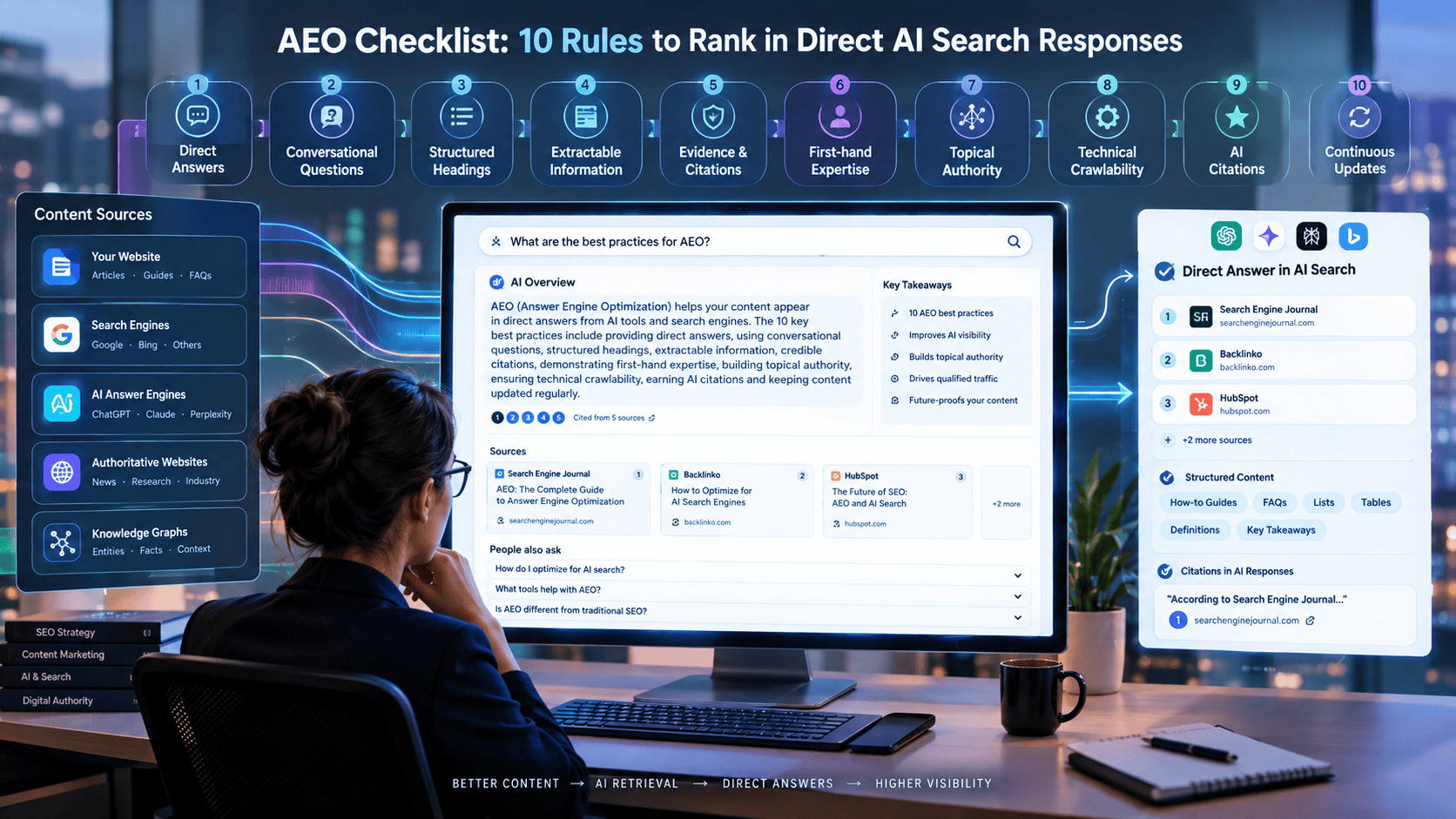
While ChatGPT and Perplexity are rapidly growing, Google AI Overviews and Google AI Mode are becoming major traffic sources. These AI-powered experiences summarize information directly in Google Search while linking to supporting websites.
Unlike traditional search results, AI Overviews prioritize content that is:
- Factually accurate
- Well-structured
- Comprehensive
- Supported by trustworthy sources
- Easy to extract
Best Practices
1. Answer Questions Immediately
Start every section with a concise answer.
Example
Question: What is Generative Engine Optimization?
Answer: Generative Engine Optimization (GEO) is the process of optimizing content so AI search engines like ChatGPT, Perplexity, and Google AI can understand, extract, and cite it in generated responses.
This “answer-first” style increases the likelihood of being used in AI-generated summaries.
2. Demonstrate E-E-A-T
Google evaluates:
- Experience
- Expertise
- Authoritativeness
- Trustworthiness
Strengthen these signals by including:
- Author biographies
- Professional credentials
- Editorial policies
- Original research
- Transparent sourcing
- Updated publication dates
3. Use Semantic Headings
Instead of vague headings like:
❌ Tips
Use descriptive headings such as:
✅ How to Optimize Your Robots.txt for AI Crawlers
This helps AI systems identify the exact topic of each section.
4. Add Original Insights
Google increasingly rewards original content.
Examples include:
- Internal case studies
- Performance benchmarks
- Survey results
- Experiments
- Screenshots
- Unique frameworks
If your article only summarizes existing information, it is less likely to stand out.
5. Strengthen Internal Linking
Link related articles using descriptive anchor text.
For example:
- Best AI Writing Tools
- AI Automation Workflows
- Local LLM Setup Guide
- Prompt Engineering Guide
- AI Productivity Tools
A well-connected content hub improves topical authority.
Google AI Optimization Checklist
✓ Use answer-first formatting
✓ Add schema markup
✓ Include original research
✓ Update content regularly
✓ Improve E-E-A-T
✓ Build topical clusters
✓ Use descriptive headings
✓ Optimize images with alt text
Phase 1: Technical GEO Foundations
Before writing AI-friendly content, ensure AI crawlers can actually access your website.
1. Allow AI Crawlers
Many websites unintentionally block AI bots.
Check your:
- robots.txt
- CDN firewall
- Cloudflare rules
- WAF settings
- Rate limiting
Important crawlers may include:
- ChatGPT-User
- OAI-SearchBot (if applicable)
- PerplexityBot
- Bingbot
- Googlebot
Blocking these bots prevents your content from being discovered or retrieved.
2. Use Server-Side Rendering (SSR)
Many modern websites rely heavily on JavaScript.
AI crawlers don’t always execute JavaScript as completely as browsers.
Instead:
✅ Render critical content in HTML
Avoid hiding:
- headings
- paragraphs
- FAQs
- article text
- author information
Server-side rendering dramatically improves AI readability.
3. Remove Content Walls
AI prefers immediately accessible content.
Avoid placing important answers behind:
- login forms
- cookie walls
- tabs
- accordions (for essential content)
- “Read More” buttons
- pop-ups
The first answer should always exist directly within the HTML.
4. Improve Crawl Efficiency
Optimize:
- XML sitemap
- internal linking
- canonical URLs
- breadcrumb navigation
- clean URL structure
The easier your content is to crawl, the easier it is to cite.
5. Add Structured Data
Schema helps AI understand relationships between entities.
Recommended schema includes:
- Article
- FAQPage
- HowTo
- Organization
- Person
- BreadcrumbList
- WebPage
Rich structured data also supports knowledge graph understanding.
Phase 2: On-Page GEO Strategies
Technical optimization gets crawled.
Content optimization gets cited.
1. Use the BLUF Method
BLUF means:
Bottom Line Up Front
Instead of writing:
AI optimization is important because…
Write:
To optimize for ChatGPT and Perplexity, place a direct answer in the first paragraph, use structured headings, cite reliable sources, and ensure AI crawlers can access your content.
Then explain why.
AI systems love immediate answers.
2. Create Self-Contained Sections
Every H2 should answer one question completely.
Instead of requiring readers (or AI) to reference earlier paragraphs, make each section understandable on its own.
Ideal section length:
200–400 words
This improves extraction quality.
3. Add Original Statistics
AI systems often favor content backed by measurable evidence.
Examples include:
- survey results
- benchmark data
- experiments
- performance metrics
- case studies
- comparisons
Whenever possible, include citations to reputable sources and clearly label any original research or internal data.
4. Use Expert Quotes
AI models value authoritative perspectives.
Include:
- industry experts
- research institutions
- official documentation
- experienced practitioners
Example:
“Structured, authoritative content with verifiable references is more likely to be reused in AI-generated answers.”
Always attribute quotations correctly and cite the original source.
5. Optimize Heading Structure
Good:
H2
H3
H3
H2
H3
Bad:
H2
H4
H5
H3
Logical hierarchy improves comprehension.
6. Write in Natural Language
Instead of keyword stuffing:
best ai tools
best ai tools
best ai tools
Write naturally:
The best AI tools for marketers include ChatGPT, Claude, Gemini, and Microsoft Copilot because each excels at different workflows.
Modern AI understands context.
7. Keep Content Fresh
Update articles regularly by:
- refreshing statistics
- revising screenshots
- updating examples
- correcting outdated information
- adding recent developments
Freshness is particularly valuable for fast-changing technology topics.
Phase 3: Platform-Specific Optimization
Optimizing for ChatGPT
Prioritize Bing Indexing
Because ChatGPT may rely on Bing during web searches, ensure your site is indexed in Bing Webmaster Tools.
Monitor:
- indexing
- crawl issues
- sitemap health
Write Encyclopedic Content
ChatGPT favors:
- definitions
- comparisons
- step-by-step guides
- FAQs
- tutorials
- tables
Content should answer questions directly before expanding.
Strengthen Entity Signals
Clearly identify:
- your brand
- author
- company
- products
- services
- topics
Consistency helps AI associate your site with relevant subjects.
Optimizing for Perplexity
Reference Multiple Trusted Sources
Perplexity frequently synthesizes information from several high-quality sources.
Support your article with links to:
- official documentation
- academic studies
- reputable industry publications
- government resources
Be Comprehensive
Cover:
- definitions
- benefits
- drawbacks
- examples
- FAQs
- comparisons
- implementation steps
Comprehensive pages have more opportunities to match diverse user questions.
Build Community Signals
Perplexity often references discussions from:
- YouTube transcripts
- GitHub (for technical topics)
- public forums
Participating in these communities can strengthen your brand’s visibility.
Phase 4: Off-Page GEO & Brand Authority
AI models evaluate more than backlinks.
They also recognize broader signals of authority.
Build Brand Mentions
Aim to be mentioned across:
- podcasts
- newsletters
- interviews
- expert roundups
- conference talks
- industry blogs
Even unlinked mentions can reinforce topical association.
Invest in Digital PR
Publish:
- original research
- surveys
- benchmark reports
- annual industry insights
Original data is more likely to be referenced and cited.
Build Consistent Entity Profiles
Maintain accurate, consistent information across major platforms such as:
- GitHub (where relevant)
- Crunchbase
- industry directories
- business profiles
Consistency strengthens entity recognition.
Demonstrate E-E-A-T
Strengthen:
- Experience
- Expertise
- Authoritativeness
- Trustworthiness
Include:
- author bios
- credentials
- publication dates
- editorial policies
- transparent sourcing
These trust signals help both users and AI systems evaluate credibility.
Phase 5: Measuring GEO Performance
Unlike traditional SEO, GEO success isn’t measured only by rankings.
Track:
1. AI Citations
Ask platforms questions like:
- Best AI workflow tools
- How to automate PDFs
- Best local LLM
Record:
- Was your website cited?
- Which page appeared?
- Which competitor was cited?
Maintain a monthly log.
2. Share of Voice (SoV)
Compare how frequently your brand appears versus competitors for your target prompts.
A growing share of voice indicates stronger AI visibility.
3. Referral Traffic
Monitor referrals from AI platforms in your analytics, where available.
Potential sources include traffic originating from ChatGPT, Perplexity, Bing, or other AI-assisted interfaces.
4. Brand Searches
Growth in branded search queries often indicates increasing awareness driven by AI recommendations and broader visibility.
5. Content Reuse
Observe whether your research, definitions, or frameworks are being referenced by others online.
Original insights tend to generate more citations over time.
30-Point GEO Audit Checklist
Technical (10)
- AI crawlers allowed
- robots.txt reviewed
- XML sitemap submitted
- Bing Webmaster Tools configured
- Server-side rendering enabled
- Fast page speed
- Mobile-friendly design
- HTTPS enabled
- Canonical URLs configured
- Structured data validated
Content (10)
- Answer-first introductions
- Descriptive H2/H3 headings
- Self-contained sections
- Original insights
- Relevant statistics
- Expert references
- FAQ section
- Updated publication date
- Clear conclusion
- Helpful internal links
Authority (5)
- Detailed author bio
- Editorial policy
- About page
- Contact information
- Consistent brand profiles
Monitoring (5)
- Track AI citations monthly
- Monitor referral traffic
- Review Bing indexing
- Refresh outdated content
- Compare Share of Voice against competitors
Bonus: “The GEO Pyramid Framework” (Highly Recommended)
To make your article even more unique and link-worthy, consider introducing your own framework:
                    GEO Success
          (AI Citations & Brand Mentions)
                       ▲
             Authority & E-E-A-T
                       ▲
          Original Research & Statistics
                       ▲
      AI-Friendly Content Structure (BLUF)
                       ▲
      Technical Accessibility (HTML, Schema,
      Crawlability, Bing Indexing, Page Speed)
You can refer to this as the GEO Pyramid Framework, explaining that each layer builds upon the previous one. Proprietary frameworks like this often improve memorability, encourage backlinks, and establish your site as a thought leader.
Common GEO Mistakes to Avoid
- Blocking AI crawlers
- Publishing thin content
- Using excessive keyword stuffing
- Hiding key information behind scripts or interactive elements
- Not updating outdated articles
- Omitting structured data
- Publishing without credible references
- Failing to establish author expertise
- Ignoring Bing indexing
- Creating pages without clear topical focus
Quick GEO Checklist
Before publishing any article, verify that you have:
- Allowed AI crawlers to access the site
- Submitted your sitemap to search engines
- Used a clear H1 and logical H2/H3 structure
- Answered the main question immediately
- Added relevant schema markup
- Included reputable references
- Cited original data where possible
- Written self-contained content sections
- Optimized internal linking
- Reviewed the article for freshness and accuracy
The Future of GEO
Generative AI will continue to reshape search.
Rather than replacing SEO, GEO expands it.
Successful websites in the coming years will combine:
- Technical SEO
- Helpful, original content
- Structured data
- Strong entity signals
- Brand authority
- Regular updates
- Clear, answer-focused formatting
The websites that consistently provide trustworthy, well-organized information are the ones most likely to earn citations in AI-generated answers.
Common GEO Mistakes (and How to Fix Them)
Even high-quality websites can struggle to appear in AI-generated answers if they overlook a few key optimization practices. Below are the most common Generative Engine Optimization (GEO) mistakes and how to fix them.
| Common Mistake | Why It Hurts AI Visibility | How to Fix It |
|---|---|---|
| Blocking AI Crawlers | AI search engines can’t access or retrieve your content. | Review your robots.txt, CDN, and firewall settings to allow legitimate AI crawlers and search engine bots. |
| Relying Only on Traditional SEO | Ranking well doesn’t automatically mean AI assistants will cite your content. | Combine SEO with GEO by writing answer-first, structured, and authoritative content. |
| No Structured Data (Schema) | AI systems have less context about your content and entities. | Implement Article, FAQPage, HowTo, Organization, and BreadcrumbList schema where appropriate. |
| Writing Long Introductions Before the Answer | AI prefers pages that answer the user’s question immediately. | Use the BLUF (Bottom Line Up Front) approach and provide the direct answer in the first 1–2 sentences. |
| Publishing Thin or Generic Content | AI favors comprehensive, trustworthy resources over shallow articles. | Create in-depth guides with practical examples, comparisons, FAQs, and actionable advice. |
| No Original Research or Insights | AI tends to value unique information over repeated summaries. | Add case studies, benchmark data, experiments, surveys, or original frameworks. |
| Outdated Information | AI search often prioritizes recently updated content for fast-changing topics. | Refresh statistics, screenshots, examples, and publication dates regularly. |
| Poor Heading Structure | Disorganized content is harder for AI to understand and extract. | Use a logical hierarchy with one H1 and descriptive H2/H3 headings. |
| Weak Internal Linking | AI and users may struggle to understand your topical expertise. | Build topic clusters by linking to related articles with descriptive anchor text. |
| Ignoring Bing Indexing | Some AI search experiences rely on Bing’s search infrastructure. | Verify your site in Bing Webmaster Tools, submit your sitemap, and monitor crawl issues. |
| No Expert Attribution | Unsupported claims reduce credibility and trust. | Reference reputable sources, official documentation, and expert opinions where appropriate. |
| Hiding Key Content Behind JavaScript or Interactive Elements | AI crawlers may not fully process content that isn’t available in the initial HTML. | Ensure essential content is rendered server-side and visible without user interaction. |
| Ignoring Brand Authority | AI systems consider overall reputation and entity recognition. | Build consistent brand profiles, earn mentions on authoritative sites, and strengthen your online presence. |
| Publishing Without E-E-A-T Signals | Anonymous or unverified content is generally less trustworthy. | Include author bios, credentials, editorial policies, contact information, and publication dates. |
| Never Monitoring AI Citations | You won’t know whether your GEO strategy is working. | Regularly test prompts in ChatGPT, Perplexity, and Google AI, and track citations, referral traffic, and share of voice. |
Who Should Read This Guide?
Generative Engine Optimization (GEO) is no longer just for SEO professionals. As AI-powered search becomes more common, anyone who publishes content online can benefit from understanding how AI systems discover, evaluate, and cite information.
This guide is especially useful for:
Bloggers & Content Creators
Learn how to structure articles so they are more likely to be cited by ChatGPT, Perplexity, Google AI Overviews, and other AI-powered search tools. Improve your content’s visibility while continuing to grow organic traffic.
SEO Professionals
Expand your SEO strategy beyond traditional keyword rankings. Discover how to optimize for AI-generated answers, entity recognition, structured data, and citation opportunities.
Digital Marketers
Understand how AI search is reshaping customer discovery and learn strategies to increase brand visibility across search engines, AI assistants, and answer engines.
Small Business Owners
If your website generates leads or sales, GEO can help your business appear in AI-generated recommendations when potential customers ask for products, services, or local solutions.
SaaS Companies & Startups
Increase the likelihood of your software, tools, and documentation being referenced by AI assistants. Learn how to build authority through comprehensive guides, technical documentation, and trusted brand signals.
E-commerce Store Owners
Optimize product guides, buying guides, FAQs, and comparison pages so AI search engines can better understand and recommend your products to potential buyers.
Publishers & Affiliate Marketers
Future-proof your content strategy by creating authoritative, answer-first articles that attract both traditional search traffic and AI-driven citations.
Web Developers & WordPress Users
Learn the technical side of GEO, including robots.txt configuration, server-side rendering (SSR), structured data, crawlability, page speed optimization, and Bing indexing.
AI Automation Enthusiasts
If you’re working with AI tools like ChatGPT, Claude, Gemini, Microsoft Copilot, or Perplexity, this guide will help you understand how these platforms retrieve and evaluate web content.
Students & Digital Marketing Learners
Gain a practical understanding of how AI search works and why Generative Engine Optimization is becoming an essential digital marketing skill.
Frequently Asked Questions
Is GEO replacing SEO?
No. GEO complements SEO. Traditional SEO helps search engines discover and rank your content, while GEO helps AI systems understand, extract, and cite it.
Does ChatGPT use Google Search?
No. When ChatGPT performs live web searches, it has commonly relied on Microsoft’s Bing search infrastructure rather than Google Search.
Does Perplexity use live web pages?
Yes. Perplexity retrieves information from live web sources, synthesizes content from multiple pages, and typically cites those sources in its responses.
Is schema markup important for GEO?
Yes. Structured data helps search engines and AI systems better understand the entities, relationships, and purpose of your content.
How often should I update GEO content?
For fast-moving topics such as AI, software, and technology, reviewing and updating important articles every 30–90 days is a practical goal.
Final Thoughts
Generative Engine Optimization is becoming an essential extension of modern SEO. As users increasingly rely on AI assistants for answers, the websites that are cited most often will be those that combine technical accessibility, authoritative content, structured data, and strong topical expertise.
Start by making your content easy to crawl, easy to understand, and easy to verify. Then focus on publishing original insights, maintaining freshness, and building your brand’s authority across the web. Those practices will not only improve your visibility in AI search but also strengthen your overall organic search performance.
Key Takeaways
✅ Allow AI crawlers through your robots.txt and security settings.
✅ Put the direct answer at the beginning of every major section.
✅ Use structured data such as Article, FAQPage, HowTo, and Organization schema.
✅ Publish original research, statistics, and expert-backed insights.
✅ Build consistent brand authority through digital PR, community engagement, and authoritative mentions.
Ready to Future-Proof Your Website for AI Search?
AI-powered search is no longer a trend—it’s becoming a fundamental part of how people discover information online. While traditional SEO remains essential, websites that combine strong SEO with Generative Engine Optimization (GEO) will be better positioned to earn citations, recommendations, and visibility across ChatGPT, Perplexity, Google AI Overviews, Microsoft Copilot, and future AI search platforms.
Don’t wait for your competitors to adapt first. Start by auditing your website, improving your content structure, implementing structured data, and publishing authoritative, answer-first content that AI systems can easily understand and trust.
The sooner you optimize for AI search, the greater your opportunity to become a trusted source in the next generation of search experiences.
Your Next Steps
✅ Audit your website for AI crawler accessibility.
✅ Implement schema markup and improve technical SEO.
✅ Rewrite your highest-performing articles using an answer-first (BLUF) structure.
✅ Publish original research, case studies, and expert-backed content.
✅ Build topical authority with strong internal linking and consistent content updates.
✅ Track your AI citations and continuously refine your GEO strategy.
Start Optimizing Today
Generative Engine Optimization isn’t replacing SEO—it’s the next evolution of it. Every article you publish today is an opportunity to become a trusted source that AI assistants recommend tomorrow.
Also Read
- Make.com vs n8n for AI Automation: Which Is Better for Beginners?
- Extract Structured Data from PDFs Using Local LLMs
- How AI Can Save You Hours Every Week
- AI Automation Ideas for Beginners
- Best Free Open-Source AI Automation Tools for Small Businesses
- How to Build a Custom AI Assistant for Customer Support Without Code
- Best AI Productivity Tools for Daily Tasks
- OpenAI Sora Alternatives You Can Actually Use
- How to Automate Lead Capture with n8n and Open-Source LLMs
- 25 Real-World AI Workflows That Save 10+ Hours Every Week (With Free Templates)






Leave a Reply