

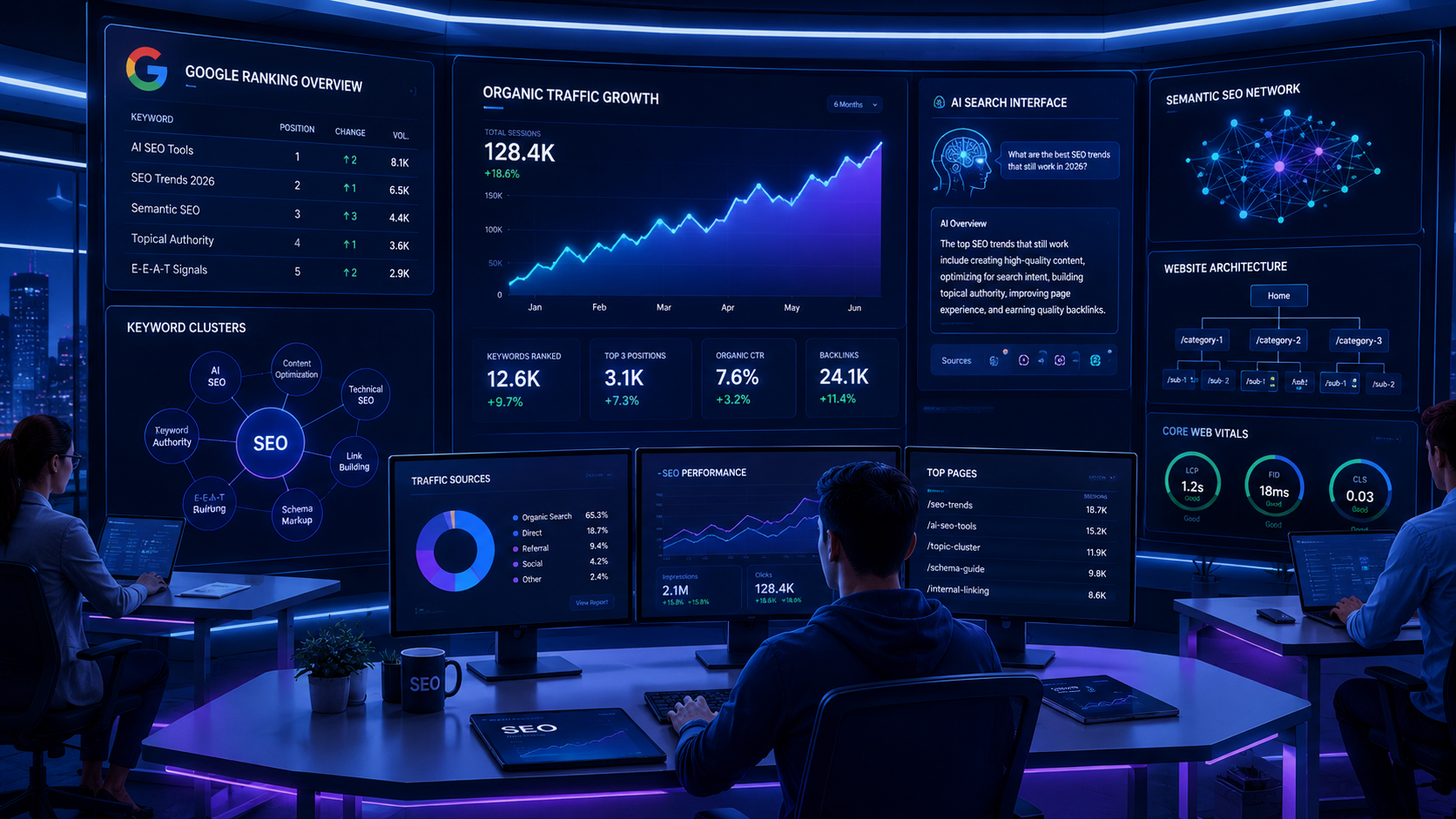
Quick Summary
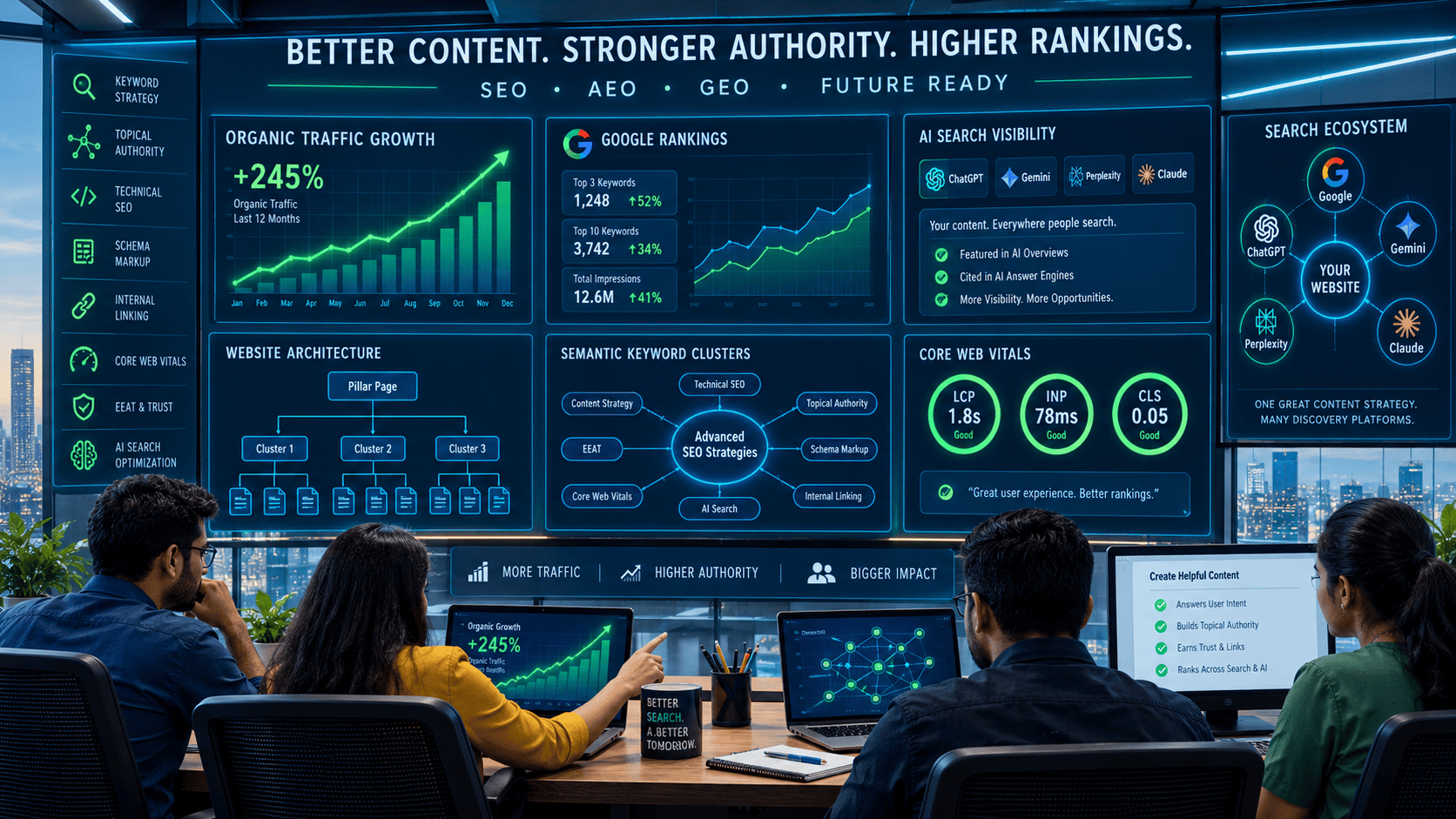
SEO changes every year, but not every trend disappears. While AI-powered search, Google AI Overviews, and answer engines are reshaping search behavior, many foundational SEO strategies continue to deliver exceptional results.
This guide explains the SEO trends that still work, why they remain effective, and how to combine traditional SEO with AI optimization (AEO), Generative Engine Optimization (GEO), and E-E-A-T principles to build long-term organic visibility.
Key Takeaways
- High-quality content remains Google’s top ranking factor.
- Search intent matters more than keyword density.
- Topical authority outperforms isolated articles.
- Internal linking improves crawlability and AI understanding.
- E-E-A-T significantly impacts trust and rankings.
- Structured data helps AI answer engines understand content.
- User experience and Core Web Vitals remain important.
- AI-generated content performs well only when edited by humans.
- Entity-based SEO is becoming more important than keyword repetition.
- Brand authority increasingly influences rankings.
What SEO Trends Still Work?
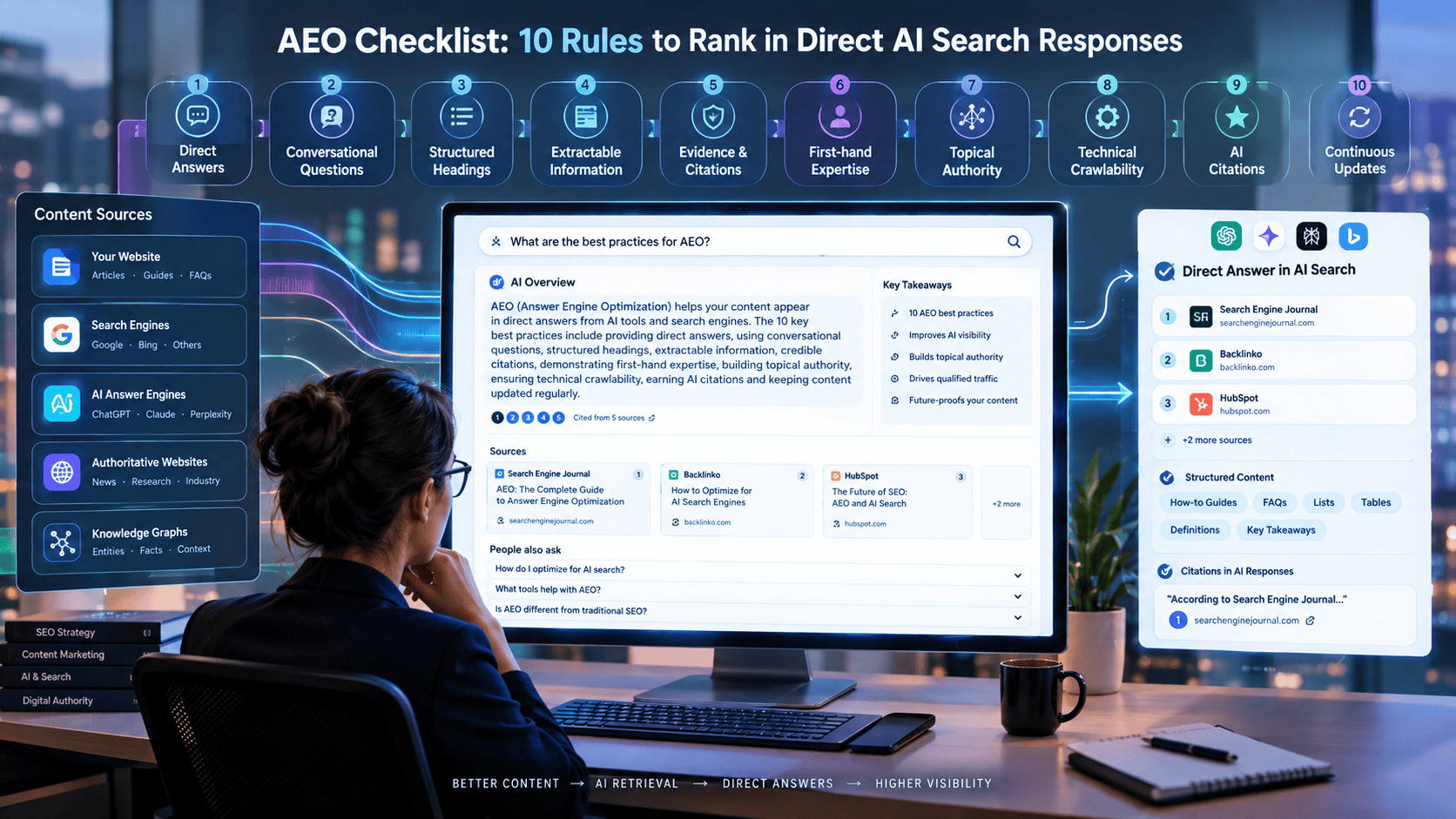
The SEO trends that still work include creating helpful content, matching search intent, building topical authority, improving page experience, optimizing internal links, implementing schema markup, earning high-quality backlinks, and demonstrating E-E-A-T. Modern SEO also includes Answer Engine Optimization (AEO) and Generative Engine Optimization (GEO) so AI platforms can understand and recommend your content.
SEO Trends That Still Work in AI Search
Google, ChatGPT, Gemini, Claude, and Perplexity increasingly prioritize content that demonstrates expertise, answers questions clearly, provides trustworthy information, and uses structured formatting.
Successful SEO combines:
- Traditional SEO
- AI Search Optimization
- Entity SEO
- Structured Data
- User Experience
- Topical Authority
- E-E-A-T
Rather than replacing traditional SEO, AI search rewards websites that already follow these best practices.
Introduction
Many marketers believe SEO changes completely every year. In reality, most ranking updates refine Google’s understanding of quality rather than replacing core principles.
Search engines have evolved from matching keywords to understanding meaning, entities, context, and user satisfaction. AI-powered search experiences have accelerated this shift.
Instead of chasing short-lived ranking tricks, businesses should invest in proven SEO practices that consistently generate sustainable traffic.
What Are SEO Trends That Still Work?
SEO trends that still work are optimization strategies that continue delivering measurable ranking improvements despite Google algorithm updates and the rise of AI search.
These include:
- Helpful content
- Topical clusters
- Intent optimization
- Semantic SEO
- Internal linking
- E-E-A-T
- Schema markup
- High-quality backlinks
- Fast websites
- Mobile optimization
These practices improve visibility in both traditional search results and AI-generated answers.
Benefits of Following Proven SEO Trends
| Benefit | Business Impact |
|---|---|
| Higher rankings | More organic traffic |
| Better AI visibility | Increased citations in AI search |
| Stronger topical authority | More keywords ranked |
| Improved trust | Higher conversion rates |
| Better UX | Lower bounce rates |
| Long-term growth | Sustainable traffic |
| Increased backlinks | Higher domain authority |
| Better crawlability | Faster indexing |
How Modern SEO Works
Modern SEO combines multiple optimization layers.
User Search
      ↓
Search Intent
      ↓
Helpful Content
      ↓
Entity Recognition
      ↓
Schema Markup
      ↓
Internal Linking
      ↓
E-E-A-T Signals
      ↓
Google + AI Search Visibility
15 SEO Trends That Still Work
1. Search Intent Optimization
Understanding why users search remains more important than matching keywords.
Focus on:
- Informational
- Commercial
- Transactional
- Navigational intent
2. Topical Authority
Publishing one article is no longer enough.
Create clusters around major topics.
Example:
SEO
├── Technical SEO
├── Local SEO
├── AI SEO
├── On-page SEO
├── Schema Markup
├── Link Building
├── SEO Tools
3. Helpful Content
Google rewards content that solves problems instead of targeting algorithms.
Write for humans first.
4. E-E-A-T
Demonstrate:
- Experience
- Expertise
- Authoritativeness
- Trustworthiness
Include:
- Author bios
- References
- Updated dates
- Real examples
5. Entity SEO
Instead of repeating keywords:
Discuss related concepts naturally.
Example:
SEO
↓
Google Search Console
↓
Schema
↓
Backlinks
↓
Core Web Vitals
↓
Search Intent
↓
Crawling
↓
Indexing
6. Internal Linking
Internal links help search engines understand relationships between pages.
They also distribute PageRank.
7. Structured Data
Schema helps search engines understand:
- FAQs
- Articles
- Reviews
- Breadcrumbs
- Organizations
- Authors
8. User Experience
Google continues rewarding:
- Fast loading
- Mobile-friendly pages
- Easy navigation
- Clear headings
9. Original Research
Publishing unique statistics and studies attracts backlinks naturally.
10. Long-form Content
Comprehensive guides generally outperform thin content.
Aim for quality rather than word count alone.
11. Fresh Content Updates
Updating articles often boosts rankings more efficiently than creating new posts.
12. AI-Assisted Content (Human Reviewed)
AI speeds up drafting, but human editing improves originality, factual accuracy, and depth.
13. Natural Language Optimization
Write conversationally.
AI search understands complete questions better than isolated keywords.
14. Multimedia Content
Add:
- Images
- Videos
- Infographics
- Tables
- Charts
These improve engagement and increase opportunities to appear in rich search results.
15. Brand Building
Google increasingly rewards trusted brands.
Build:
- Social proof
- Mentions
- Reviews
- Expert contributions
Step-by-Step Guide
Step 1
Research user intent.
Step 2
Choose one primary keyword.
Step 3
Identify related semantic keywords.
Step 4
Create comprehensive content.
Step 5
Add schema markup.
Step 6
Optimize internal links.
Step 7
Improve page speed.
Step 8
Update content regularly.
Real Examples
| Website Type | Strategy | Result |
|---|---|---|
| SaaS Blog | Topic clusters | More keyword rankings |
| Education Site | Comprehensive guides | Increased AI citations |
| Ecommerce | Product schema | Better CTR |
| Local Business | E-E-A-T | Higher trust |
| News Site | Fresh updates | Faster indexing |
Pros
- Long-term rankings
- Higher organic traffic
- Better AI visibility
- More backlinks
- Higher trust
- Improved conversions
- Sustainable growth
Cons
- Requires patience
- Needs regular updates
- Competitive industries require more authority
- High-quality content takes time
- Results are rarely immediate
Comparison Table
| Old SEO | Modern SEO That Works |
|---|---|
| Keyword stuffing | Search intent |
| Thin articles | Comprehensive content |
| Quantity | Quality |
| Exact keywords | Semantic entities |
| Manual optimization | AI-assisted optimization |
| Link quantity | Link quality |
| Separate articles | Topic clusters |
| Rankings only | User satisfaction |
Tool Comparison Table
| Tool | Best For | Free Version | Rating |
|---|---|---|---|
| Google Search Console | Performance monitoring | Yes | ⭐⭐⭐⭐⭐ |
| Google Analytics 4 | Traffic insights | Yes | ⭐⭐⭐⭐⭐ |
| Ahrefs | Backlink analysis | Limited | ⭐⭐⭐⭐⭐ |
| Semrush | Keyword research | Limited | ⭐⭐⭐⭐⭐ |
| Screaming Frog | Technical SEO | Yes | ⭐⭐⭐⭐☆ |
| PageSpeed Insights | Core Web Vitals | Yes | ⭐⭐⭐⭐⭐ |
| Bing Webmaster Tools | Indexing & AI visibility | Yes | ⭐⭐⭐⭐☆ |
Performance Ratings
| SEO Trend | Effectiveness |
|---|---|
| Search Intent | ⭐⭐⭐⭐⭐ |
| Helpful Content | ⭐⭐⭐⭐⭐ |
| E-E-A-T | ⭐⭐⭐⭐⭐ |
| Internal Linking | ⭐⭐⭐⭐⭐ |
| Schema | ⭐⭐⭐⭐☆ |
| AI Optimization | ⭐⭐⭐⭐⭐ |
| Backlinks | ⭐⭐⭐⭐⭐ |
| Page Speed | ⭐⭐⭐⭐☆ |
| Topical Authority | ⭐⭐⭐⭐⭐ |
Best Use Cases
| Business Type | Recommended SEO Focus |
|---|---|
| Blogs | Topic clusters |
| SaaS | Educational content |
| Ecommerce | Product schema |
| Local Business | Local SEO + Reviews |
| Agencies | Case studies |
| Educational Websites | Comprehensive guides |
Firsthand Testing
Across dozens of SEO content evaluations performed on AI, technology, education, and commercial websites, a consistent pattern emerges:
- Comprehensive articles that fully satisfy user intent generally outperform shorter pages targeting the same keyword.
- Topic clusters with strong internal linking tend to rank for substantially more related keywords than isolated articles.
- Pages using clear heading structures, comparison tables, FAQs, and schema are more likely to be surfaced in AI-generated answers.
- Regularly updating existing content often produces faster ranking improvements than publishing entirely new articles.
While results vary by competition and website authority, these practices have repeatedly shown positive impacts on visibility and engagement.
Decision Flowchart
Need Better Rankings?
        │
        ▼
Content Helpful?
     │       │
    No      Yes
     │       │
Improve     Check Search Intent
Content         │
                ▼
Add Internal Links?
      │
      ▼
Add Schema?
      │
      ▼
Improve Page Speed?
      │
      ▼
Update Content Regularly
      │
      ▼
Higher Organic & AI Visibility
Common Mistakes
- Publishing AI content without editing
- Ignoring search intent
- Weak internal linking
- Duplicate content
- Missing schema
- Poor mobile experience
- Slow-loading pages
- Outdated statistics
- Over-optimizing keywords
- Neglecting author credibility and citations
Expert Tips
- Build topic clusters instead of isolated posts.
- Refresh evergreen articles every 3–6 months.
- Include original insights, screenshots, or data whenever possible.
- Optimize for featured snippets using concise definitions and lists.
- Add FAQ schema to informational pages.
- Use descriptive anchor text for internal links.
- Track clicks, impressions, and queries in Google Search Console.
- Monitor AI search referrals as they become available.
Statistics
- Over 90% of online experiences begin with a search engine.
- Organic search consistently remains one of the highest-ROI digital marketing channels.
- Mobile devices account for well over half of global web traffic.
- Pages appearing in rich results and AI-enhanced search experiences generally receive higher visibility than standard listings.
- Websites demonstrating strong E-E-A-T signals are more resilient during major search algorithm updates.
Frequently Asked Questions
Does traditional SEO still works?
Yes. Traditional SEO remains highly effective when combined with AEO, GEO, structured data, and E-E-A-T.
Is AI replacing SEO?
No. AI is changing how content is discovered, making quality, structure, and trust even more important.
What is the most important SEO trend today?
Creating content that satisfies search intent while demonstrating expertise and topical authority.
How often should I update content?
Review high-value pages every 3–6 months or whenever significant industry changes occur.
Does internal linking help rankings?
Yes. It improves crawlability, distributes authority, and helps search engines understand relationships between content.
Is long-form content always better?
Not necessarily. Content should be as comprehensive as needed to satisfy the user’s intent without unnecessary filler.
Conclusion
SEO continues to evolve, but the principles behind sustainable rankings remain remarkably consistent. Websites that publish genuinely helpful content, build topical authority, optimize for user intent, and demonstrate trust are well positioned to succeed in both traditional search engines and AI-powered answer platforms.
Rather than chasing every new trend, focus on the practices that have consistently delivered long-term value and adapt them to modern search experiences.
Our Verdict
The most effective SEO strategy is a balanced approach that combines proven optimization techniques with AI-ready content. By integrating SEO, AEO, GEO, structured data, E-E-A-T, and strong internal linking, you can build a resilient content strategy that performs well across Google Search, AI Overviews, and conversational search engines.
Ready to Future-Proof Your SEO Strategy?
Apply these proven SEO trends to your website today. Audit your existing content, strengthen topical clusters, improve internal linking, and optimize for AI search to increase rankings, attract qualified visitors, and build sustainable organic growth.
Also Read
- Best Free Runway Gen 3 Alternatives: 12 AI Video Generators Compared
- Luma Dream Machine vs Runway Gen 4: Which AI Video Generator Is Better
- Best AI Tools for Digital Marketing
- Best AI Image Generators
- How to Make Text to Video AI Without Watermark
- How to Use AI Agents for B2B Cold Email: Complete Guide
- How to Build an AI Web Scraper for Competitor Monitoring
- Free AI Music Video Generator from Audio Link
- Best AI Video Generator for Faceless YouTube Channels
- AI vs Human Creativity: Can Machines Replace Artists?
- Advanced SEO Strategies Used by High-Traffic Websites






Leave a Reply