

Quick Summary
Answer Engine Optimization (AEO) is the practice of creating and structuring content so AI-powered search and answer engines can easily understand, extract, summarize, and cite the information.
A strong AEO strategy does not mean writing exclusively for AI. It means making content clear, direct, trustworthy, well-structured, evidence-supported, and useful to humans.
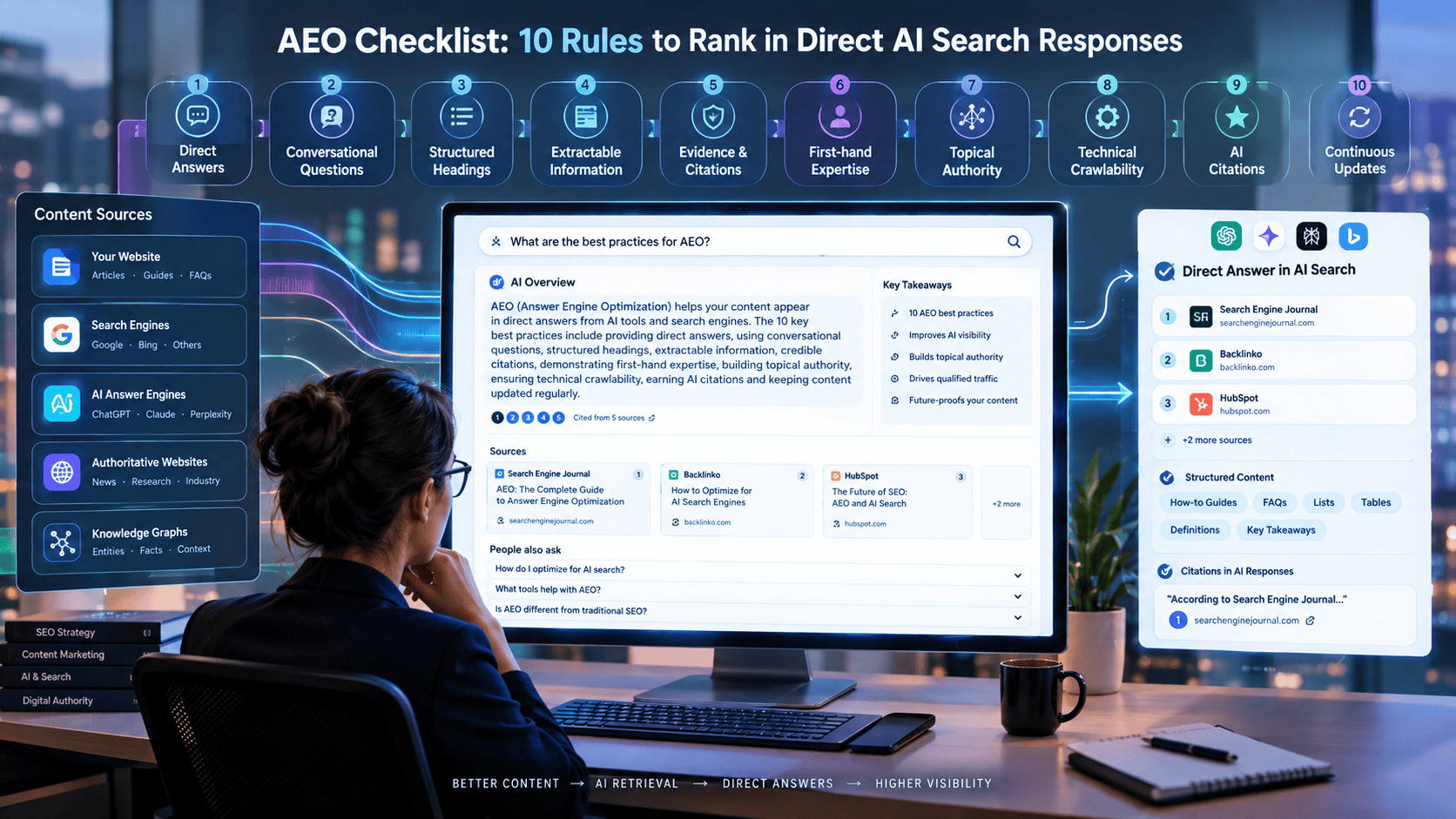
The 10 core AEO rules covered in this guide are:
- Answer the main question immediately.
- Match conversational search intent.
- Structure content around specific questions.
- Make important facts easy to extract.
- Support claims with authoritative evidence.
- Demonstrate first-hand expertise.
- Build topical authority with related content.
- Strengthen technical accessibility and crawlability.
- Optimize for citations, not just rankings.
- Measure and continuously improve AI visibility.
There is no guaranteed formula for appearing in ChatGPT, Google AI search, Bing Copilot, Perplexity, or another AI answer engine. However, these principles make content substantially easier for both traditional search systems and AI systems to discover, understand, evaluate, and reference.
Key Takeaways
- AEO complements SEO and GEO rather than replacing them.
- Put the direct answer near the beginning of important sections.
- Write headings as questions when they naturally reflect user queries.
- Use concise definitions, tables, lists, examples, and step-by-step explanations.
- Cite statistics and important factual claims.
- Add genuine first-hand observations, testing methodology, screenshots, examples, or original analysis where appropriate.
- Build topic clusters instead of publishing isolated articles.
- Make your content accessible to search crawlers and AI crawlers.
- Monitor AI citations separately from traditional organic rankings.
- Never assume that adding FAQ schema, an
llms.txtfile, or AI-related keywords automatically produces AEO visibility.
What Is AEO and How Do You Optimize Content for AI Search?
Answer Engine Optimization (AEO) is the process of optimizing content so AI-powered answer engines can understand, extract, summarize, and cite it when answering user questions. To improve AEO, provide direct answers, use clear question-based headings, organize information into concise sections and lists, support claims with reliable sources, demonstrate expertise, maintain crawlable technical infrastructure, and build topical authority around related questions.
AEO works alongside traditional SEO. Search engines and AI answer systems still need to discover, crawl, understand, and evaluate web content before it can potentially be surfaced or cited. Bing explicitly states that SEO fundamentals continue to support its AI and grounding experiences.
How Does AEO Help Content Appear in AI Search Results?
AI search systems increasingly generate answers by retrieving information from multiple sources and presenting synthesized responses, often with links or citations.
For example, ChatGPT Search can search the web and provide citations to sources. OpenAI also states that websites should allow OAI-SearchBot to crawl their content if they want their pages to be eligible for inclusion in ChatGPT search results.
Bing similarly reports which pages are cited in AI-generated answers through its AI Performance reporting. Its guidance recommends clear structure, evidence-supported claims, topical depth, and fresh information as useful content practices for AI visibility.
Therefore, modern search optimization increasingly involves two related goals:
Traditional SEO:
Get discovered → indexed → ranked → clicked.
AEO/GEO:
Get discovered → retrieved → understood → selected → cited or referenced.
The important point is that there is no guaranteed “AI ranking formula.” AEO should instead focus on making genuinely useful information easy for both users and retrieval systems to understand.
Introduction
Search behavior is changing.
Instead of typing:
“best AI browser extensions productivity”
a user may ask:
“Which AI browser extensions are actually useful for research, writing, and productivity?”
Instead of scanning ten blue links, users increasingly expect an answer directly inside the search interface.
AI-powered search experiences can synthesize information from multiple sources and provide an answer with supporting links or citations. ChatGPT Search, for example, can search the web and provide citations to relevant sources.
This creates a new challenge for publishers:
How do you make your content useful enough, clear enough, and accessible enough to become part of an AI-generated answer?
That is where AEO becomes useful.
AEO does not mean stuffing a page with questions such as “What is…” or adding dozens of FAQs.
Instead, it means designing content around the way people ask questions and the way answer systems need to retrieve information.
What Is Answer Engine Optimization (AEO)?
Answer Engine Optimization is the process of structuring and improving content so answer engines can efficiently understand, retrieve, summarize, and potentially cite the information.
An answer engine may include:
- AI-powered search engines
- AI search modes
- ChatGPT Search
- Google AI search experiences
- Microsoft Copilot
- Perplexity
- Other generative search and answer platforms
AEO focuses heavily on answerability.
Traditional SEO may ask:
“Can this page rank for the keyword?”
AEO asks:
“Can an answer engine confidently extract a useful answer from this page?”
GEO is closely related but broader.
SEO vs AEO vs GEO
| Optimization | Primary Objective | Typical Focus |
|---|---|---|
| SEO | Improve search visibility | Keywords, crawling, indexing, rankings |
| AEO | Improve answer visibility | Direct answers, questions, extractable information |
| GEO | Improve generative visibility | AI retrieval, citations, entity/context signals |
| Content Marketing | Build audience and demand | Education, trust, engagement |
| E-E-A-T | Demonstrate quality and trust | Experience, expertise, authority, trust |
These disciplines overlap.
The strongest strategy is therefore not SEO vs AEO vs GEO.
It is:
SEO + AEO + GEO + E-E-A-T + excellent content.
Why AEO Matters
AI search changes what visibility can look like.
A page might rank well traditionally but never become a cited source in an AI-generated answer.
Conversely, a page can potentially become a useful source for an AI response because it provides a particularly clear explanation, comparison, statistic, methodology, or answer.
Bing’s AI Performance reporting illustrates this difference by separately measuring pages cited in AI-generated answers and the grounding queries associated with those citations.
This means website owners should increasingly monitor more than rankings.
Important visibility signals can include:
- Organic impressions
- Organic clicks
- Featured snippets
- AI citations
- AI-referenced pages
- Grounding queries
- Brand mentions
- Referral traffic
- Search visibility by topic
- Conversion performance
Benefits of AEO
A well-executed AEO strategy can provide several benefits.
1. Better Answer Visibility
Your content becomes easier for AI systems to understand and potentially reference.
2. Better Featured-Snippet Eligibility
Clear answers can also work well for traditional search features such as snippets.
3. Improved User Experience
Readers benefit from concise answers before detailed explanations.
4. Stronger Topical Authority
Question-focused content encourages publishers to cover related subtopics comprehensively.
5. Better Content Structure
AEO naturally encourages useful headings, tables, definitions, examples, and summaries.
6. Stronger Citation Potential
Evidence-supported claims are easier to evaluate than unsupported assertions.
7. Future-Proof Search Strategy
Search interfaces continue to evolve. Clear, structured, authoritative content remains useful across different discovery systems.
How AEO Works
A simplified AEO process looks like this:
User question
↓
Search/answer engine interprets intent
↓
Retrieval system identifies potentially relevant sources
↓
Content is evaluated for relevance, quality, clarity, and other signals
↓
Useful information is extracted
↓
AI generates an answer
↓
Relevant sources may be cited
Your goal is not to manipulate the final generation step.
Your goal is to make your page an excellent source of information for the retrieval process.
This distinction is important.
The 10-Rule AEO Checklist
Rule 1: Answer the Main Question Immediately
One of the simplest AEO improvements is also one of the most important:
Do not make users or retrieval systems hunt for the answer.
If your heading asks:
What is AEO?
Answer it immediately.
Do not begin with five paragraphs of history.
A strong structure is:
Question → direct answer → explanation → evidence → example
For example:
What is AEO?
AEO is the process of optimizing content so answer engines can understand, extract, summarize, and potentially cite the information when responding to user questions.
Then expand.
AEO Checklist
- Does the page answer its primary question?
- Is the answer near the beginning?
- Is the answer understandable without additional context?
- Can the answer stand alone if extracted?
- Does the following section provide supporting detail?
Expert Tip
Write the one-sentence answer first, then expand it.
This also forces you to clarify what the page is actually about.
Rule 2: Match Conversational Search Intent
People do not always search using perfect keywords.
They ask questions.
Examples:
- “How does AEO work?”
- “How do I optimize my website for ChatGPT?”
- “Does FAQ schema help AI search?”
- “How is AEO different from SEO?”
- “How can I get cited by AI search?”
Build content around the questions your audience genuinely has.
Convert Keywords Into Questions
| Traditional Keyword | AEO Question |
|---|---|
| AEO checklist | What is an AEO checklist? |
| AI search optimization | How do I optimize content for AI search? |
| AEO vs SEO | What is the difference between AEO and SEO? |
| ChatGPT SEO | How can I make my website discoverable in ChatGPT Search? |
| AI citations | How do AI search engines choose sources? |
This does not mean inserting every question unnaturally.
Use natural questions where they improve the article.
Rule 3: Structure Content Around Specific Questions
A strong AEO article should be easy to scan.
Use:
- H2 headings
- H3 subheadings
- short paragraphs
- numbered lists
- bullet points
- comparison tables
- definitions
- examples
- step-by-step instructions
- FAQs
Avoid creating enormous walls of text.
AEO-Friendly Section Pattern
A useful pattern is:
H2: How Does AEO Work?
Short answer.
Detailed explanation.
Example.
Checklist.
Supporting source.
This creates multiple independently understandable information units.
Rule 4: Make Important Information Easy to Extract
AI systems need to identify meaningful information within a page.
Make important information obvious.
Instead of:
There are many different reasons why a website owner might consider improving the structure of content because users and search systems may interact with the page in different ways…
Write:
Clear content structure helps both readers and search systems understand a page.
Then explain why.
Useful formats include:
Definitions
AEO: The optimization of content for answer engines.
Lists
- Identify user questions.
- Answer them directly.
- Add evidence.
- Provide examples.
- Update the information.
Tables
Tables are particularly useful for comparisons.
Key Takeaways
Summarize important conclusions.
Rule 5: Support Important Claims With Evidence
AEO is not just about clarity.
Trust matters.
If you publish:
- statistics
- market data
- product claims
- technical specifications
- research findings
- health information
- financial information
- performance claims
support them with reliable sources.
Prefer:
- Government websites
- Official documentation
- Academic research
- Original studies
- Established research organizations
- First-party documentation
- Reputable industry reports
For example, OpenAI’s documentation states that ChatGPT Search can provide citations and that websites can improve eligibility for inclusion by allowing OAI-SearchBot to crawl their content.
Bing also recommends supporting claims with evidence as part of improving clarity and trust for AI-generated answers.
Evidence Checklist
- Is the claim important?
- Is the source authoritative?
- Is the source current?
- Does the source actually support the claim?
- Is the citation placed close to the claim?
Rule 6: Demonstrate First-Hand Experience
AI-generated content is everywhere.
Simply repeating information available on dozens of websites does not create a strong competitive advantage.
Add evidence of actual experience whenever possible.
This can include:
- Your testing methodology
- Screenshots
- Performance observations
- Original examples
- Before-and-after comparisons
- Workflow experiments
- Tool configuration details
- Problems encountered
- Limitations discovered
- Original datasets
- Practical recommendations
Firsthand Testing
For AEO-related articles, a practical testing process could include asking multiple AI search systems the same set of questions and recording:
| Test | What to Record |
|---|---|
| Basic question | Which sources are cited? |
| Definition question | Which page provides the answer? |
| Comparison question | Which websites appear? |
| Long-tail question | Which pages are retrieved? |
| Brand question | Is your site mentioned? |
| Follow-up question | Does the source remain visible? |
Do not claim that you personally performed tests unless you actually did.
Instead, document your methodology and distinguish between:
Observed: What you actually tested.
Reported: What an official source or third-party study says.
Recommended: Your professional interpretation.
This distinction strengthens E-E-A-T.
Rule 7: Build Topical Authority
One AEO article is unlikely to establish strong topical authority by itself.
Build a network of related content.
For example, an AI search topic cluster could contain:
Pillar
→ AEO Checklist
Supporting Content
→ GEO Guide
→ How to Optimize Your Website for ChatGPT & Perplexity Search
→ AI Ethics for Creators
→ AI Content Optimization
→ SEO fundamentals
→ AI search visibility measurement
Then connect these pages with contextual internal links.
Why Topic Clusters Matter
A website with multiple useful pages covering related concepts can provide stronger context than a site with one isolated article.
This is especially important for your LearnInnovative content strategy because your existing SEO and GEO articles can support this AEO page.
Rule 8: Strengthen Technical Accessibility
Great content cannot help if search systems cannot access it.
Check:
- Robots.txt
- XML sitemap
- Canonical URLs
- Indexability
- Internal links
- Page status codes
- Mobile usability
- Page speed
- Structured data
- Crawl accessibility
For ChatGPT Search specifically, OpenAI states that websites should allow OAI-SearchBot to crawl pages if they want those pages to be eligible for inclusion.
Bing likewise states that traditional SEO foundations such as crawling, indexing accuracy, and URL consolidation continue to support AI experiences.
Important Note About llms.txt
Do not treat llms.txt as a guaranteed AEO ranking mechanism.
AI visibility depends on many factors, and individual platforms can use different retrieval and ranking systems.
Technical accessibility should therefore remain the priority.
Rule 9: Optimize for Citations, Not Just Rankings
Traditional SEO often focuses on:
“Where does my page rank?”
AEO introduces another question:
“Is my page being cited?”
These are not identical metrics.
Bing’s AI Performance dashboard specifically reports citation activity and grounding queries, while noting that citation counts do not represent rankings, authority, clicks, or traffic.
AEO Visibility Metrics
| Metric | What It Tells You |
|---|---|
| Organic ranking | Traditional search position |
| Organic impressions | Search visibility |
| Organic clicks | Search traffic |
| AI citations | Whether content is referenced |
| Cited pages | Which URLs are being used |
| Grounding queries | Topics associated with citations |
| Brand mentions | Entity visibility |
| Referral traffic | Traffic generated from sources |
The key lesson:
Do not use traditional rankings as your only measure of AI visibility.
Rule 10: Measure, Update, and Improve
AEO is not a one-time checklist.
AI systems change.
Search interfaces change.
User questions change.
Your competitors publish new content.
Your own articles become outdated.
Create a recurring review process.
Monthly AEO Review
Check:
- Which pages are generating organic traffic?
- Which pages answer important questions?
- Which pages have outdated information?
- Which pages have strong internal links?
- Which pages lack evidence?
- Which pages could answer questions more directly?
- Which AI systems cite your content?
- Which topics appear repeatedly in AI answers?
- Which competitors are being cited?
Bing’s AI Performance reporting can show pages cited in supported AI-generated answers and the grounding queries associated with them, making this type of monitoring increasingly practical.
Step-by-Step AEO Implementation Guide
Step 1: Identify the Primary Search Intent
Ask:
What question is this page supposed to answer?
Write the answer in one sentence.
Step 2: Collect Related Questions
Use:
- Google autocomplete
- People Also Ask
- Search Console queries
- Bing Webmaster Tools
- AI search suggestions
- Customer questions
- Reddit discussions
- Forums
- Support tickets
- Sales questions
Group related questions by intent.
Step 3: Create a Question-Based Outline
Example:
H1: AEO Checklist
H2: What Is AEO?
H2: Why Does AEO Matter?
H2: How Does AEO Work?
H2: 10 AEO Rules
H2: Common AEO Mistakes
H2: Frequently Asked Questions
This creates a logical information hierarchy.
Step 4: Write Direct Answers
For every important question:
- Give the answer.
- Explain it.
- Provide evidence.
- Give an example.
- Add actionable advice.
Step 5: Add Supporting Evidence
Audit your factual claims.
Replace unsupported:
“AI engines prefer X.”
with more defensible wording:
“AI systems can use multiple signals when selecting sources, and platform documentation emphasizes relevance, crawlability, clarity, and quality.”
Avoid presenting unverified SEO folklore as an official ranking factor.
Step 6: Add Original Value
Ask:
“What does my article provide that a generic AI-generated summary does not?”
Possible answers:
- Original framework
- Testing results
- Screenshots
- Data
- Case study
- Comparison
- Checklist
- Expert interpretation
- Practical workflow
Step 7: Strengthen Internal Links
Link to relevant articles using descriptive anchor text.
Do not create a block of unrelated links.
Step 8: Perform a Technical Audit
Check:
- Indexability
- Robots.txt
- Sitemap
- Canonical
- Page speed
- Mobile usability
- Internal links
- Structured data
- Broken links
- Crawl access
Step 9: Publish and Measure
Track both traditional and AI-related visibility.
Step 10: Update Based on Evidence
If a page is not performing:
Do not immediately rewrite everything.
First determine whether the problem is:
- Search intent
- Content quality
- Topic selection
- Internal linking
- Technical accessibility
- Lack of evidence
- Poor differentiation
- Outdated information
Then make targeted improvements.
AEO Checklist: Quick Implementation Table
| Rule | Action | Priority |
|---|---|---|
| 1 | Answer the main question immediately | High |
| 2 | Match conversational intent | High |
| 3 | Use question-focused structure | High |
| 4 | Make answers extractable | High |
| 5 | Add trustworthy evidence | High |
| 6 | Demonstrate first-hand experience | High |
| 7 | Build topical authority | High |
| 8 | Improve technical accessibility | High |
| 9 | Monitor citations | Medium-High |
| 10 | Update continuously | High |
Examples of AEO Optimization
Example 1: Definition
Weak
Answer Engine Optimization has become increasingly important in today’s rapidly changing digital environment…
Better
Answer Engine Optimization (AEO) is the practice of optimizing content so AI-powered answer engines can understand, retrieve, summarize, and potentially cite it.
Then explain the concept.
Example 2: How-To Query
Weak
There are several different approaches that can be used to improve website visibility…
Better
To improve AI-search visibility, make your content crawlable, answer questions directly, organize information clearly, support important claims with evidence, and build topical authority.
Then provide the detailed process.
Example 3: Comparison
Instead of explaining SEO and AEO entirely through paragraphs:
| SEO | AEO |
|---|---|
| Focuses heavily on search visibility | Focuses heavily on answer visibility |
| Targets keywords and search intent | Targets questions and answer intent |
| Measures rankings and traffic | Can also measure citations and AI visibility |
| Uses traditional search results | Targets AI-generated answers and other answer surfaces |
Pros and Cons of AEO
Pros
- Encourages clearer writing.
- Improves question-answer coverage.
- Can complement SEO.
- Makes information easier to scan.
- Supports featured-snippet opportunities.
- Encourages evidence-based content.
- Helps identify content gaps.
- Supports AI-search visibility measurement.
Cons
- There is no universal AEO ranking formula.
- AI platforms behave differently.
- Citation visibility can fluctuate.
- Attribution and traffic measurement are still evolving.
- Over-optimizing for AI can make content unnatural.
- Some AI answers may not generate a click.
- Measuring AEO can be more complicated than tracking traditional rankings.
AEO vs SEO vs GEO Comparison
| Factor | SEO | AEO | GEO |
|---|---|---|---|
| Main goal | Search visibility | Answer visibility | Generative AI visibility |
| Primary target | Search engines | Answer engines | Generative engines |
| Content emphasis | Relevance + quality | Direct answers | Retrieval + context + authority |
| Question optimization | Useful | Essential | Highly useful |
| Citations | Important | Very important | Very important |
| Technical SEO | Essential | Essential | Essential |
| Topical authority | Important | Important | Important |
| Human readability | Essential | Essential | Essential |
| AI visibility | Indirect | Direct focus | Direct focus |
The Best Approach
Do not choose only one.
For a modern content website:
SEO = foundation
AEO = answerability
GEO = generative visibility
E-E-A-T = trust
AEO Performance Rating Framework
You can use this simple scoring system to audit an article.
| Area | Score |
|---|---|
| Search intent | /10 |
| Direct answers | /10 |
| Content structure | /10 |
| Evidence | /10 |
| First-hand expertise | /10 |
| Topical depth | /10 |
| Internal linking | /10 |
| Technical accessibility | /10 |
| Original value | /10 |
| Freshness | /10 |
| Total | /100 |
Suggested Interpretation
- 90–100: Excellent AEO foundation
- 80–89: Strong
- 70–79: Good but needs improvement
- 60–69: Moderate
- Below 60: Significant optimization opportunities
This is a practical audit framework, not an official search-engine scoring system.
AEO Statistics and Industry Signals
AEO is moving from an experimental topic toward a measurable part of search strategy.
A 2026 AEO Canon survey of 412 marketing professionals reported that 42% of teams measured AI visibility by engine, compared with 19% a year earlier. The report also found that 78% of surveyed teams listed ChatGPT as an optimization target and 71% listed Google AI Overviews. These figures describe survey respondents rather than the entire search industry, so they should be treated as directional rather than universal market statistics.
Bing introduced an AI Performance report in 2026 that provides publishers with visibility into how often their pages are cited across supported AI experiences, including Microsoft Copilot and Bing AI-generated summaries.
OpenAI’s current documentation confirms that ChatGPT can search the web, cite sources, and use website content in search results. OpenAI also provides specific guidance for publishers regarding OAI-SearchBot access.
What These Statistics Actually Tell Us
The important trend is not that there is one magic AEO tactic.
The important trend is that AI visibility is becoming measurable.
Best Use Cases for AEO
AEO is particularly useful for content that answers questions.
Excellent Use Cases
- How-to guides
- Tutorials
- Definitions
- Product comparisons
- Software comparisons
- Troubleshooting guides
- Educational content
- Research guides
- Industry explainers
- FAQs
- Data-driven articles
- Buying guides
- Technical documentation
Less Suitable as a Primary Strategy
AEO should not replace traditional conversion optimization for:
- Checkout pages
- Login pages
- Account pages
- Highly transactional pages
- Pages whose primary purpose is navigation
AEO principles can still improve clarity, but the primary objective should remain the user’s task.
Common AEO Mistakes
1. Keyword Stuffing Questions
Adding dozens of awkward questions does not automatically make a page AEO-friendly.
2. Writing Only for AI
If the article sounds robotic, readers will leave.
Write for humans first.
3. Unsupported Claims
Statements such as:
“AI engines always prefer pages with FAQ schema.”
should not be presented as fact without evidence.
4. Ignoring Traditional SEO
AI search systems still depend on discovery, crawling, indexing, and retrieval.
Bing explicitly states that SEO fundamentals continue to support its AI experiences.
5. Overusing FAQs
FAQs are useful when they answer genuine questions.
Do not create 50 artificial questions simply to increase keyword coverage.
6. No Original Value
If your article simply repeats what every competitor already says, it has limited differentiation.
7. Forgetting Sources
Important claims should be supported by credible evidence.
8. Ignoring Technical Accessibility
A brilliant article that cannot be crawled has limited search visibility.
9. Confusing Citation With Ranking
Being cited in an AI answer is not the same thing as ranking #1 in traditional search.
Bing specifically warns that its AI citation metrics do not measure rankings, authority, or traffic.
10. Treating AEO as a One-Time Task
AI search is evolving.
Your strategy needs regular monitoring.
Expert Tips for Better AEO
Tip 1: Put Your Best Answer First
Do not hide your strongest information halfway through the article.
Tip 2: Use “Definition + Explanation + Example”
This is one of the easiest structures for making complex concepts understandable.
Tip 3: Write Standalone Sections
A section should remain understandable even when separated from the rest of the page.
Tip 4: Use Specific Language
Prefer:
“Bing Webmaster Tools can show pages cited in supported AI-generated answers.”
over:
“Bing provides AI ranking data.”
The first statement is more precise and easier to verify.
Tip 5: Separate Facts From Recommendations
Use phrases such as:
- “According to…”
- “Our recommendation…”
- “In practice…”
- “Based on our testing…”
- “The documentation states…”
This improves transparency.
Tip 6: Add Original Examples
Examples demonstrate understanding instead of simply repeating definitions.
Tip 7: Update Statistics
Old statistics can damage credibility.
Always verify the publication date and methodology before using a number.
Tip 8: Build Topic Clusters
One excellent article supported by 10 related articles is more strategically useful than 10 unrelated posts.
Tip 9: Make Internal Links Contextual
Use anchor text that tells readers what they will find.
Tip 10: Don’t Chase Every AI Platform Separately
Build strong fundamentals first.
The underlying principles—crawlability, relevance, clarity, authority, evidence, and useful content—transfer across many search experiences.
What We Learned
AEO is not a secret technique for forcing AI systems to mention a website.
It is a content quality and information architecture discipline.
The most sustainable AEO strategy is to:
- Understand the user’s question.
- Answer it clearly.
- Provide supporting detail.
- Demonstrate expertise.
- Support important claims.
- Organize information logically.
- Build topical authority.
- Keep the site technically accessible.
- Monitor AI citations.
- Improve content based on evidence.
The biggest mistake is treating AEO as completely separate from SEO.
It isn’t.
Modern search visibility increasingly requires both traditional discoverability and answer-friendly content.
Frequently Asked Questions
What is AEO?
AEO stands for Answer Engine Optimization. It is the practice of structuring content so answer engines can understand, retrieve, summarize, and potentially cite the information.
Is AEO the same as SEO?
No. SEO broadly focuses on search visibility, while AEO focuses more specifically on becoming a useful source for direct answers. They overlap heavily.
Is AEO the same as GEO?
No. GEO, or Generative Engine Optimization, is a broader concept focused on visibility within generative AI experiences. AEO emphasizes answerability and direct responses.
How do I optimize my website for AI search?
Start with traditional SEO fundamentals, then make your content easy to understand and extract. Answer questions directly, use clear headings, provide evidence, demonstrate expertise, strengthen internal linking, maintain crawlability, and monitor AI citations.
Can FAQ schema guarantee AI visibility?
No. Structured data can help search engines understand page content, but there is no guarantee that FAQ schema will cause an AI system to cite a page.
Does AEO replace SEO?
No. SEO remains important because AI systems still need to discover, crawl, index, and retrieve content.
Bing explicitly states that SEO fundamentals continue to support AI and grounding experiences.
Does ChatGPT use website content?
ChatGPT can search the web and provide cited sources. OpenAI says websites should allow OAI-SearchBot to crawl their content if they want to be eligible for inclusion in ChatGPT search results.
How can I check whether my content appears in AI answers?
Search your target questions across relevant AI search platforms and record which sources are cited. Bing Webmaster Tools also provides AI Performance reporting for supported Bing and Copilot experiences.
How often should I update AEO content?
Review important content whenever major information changes and perform a broader content audit periodically. High-value pages should receive more frequent checks than low-priority evergreen pages.
Does AEO guarantee more traffic?
No. AI citations and traditional search traffic are different metrics. A page can be cited without generating a click, and AI visibility can fluctuate.
What is the most important AEO rule?
If only one rule can be implemented, answer the user’s primary question clearly and directly before adding unnecessary background information.
Conclusion
AEO is becoming an important extension of modern search optimization.
But successful AEO does not require writing strange content designed exclusively for machines.
The strongest approach is surprisingly simple:
Create the clearest, most useful, most trustworthy answer to the user’s question.
Then make that answer:
- Easy to discover
- Easy to crawl
- Easy to understand
- Easy to extract
- Easy to verify
- Supported by evidence
- Connected to related content
- Regularly updated
Traditional SEO provides the foundation.
AEO improves answerability.
GEO expands the strategy toward generative search.
E-E-A-T strengthens trust.
Together, these approaches create a more resilient content strategy for the evolving search ecosystem.
Our Verdict
AEO is worth implementing, but it should not be treated as a replacement for SEO.
The best AEO strategy is not about manipulating ChatGPT, Google, Bing, or another AI system.
It is about becoming a clear, credible, authoritative source that answer engines can confidently understand and reference.
For website owners, the practical priority should be:
SEO foundation → useful content → direct answers → evidence → expertise → topical authority → technical accessibility → AI visibility measurement.
If your website already follows strong SEO practices, AEO can be added as a structured layer rather than requiring a complete content strategy overhaul.
Ready to Make Your Content More Visible in AI Search?
Start with your most important existing articles.
Choose one page and run the 10-point AEO checklist:
Answer directly → match intent → structure questions → improve extractability → add evidence → demonstrate expertise → strengthen topical authority → verify crawlability → monitor citations → update continuously.
Then repeat the process across your highest-value pages.
The goal isn’t to create content specifically for machines.
The goal is to create content so useful and well-structured that both people and answer engines can understand its value.
Also Read
- Make vs n8n for AI Automation
- How to Build an AI Assistant Without Code
- How to Set Up Open WebUI for a Private Local AI Chat Experience
- Local AI vs Cloud AI: Cost, Speed, and Privacy Comparison
- How to Create a Private Document QA Bot Using AnythingLLM
- Best Free AI Note-Taking Apps for Meetings and Lectures
- How to Use AI for E-commerce Product Description Generation at Scale
- How to Use AI in Excel and Google Sheets to Automate Formulas
- How to Build an Interactive AI Resume That Stands Out to Recruiter AI
- How Freelancers Can Package AI Automation Services as High-Ticket Offers
- Best AI Browser Extensions for Writing, Research & Productivity
- Best AI Voice Generator Tools for Video Editing (Free vs Paid)
- How to Turn Audio Recordings into Published Articles with AI
- AI Ethics for Creators: How to Disclose AI-Generated Content









Leave a Reply