

Quick Summary
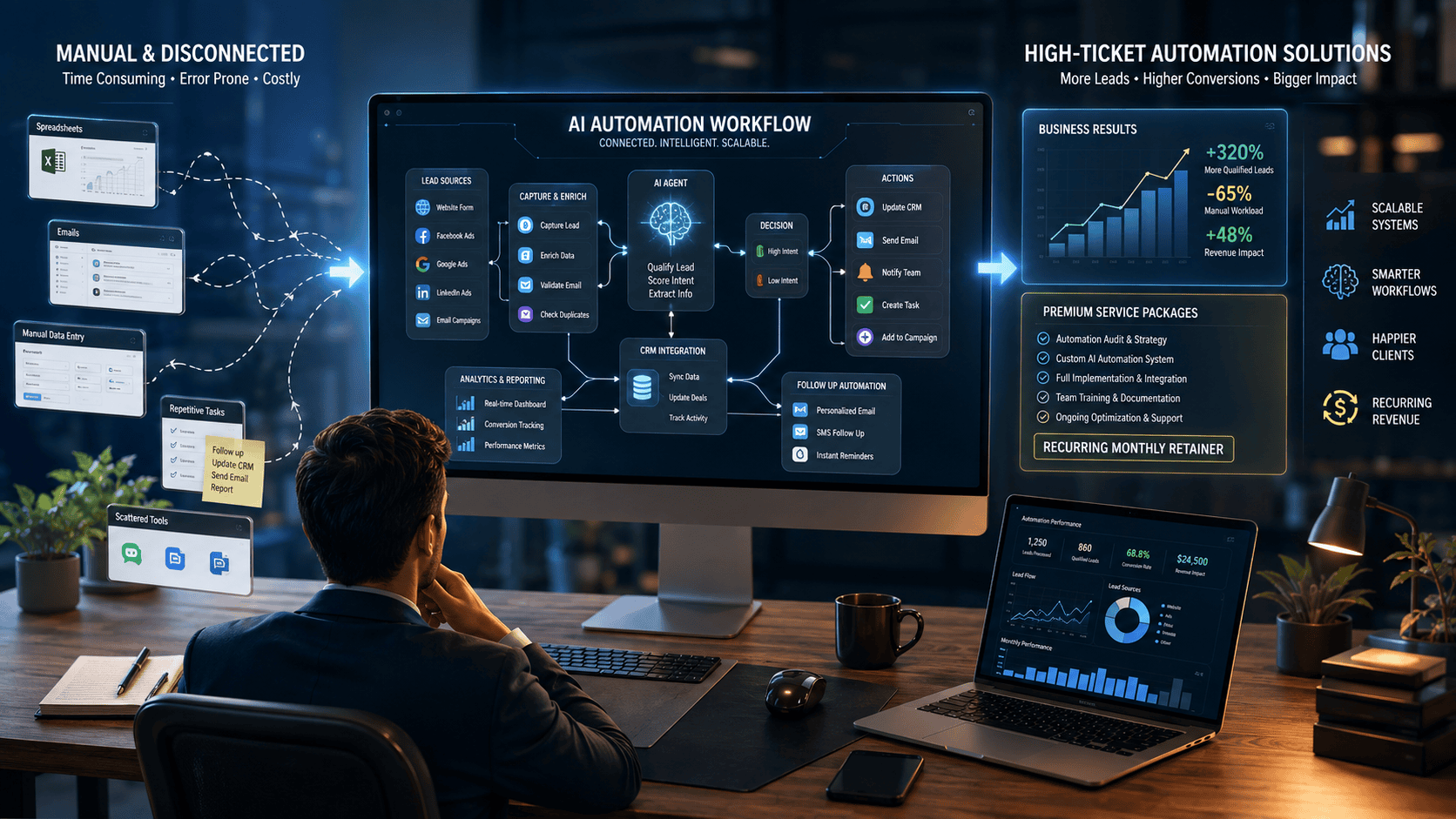
Freelancers can turn AI automation skills into high-ticket offers by selling business outcomes instead of individual tools or hours.
Rather than saying, “I build n8n workflows,” a freelancer can offer:
“I help service businesses automate lead qualification, follow-ups, appointment booking, and CRM updates.”
This approach makes the service easier for clients to understand and allows pricing to be based on business value, complexity, and measurable outcomes rather than hourly work.
A strong high-ticket AI automation offer typically combines:
- Workflow discovery and business analysis
- Automation strategy
- AI and software integration
- Implementation
- Testing and quality assurance
- Documentation
- Team training
- Ongoing monitoring and optimization
The biggest opportunity is not simply building AI workflows. It is identifying expensive, repetitive business problems and packaging a complete solution around them.
Key Takeaways
- High-ticket AI automation offers should sell outcomes, not software tools.
- The best automation opportunities usually involve repetitive, high-volume, or revenue-related processes.
- Specializing in a niche can make freelancers more credible and easier to position.
- A productized service is easier to sell than completely custom consulting.
- Discovery and workflow audits are essential before quoting a large automation project.
- Setup fees can be combined with recurring maintenance retainers.
- Clear ROI metrics help justify premium pricing.
- AI automation freelancers should include human review, security, and error-handling systems.
- Case studies and proof of measurable results are more persuasive than tool certifications.
- Successful freelancers increasingly position themselves as automation partners, not just workflow builders.
Recent marketplace data supports the opportunity around AI specialization. Upwork reported that demand for top AI-enabled skills more than doubled year over year, with AI integration growing 178% and AI chatbot development growing 71% in its 2026 skills report.
At a Glance
| Element | High-Ticket AI Automation Offer |
|---|---|
| What you sell | A business outcome |
| Typical deliverable | Complete automated workflow |
| Pricing basis | Value and complexity |
| Client focus | Businesses with repetitive processes |
| Best positioning | Specialist or niche expert |
| Revenue model | Setup fee + recurring retainer |
| Key proof | ROI, time savings, revenue impact |
| Main advantage | Higher project value than hourly freelancing |
How Can Freelancers Package AI Automation Services as High-Ticket Offers?
Freelancers can package AI automation services as high-ticket offers by solving specific business problems rather than selling individual AI tools or hourly services. A strong offer combines workflow analysis, automation strategy, implementation, AI integration, testing, documentation, and ongoing optimization. Freelancers can increase pricing by specializing in a niche, targeting high-value processes, demonstrating measurable ROI, and offering complete solutions with setup fees and monthly retainers.
How Freelancers Package AI Automation Services: The Simple Business Model
AI automation services involve using artificial intelligence and automation platforms to reduce manual work inside a business.
For example, a freelancer might build a system that:
- Captures a new lead.
- Enriches the lead with relevant information.
- Uses AI to classify the inquiry.
- Assigns a lead score.
- Updates the CRM.
- Sends a personalized follow-up.
- Notifies the sales team.
- Tracks the outcome.
Instead of selling each of those tasks separately, the freelancer packages the entire system as one business automation solution.
That is the foundation of a high-ticket offer.
Introduction
AI has created a major opportunity for freelancers, but there is also a growing problem: many freelancers are selling themselves too cheaply.
They advertise services such as:
- “I will build an n8n workflow.”
- “I will create a chatbot.”
- “I will connect ChatGPT to your business.”
- “I will automate your Zapier workflow.”
The problem is that clients often do not care about the technology itself.
They care about questions like:
- Can you help us get more leads?
- Can you reduce manual work?
- Can you respond to customers faster?
- Can you reduce operational costs?
- Can you improve follow-up rates?
- Can you eliminate repetitive tasks?
This is why the most successful AI automation freelancers are shifting from tool-based selling to outcome-based selling.
Instead of being an “n8n freelancer,” you become a:
Lead Automation Specialist for Real Estate Agencies
or:
AI Operations Automation Partner for E-commerce Businesses
or:
AI Client Onboarding Automation Specialist for Marketing Agencies
The technology becomes the delivery mechanism. The business result becomes the product.
McKinsey estimated that generative AI could create $2.6 trillion to $4.4 trillion in annual value across the use cases it analyzed, with a significant share concentrated in customer operations, marketing and sales, software engineering, and R&D.
For freelancers, this creates a clear opportunity: businesses need people who can convert AI capabilities into practical workflows.
What Is a High-Ticket AI Automation Offer?
A high-ticket AI automation offer is a premium service package designed to solve a significant business problem using AI and automation technologies.
Unlike a basic freelance gig, the offer usually includes multiple components.
Example:
A freelancer could sell:
Basic Gig
“I will build an AI chatbot for $200.”
High-Ticket Offer
AI Lead Conversion System for Service Businesses
The package could include:
- Lead capture automation
- AI lead qualification
- CRM integration
- Automated follow-ups
- Appointment scheduling
- Sales notifications
- Lead tracking dashboard
- Team training
- Documentation
- 30 days of optimization
The second offer is more valuable because it solves a larger business problem.
Benefits of Packaging AI Automation as a High-Ticket Service
1. Higher Revenue Per Client
Instead of managing dozens of small projects, freelancers can focus on fewer, higher-value clients.
This can reduce:
- Sales workload
- Client communication overhead
- Project switching
- Administrative complexity
2. Easier Value-Based Pricing
Clients are less likely to compare your price with another freelancer’s hourly rate when you sell a complete business solution.
For example:
A workflow that saves a company 80 hours per month has a clearer business value than:
“20 hours of n8n development.”
3. Recurring Revenue Opportunities
Automation systems require:
- Monitoring
- Maintenance
- API updates
- Prompt optimization
- Error handling
- New integrations
- Performance improvements
This creates opportunities for monthly retainers.
4. Stronger Client Relationships
When your automation becomes part of a client’s operations, you move closer to being a strategic technology partner.
That can lead to:
- Larger projects
- Referrals
- Long-term retainers
- Additional automation opportunities
5. Less Competition Through Specialization
A generic “AI automation freelancer” competes with thousands of people.
A freelancer specializing in:
AI Automation for Dental Clinics
or:
AI Lead Management for Real Estate Agencies
has a more specific market position.
Upwork’s marketplace research found that AI-related work has commanded substantial rate premiums compared with non-AI work, while specialized AI categories have continued to grow.
How High-Ticket AI Automation Services Work
A successful service usually follows this structure:
Step 1: Identify the Business Problem
Example:
Sales representatives spend several hours every day manually responding to leads.
Step 2: Map the Existing Workflow
Document:
Trigger → Process → Decision → Action → Result
For example:
New Lead → Collect Data → AI Qualification → CRM Update → Follow-Up → Sales Notification
Step 3: Identify Automation Opportunities
Look for tasks that are:
- Repetitive
- Rules-based
- High-volume
- Time-consuming
- Prone to human error
Step 4: Build the Automation System
Possible technology stack:
- AI model
- Automation platform
- CRM
- Email system
- Database
- Communication platform
Step 5: Test the Workflow
Test:
- Normal scenarios
- Incorrect data
- Missing information
- API failures
- AI errors
- Duplicate submissions
Step 6: Measure Results
Track:
- Hours saved
- Response time
- Leads processed
- Conversion rates
- Cost reduction
- Revenue impact
Step 7: Optimize Continuously
The automation should evolve as the business changes.
Step-by-Step Guide: How to Create a High-Ticket AI Automation Offer
Step 1: Choose a Profitable Business Problem
Do not start with:
“Which AI tool should I sell?”
Start with:
“Which expensive business problem can I solve?”
Good problems usually involve:
Revenue Problems
- Poor lead response times
- Missed leads
- Weak follow-up
- Low conversion rates
Operational Problems
- Manual data entry
- Repetitive reporting
- Document processing
- Customer support overload
Marketing Problems
- Slow content production
- Lead nurturing
- Campaign reporting
- Customer segmentation
Step 2: Choose a Target Market
You can target businesses by:
- Industry
- Company size
- Business model
- Specific workflow
Examples
| Target Market | Automation Opportunity |
|---|---|
| Marketing agencies | Client reporting automation |
| Real estate agencies | Lead qualification |
| E-commerce stores | Customer support automation |
| Recruitment agencies | Candidate screening workflows |
| Coaches | Lead nurturing and appointment booking |
| SaaS companies | Customer onboarding automation |
| Accounting firms | Document processing workflows |
Expert Tip
Start with one niche and one major problem.
For example:
I help marketing agencies automate client reporting with AI and workflow automation.
This is much easier to sell than:
I provide AI automation services for everyone.
Step 3: Create an Outcome-Based Offer
Use this formula:
Target Client + Business Problem + Desired Outcome + Delivery System
Example
We help real estate agencies respond to and qualify new leads automatically using AI-powered CRM workflows.
Another example:
We help marketing agencies reduce manual reporting by building automated AI-powered reporting systems.
Step 4: Package the Service
A high-ticket offer should feel like a complete solution.
Example Package Structure
Phase 1: Automation Audit
- Business process analysis
- Workflow mapping
- Opportunity identification
Phase 2: Strategy
- Automation architecture
- Technology selection
- Implementation plan
Phase 3: Implementation
- Workflow development
- AI integration
- Software connections
Phase 4: Testing
- Quality assurance
- Error testing
- Performance testing
Phase 5: Deployment
- System launch
- Documentation
- Team training
Phase 6: Optimization
- Monitoring
- Maintenance
- Workflow improvements
Step 5: Create Pricing Tiers
Avoid offering unlimited customization for one fixed price.
Instead, create structured packages.
| Package | Best For | Typical Scope |
|---|---|---|
| Starter Automation | Small businesses | One workflow |
| Growth Automation System | Growing businesses | Multiple connected workflows |
| Premium AI Operations System | Established businesses | Complete automation ecosystem |
| Custom Enterprise Solution | Complex operations | Custom architecture |
Illustrative Pricing Framework
| Package | Example Pricing Approach |
|---|---|
| Automation Audit | Paid fixed fee |
| Starter Implementation | Lower four-figure project |
| Growth System | Mid four-figure project |
| Advanced System | Higher four-figure or custom pricing |
| Monthly Optimization | Recurring retainer |
Important: Pricing should depend on the complexity, business value, risk, integrations, support requirements, and expected outcomes. Avoid promising specific financial results unless they can be independently measured and reasonably supported.
Step 6: Build a Clear ROI Story
Clients need to understand why the investment makes sense.
Example
Suppose a business has:
- 3 employees
- 10 hours per week each spent on repetitive reporting
- 30 total manual hours per week
If automation significantly reduces that workload, the business may recover substantial staff capacity.
Your conversation should focus on:
What does the current process cost the business?
Then:
What would improvement be worth?
Example ROI Calculation
| Metric | Before Automation | After Automation |
|---|---|---|
| Manual hours per month | 120 | 30 |
| Hours saved | — | 90 |
| Response time | 4 hours | 15 minutes |
| Manual errors | Higher | Potentially reduced |
| Team capacity | Limited | Increased |
The exact financial value depends on employee costs, process quality, and whether saved time is actually redeployed productively.
This distinction matters for credible E-E-A-T content: time saved is not automatically equal to revenue gained.
Examples of High-Ticket AI Automation Offers
Example 1: AI Lead Management System
Target Client
Marketing agencies
Problem
Leads arrive from multiple channels and follow-up is inconsistent.
Solution
An automation system that:
- Captures leads
- Enriches data
- Classifies leads
- Updates CRM records
- Sends personalized follow-ups
- Alerts sales teams
Possible Offer Name
AI Lead Conversion Automation System
Example 2: AI Client Onboarding System
Target Client
Consultants and agencies
Problem
Client onboarding requires repetitive emails, forms, documents, and manual setup.
Solution
Automate:
- Welcome emails
- Form collection
- Document generation
- Project setup
- Team notifications
Example 3: AI Customer Support Automation
Target Client
E-commerce businesses
Solution
Build a workflow that:
- Categorizes customer inquiries
- Searches approved knowledge sources
- Drafts responses
- Escalates complex issues
- Updates customer records
Important
For customer-facing AI systems, include human escalation and quality controls rather than assuming AI should handle every request autonomously.
Pros of High-Ticket AI Automation Services
1. Higher Project Value
You can earn more from a smaller number of clients.
2. Recurring Revenue
Maintenance and optimization create retainer opportunities.
3. Strong Differentiation
Specialization can make your positioning clearer.
4. More Strategic Work
You focus on solving business problems.
5. Scalable Delivery
Reusable frameworks can reduce future implementation time.
Cons of High-Ticket AI Automation Services
1. Longer Sales Cycles
Larger projects may require more trust-building.
2. Higher Client Expectations
Premium clients expect professional delivery.
3. Technical Complexity
Multiple integrations can create failure points.
4. Security Responsibilities
Client data must be handled carefully.
5. Scope Creep
Poorly defined projects can become unprofitable.
High-Ticket AI Automation vs Traditional Freelancing
| Factor | Traditional Freelancing | High-Ticket AI Automation |
|---|---|---|
| Pricing model | Hourly or task-based | Value and project-based |
| Client relationship | Transactional | Strategic |
| Deliverable | Individual task | Complete system |
| Revenue potential | Limited by hours | Higher per project |
| Differentiation | Often low | Higher with specialization |
| Retainer potential | Moderate | Strong |
| Sales message | “I provide a service” | “I solve a business problem” |
Tool Comparison Table
The best platform depends on workflow complexity, technical requirements, client infrastructure, and budget.
| Tool Type | Best For | Strength | Limitation |
|---|---|---|---|
| ChatGPT/API-based AI | AI reasoning and content tasks | Flexible AI capabilities | Requires careful workflow design |
| n8n | Advanced workflow automation | High flexibility and customization | More technical |
| Make | Visual automation workflows | User-friendly visual building | Complex workflows can become difficult to manage |
| Zapier | Simple business integrations | Large integration ecosystem | Can become costly at scale |
| CRM automation tools | Sales workflows | Native customer data management | Less flexible outside the CRM |
| Custom code | Highly specialized systems | Maximum flexibility | Higher development and maintenance requirements |
Recommended Approach
Do not choose tools because they are popular.
Choose tools based on:
- Client requirements
- Security needs
- Budget
- Workflow complexity
- Scalability
- Existing software stack
Best Use Cases for High-Ticket AI Automation
High-ticket automation is especially suitable when the workflow has:
High Volume
Many tasks happen every day.
High Cost
Manual processing consumes expensive employee time.
Revenue Impact
The workflow affects:
- Leads
- Sales
- Customer retention
Multiple Systems
Employees repeatedly move information between platforms.
Measurable Results
You can track improvement.
Practical Testing Framework
A Practical Testing Framework Before Selling an AI Automation
Freelancers should avoid selling automation concepts that have not been properly tested.
Before deploying a client workflow, test the automation using realistic scenarios.
Test Category 1: Normal Inputs
Does the workflow work correctly under expected conditions?
Test Category 2: Bad Inputs
What happens when:
- Information is missing?
- Data is incorrectly formatted?
- Duplicate records are submitted?
Test Category 3: AI Quality
Check whether the AI:
- Follows instructions
- Produces consistent outputs
- Uses approved data
- Escalates uncertain cases
Test Category 4: Integration Failures
Simulate:
- API failures
- Connection errors
- Rate limits
- Software downtime
Test Category 5: Human Handoff
Verify that important cases can be transferred to a human.
E-E-A-T Recommendation: Do not claim “100% automated” or “error-free” results unless you can demonstrate and maintain that standard under real operating conditions.
Is a Workflow Suitable for AI Automation?
START
  ↓
Is the task repetitive?
  ↓
NO → Keep manual or redesign the process
YES
  ↓
Does it happen frequently?
  ↓
NO → Calculate whether automation is worth the cost
YES
  ↓
Does the workflow have clear inputs and outputs?
  ↓
NO → Standardize the process first
YES
  ↓
Can AI or automation improve speed, quality, or capacity?
  ↓
NO → Use conventional process improvements
YES
  ↓
Can results be measured?
  ↓
NO → Define KPIs before implementation
YES
  ↓
BUILD A PILOT AUTOMATION
  ↓
TEST → MEASURE → IMPROVE → DEPLOY
Common Mistakes Freelancers Make
1. Selling Tools Instead of Outcomes
Bad:
“I build AI agents.”
Better:
“I build AI systems that automatically qualify inbound leads.”
2. Targeting Everyone
A generic offer makes marketing difficult.
Choose:
- A niche
- A problem
- A clear outcome
3. Underpricing Complex Projects
Multiple integrations, AI systems, databases, and APIs require proper scoping.
Always estimate:
- Development
- Testing
- Documentation
- Support
- Revisions
4. Skipping Discovery
Never assume you understand the client’s process immediately.
Map the workflow first.
5. Automating a Broken Process
Automation does not automatically fix poor operations.
Sometimes the process must be simplified before automation.
6. Ignoring Security
Ask:
- What data is being processed?
- Where is it stored?
- Who has access?
- Does the client have compliance requirements?
7. Promising Unrealistic Results
Avoid guarantees such as:
- “This will double your revenue.”
- “This AI will replace your team.”
- “You will save 90% of your costs.”
Instead, define measurable targets and test them.
Expert Tips for Selling High-Ticket AI Automation
Tip 1: Start With a Paid Automation Audit
Instead of offering free consulting, sell an audit.
The audit can include:
- Workflow mapping
- Bottleneck identification
- Automation opportunities
- Technology recommendations
- Implementation roadmap
This can also act as the first phase of a larger project.
Tip 2: Productize Your Delivery
Create reusable frameworks.
For example:
Your Standard Delivery Framework
- Discovery
- Workflow mapping
- Architecture
- Development
- Testing
- Deployment
- Training
- Optimization
This improves consistency and scalability.
Tip 3: Build Case Studies
Track:
- Time saved
- Tasks automated
- Response speed
- Error reduction
- Capacity improvements
Use verified client results whenever possible.
Tip 4: Sell the Problem Before the Technology
Clients usually understand:
“We lose leads because our response time is slow.”
They may not understand:
“We use webhooks and LLM orchestration.”
Lead with the business problem.
Tip 5: Create a Strong Guarantee Structure Carefully
Instead of guaranteeing business results, guarantee elements you control.
For example:
- Clear project scope
- Documentation
- Testing process
- Post-launch support period
AI Automation Statistics Freelancers Should Know
- Upwork reported that demand for the top AI-enabled skills grew 109% year over year in its 2026 in-demand skills report.
- The same report highlighted growth in AI integration of 178% and AI chatbot development of 71%.
- Upwork’s 2025 marketplace research reported AI-related work growing faster than many traditional categories, with AI-related freelancers receiving an average rate premium compared with non-AI work.
- McKinsey estimated that generative AI could add $2.6 trillion to $4.4 trillion annually across the use cases it studied.
- McKinsey also estimated that around 75% of generative AI’s potential value in its analysis could come from customer operations, marketing and sales, software engineering, and R&D.
Important context: These statistics describe market trends and economic potential, not guaranteed income for individual freelancers.
Who Is This Guide For?
This guide is useful for:
- Freelancers learning AI automation
- Automation consultants
- n8n freelancers
- Make.com specialists
- AI consultants
- Agency owners
- Developers moving into consulting
- Freelancers looking to increase project value
It is especially relevant if you currently sell:
- Small automation gigs
- Hourly technical work
- Individual chatbot projects
- Basic AI integrations
and want to move toward larger solution-based projects.
What We Learned
The biggest lesson is simple:
High-ticket AI automation is not about charging more for the same technical work. It is about solving a more valuable business problem.
The strongest offers combine:
Business Problem + Specialized Expertise + Complete Solution + Measurable Outcome
Freelancers who focus only on tools may compete primarily on price.
Freelancers who understand:
- Business workflows
- Operations
- ROI
- Automation architecture
- AI capabilities
can position themselves as strategic partners.
Frequently Asked Questions
Can freelancers really charge high-ticket prices for AI automation?
Yes, but pricing depends on the value, complexity, risk, scope, and business impact of the project. High pricing is easier to justify when the freelancer solves a significant operational or revenue-related problem rather than simply delivering a technical task.
What is the best AI automation niche for freelancers?
There is no universal best niche. Good niches have repetitive processes, clear business problems, sufficient budgets, and measurable outcomes. Examples include agencies, real estate, e-commerce, recruitment, SaaS, and professional services.
Should I learn n8n or Make.com first?
The best choice depends on the type of work you want to perform. Make.com is often approachable for visual workflow creation, while n8n offers strong flexibility for more technical and customizable workflows.
How do I find AI automation clients?
You can use:
- LinkedIn outreach
- Freelance marketplaces
- Industry networking
- Educational content
- Partnerships
- Referral programs
- Niche-specific communities
Your outreach should focus on a specific business problem rather than simply offering “AI automation services.”
Should I charge hourly or per project?
For clearly defined automation projects, fixed or value-informed project pricing can be easier for clients to understand. Hourly pricing may still be appropriate for consulting, troubleshooting, or undefined scopes.
Do I need to know programming?
Not always. No-code and low-code platforms allow many workflows to be built without extensive programming. However, technical skills can increase the complexity and customization you can handle.
Can AI automation services generate recurring revenue?
Yes. Freelancers can offer:
- Monitoring
- Maintenance
- Optimization
- Prompt updates
- Integration management
- Automation expansion
as ongoing services.
Conclusion
AI automation is creating a major opportunity for freelancers, but the most valuable opportunities are not necessarily found by selling access to the latest tool.
The winning approach is to understand how a business operates and identify where AI and automation can create measurable improvements.
Instead of selling:
“I build workflows.”
Sell:
“I help businesses eliminate a specific operational bottleneck.”
Instead of competing as a general freelancer, become known for solving a specific type of problem.
That shift can help transform AI automation from a collection of technical skills into a premium professional service.
Our Verdict
⭐⭐⭐⭐⭐ High-Potential Freelance Opportunity
AI automation services are one of the strongest opportunities for freelancers who combine technical ability with business problem-solving skills.
However, the opportunity is becoming more competitive.
Simply knowing how to connect tools will become less valuable over time.
The freelancers most likely to build premium businesses will focus on:
- Industry specialization
- Workflow expertise
- Reliable implementation
- Security and quality control
- Measurable outcomes
- Long-term client relationships
Final verdict: Focus on becoming an AI automation problem-solver, not just an AI tool operator.
Ready to Turn Your AI Skills Into a High-Value Service?
Start by choosing one industry and one expensive business problem.
Then:
- Research the existing workflow.
- Identify automation opportunities.
- Build a simple proof of concept.
- Create a repeatable service package.
- Document measurable outcomes.
- Turn successful projects into case studies.
The goal is not to sell more AI tools.
The goal is to build automation systems that businesses are willing to invest in because they solve meaningful problems.
Also Read
- Make vs n8n for AI Automation
- How to Reduce LLM API Costs for Web Apps and Chatbots
- How to Extract Structured Data from PDFs Using Local LLMs
- Best AI Productivity Tools for Daily Tasks
- How to Build an AI Assistant Without Code
- How to Set Up Open WebUI for a Private Local AI Chat Experience
- Local AI vs Cloud AI: Cost, Speed, and Privacy Comparison
- How to Create a Private Document QA Bot Using AnythingLLM
- How Students and Researchers Can Use AI for Literature Reviews Ethically
- Best Free AI Note-Taking Apps for Meetings and Lectures
- How to Use AI for E-commerce Product Description Generation at Scale
- How to Use AI in Excel and Google Sheets to Automate Formulas
- How to Build an Interactive AI Resume That Stands Out to Recruiter AI







Leave a Reply