

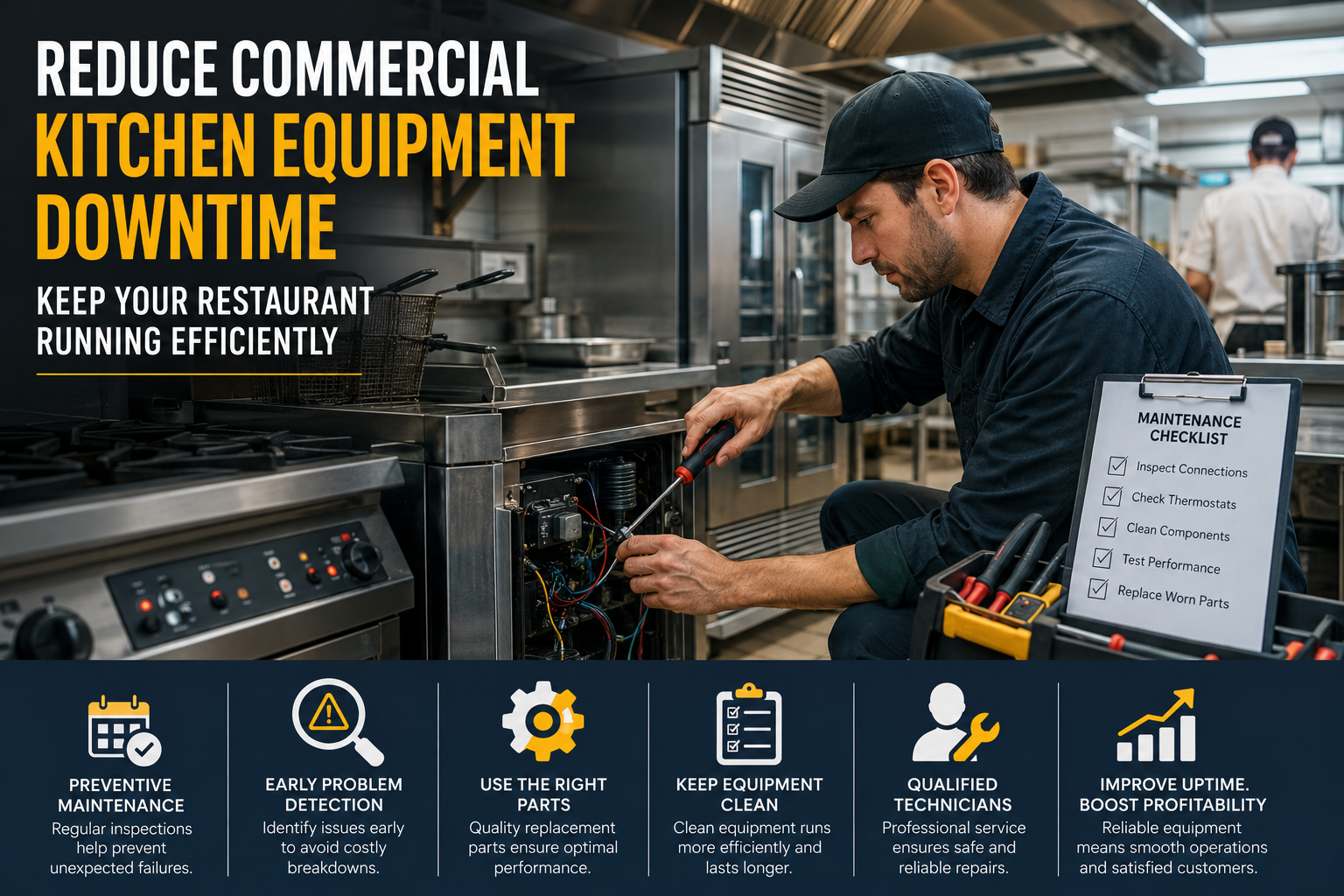
Commercial kitchens depend on reliable equipment. From ovens and fryers to refrigeration systems and ice machines, every piece of equipment plays an important role in daily restaurant operations.
When one machine stops working unexpectedly, the consequences can go far beyond a simple repair bill. Equipment downtime can interrupt food preparation, delay customer orders, increase labor costs, and potentially lead to wasted inventory.
For restaurant owners and foodservice operators, reducing equipment downtime should therefore be an important part of operational planning.
This guide explains how businesses can keep commercial kitchen equipment running efficiently, identify problems earlier, and make smarter decisions when replacement parts are needed.
Why Commercial Kitchen Equipment Downtime Is So Expensive
A busy restaurant kitchen operates under constant pressure. Equipment is often used for many hours every day, sometimes with very little downtime between services.
When essential equipment fails, businesses may face several challenges, including:
- Delayed food preparation
- Lost sales opportunities
- Emergency repair costs
- Wasted food inventory
- Increased employee workload
- Customer dissatisfaction
- Temporary changes to the menu
For example, a malfunctioning refrigerator can put perishable inventory at risk. A fryer problem can slow down service, while an oven failure may prevent an entire section of the menu from being prepared.
The best approach is not simply reacting when equipment breaks down. Restaurants should focus on preventing avoidable problems before they become major operational disruptions.
1. Create a Preventive Maintenance Schedule
Preventive maintenance is one of the most effective ways to reduce unexpected equipment failures.
Instead of waiting until a machine stops working, restaurant operators should schedule regular inspections and maintenance.
A basic maintenance plan may include checking:
- Electrical connections
- Heating elements
- Thermostats
- Motors
- Fans
- Gaskets and seals
- Valves
- Filters
- Burners
- Refrigeration components
The exact maintenance requirements will depend on the type of equipment and how frequently it is used.
High-use equipment should generally receive more frequent attention than machines that operate only occasionally.
Creating a maintenance checklist also helps employees and technicians identify developing problems before they result in complete equipment failure.
2. Train Employees to Recognize Early Warning Signs
Kitchen employees are often the first people to notice that equipment is not operating normally.
Small changes can indicate that a larger problem is developing.
Common warning signs include:
- Unusual noises
- Inconsistent temperatures
- Longer heating times
- Water leaks
- Electrical issues
- Excessive vibration
- Strange smells
- Error codes
- Reduced performance
Employees should be encouraged to report these problems immediately.
Ignoring small issues can sometimes turn a relatively simple replacement into a more expensive repair.
For example, replacing a worn component early may help prevent additional damage to other parts of the equipment.
3. Keep Equipment Clean
Regular cleaning is essential for both food safety and equipment performance.
Grease, dust, food debris, and mineral buildup can affect how efficiently commercial kitchen equipment operates.
Depending on the equipment, cleaning routines may involve:
Fryers
Regularly removing food debris and maintaining clean oil can help support efficient operation.
Refrigeration Equipment
Cleaning condenser areas and ensuring proper airflow can help refrigeration systems operate more efficiently.
Ovens and Grills
Removing grease and food buildup can help maintain consistent heating performance.
Ice Machines
Regular cleaning and sanitation can help maintain proper operation and hygiene.
Always follow the manufacturer’s maintenance and cleaning recommendations for specific equipment.
4. Use the Correct Replacement Parts
One of the biggest challenges in commercial kitchen maintenance is identifying the correct replacement part.
Many pieces of equipment contain components that look similar but have different specifications. Installing an incorrect part can create compatibility problems or affect equipment performance.
Before ordering a replacement component, verify:
- Equipment manufacturer
- Model number
- Part number
- Electrical specifications
- Dimensions
- Compatibility information
Using accurate equipment information can make the replacement process faster and reduce the risk of ordering the wrong component.
For businesses looking for commercial kitchen and foodservice equipment components, PartsFPS provides parts across numerous categories and manufacturers, with search options designed around manufacturers and part numbers.
5. Keep Critical Spare Parts Available
Restaurants that rely heavily on specific equipment may benefit from keeping selected replacement parts available.
The right spare parts will depend on the equipment used in the kitchen, but businesses may consider maintaining commonly replaced components such as:
- Gaskets
- Thermostats
- Switches
- Heating components
- Fuses
- Filters
- Small electrical components
This can be particularly useful when a small component failure could take essential equipment out of service.
However, businesses should avoid purchasing unnecessary inventory. The best approach is to identify the parts that are most important for the specific equipment used in the operation.
6. Work With Qualified Equipment Technicians
Some maintenance tasks can be performed by trained staff, but complex repairs should be handled by qualified technicians.
Commercial kitchen equipment may involve:
- High-voltage electrical systems
- Gas connections
- Refrigeration systems
- High-temperature components
- Specialized control systems
Attempting complex repairs without appropriate knowledge can create safety risks and potentially cause additional damage.
A qualified technician can diagnose the underlying cause of a problem and determine whether a component replacement or more extensive repair is required.
7. Maintain Accurate Equipment Records
Keeping detailed records can make maintenance significantly easier.
Restaurants should consider maintaining information for each major piece of equipment, including:
- Manufacturer
- Model number
- Serial number
- Installation date
- Maintenance history
- Previous repairs
- Replacement parts used
These records can help technicians diagnose recurring problems and make it easier to identify compatible replacement parts.
Digital maintenance records can be particularly useful for restaurants operating multiple locations.
8. Don’t Ignore Small Performance Problems
One of the most expensive mistakes a restaurant can make is continuing to operate equipment that is clearly showing signs of failure.
A small problem may eventually affect multiple components.
For example:
- A failing fan may contribute to overheating.
- A damaged gasket may reduce temperature efficiency.
- A malfunctioning thermostat may cause inconsistent cooking.
- A worn electrical component may eventually cause a complete shutdown.
Addressing problems early can often reduce repair complexity and minimize operational disruption.
Choosing a Reliable Source for Replacement Parts
When commercial kitchen equipment requires replacement components, speed and accuracy are important.
Restaurant operators and technicians should look for suppliers that provide:
- Clear product information
- Manufacturer and part-number search options
- A broad range of equipment categories
- Compatibility details
- Reliable customer support
- Efficient ordering options
PartsFPS specializes in foodservice and commercial kitchen equipment parts, offering components across categories such as refrigeration, motors, thermostats, fryer parts, burners, gaskets, electrical components, and other foodservice equipment supplies. The company also provides manufacturer and part-number search functionality to help customers identify relevant components.
The Bottom Line
Commercial kitchen equipment downtime can disrupt restaurant operations and create unnecessary costs.
The most effective strategy is a proactive one.
By creating a preventive maintenance schedule, training employees to recognize warning signs, keeping equipment clean, maintaining accurate records, and sourcing the correct replacement parts when needed, restaurant operators can reduce the risk of unexpected failures.
Every commercial kitchen depends on reliable equipment. Taking care of that equipment before problems become emergencies can help restaurants maintain smoother operations, protect productivity, and continue serving customers efficiently.
When replacement components are required, choosing the correct part and working with a reliable foodservice parts supplier can help get essential equipment back into operation as quickly as possible.
Also Read
- Open-Source AI Model Weekly Roundup & Performance Benchmarks
- Make vs n8n for AI Automation
- How to Reduce LLM API Costs for Web Apps and Chatbots
- How to Extract Structured Data from PDFs Using Local LLMs
- Best AI Productivity Tools for Daily Tasks
- How to Build an AI Assistant Without Code
- Best Free Open-Source AI Automation Tools
- How to Run LLMs Locally on Windows and Mac Using Ollama
- Best AI Voice Generator Tools for Video Editing (Free vs Paid)
- Weekly Content Creation Workflow Deep Dive & AI Templates
- Top 5 Open-Source AI Models Outperforming GPT-4 and Rivaling GPT-5 on Select Tasks
- How to Use AI for E-commerce Product Description Generation at Scale









Leave a Reply