

Quick Summary
Artificial intelligence (AI) is changing how restaurants, hotels, commercial kitchens, and foodservice equipment suppliers manage spare parts and supplies. By analyzing equipment data, purchase histories, inventory levels, and maintenance records, AI can help businesses anticipate equipment failures, identify replacement components, optimize stock levels, and make better purchasing decisions.
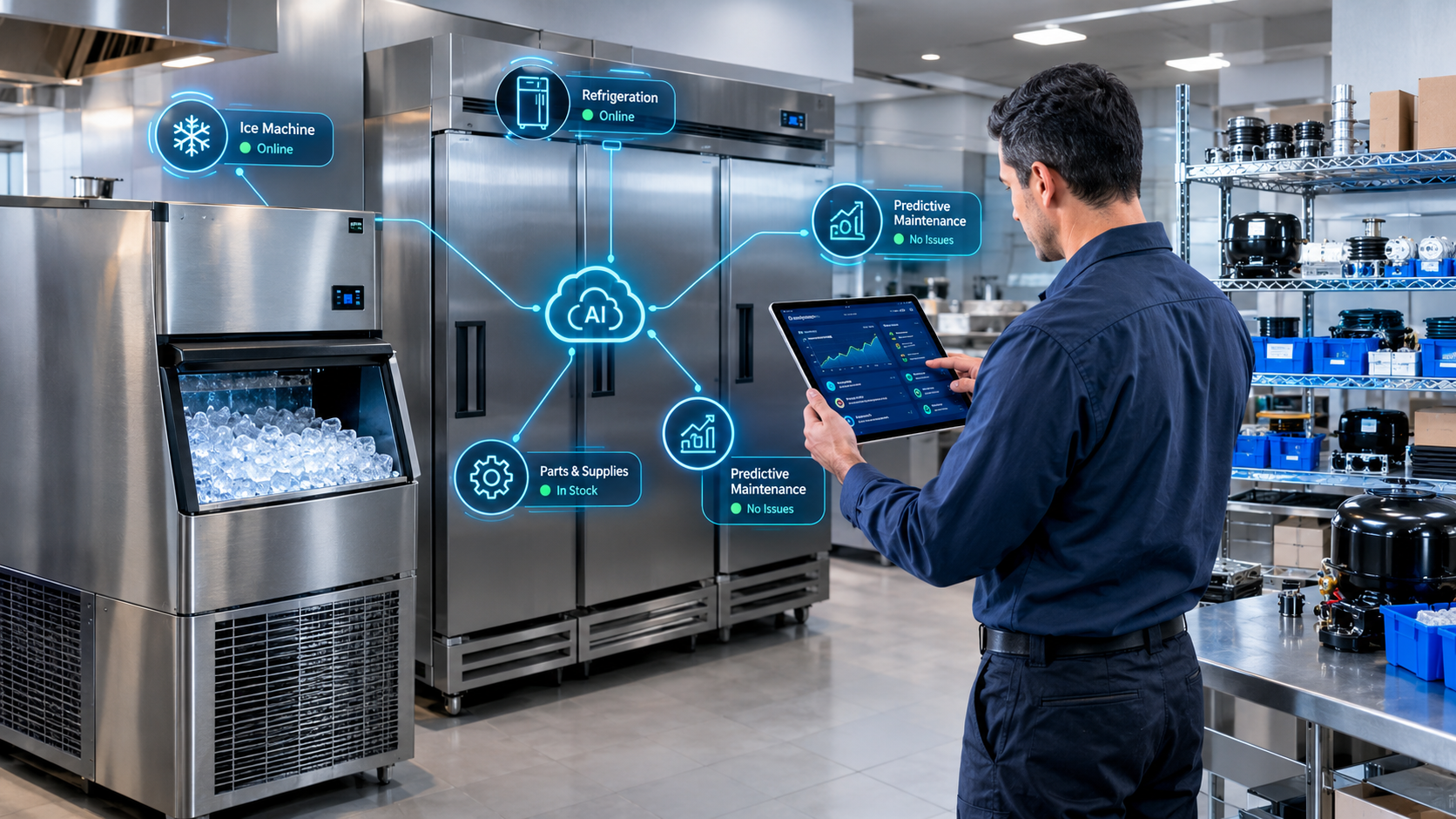
For example, a restaurant that depends on an ice machine can use AI-assisted maintenance systems to identify unusual operating patterns before a breakdown occurs. When a replacement is necessary, intelligent search tools can help maintenance teams locate the correct food service parts, including compatible Manitowoc ice machine parts, using equipment model numbers, part numbers, and verified manufacturer documentation.
AI does not replace qualified technicians or guarantee that equipment will never fail. Its greatest value comes from combining reliable data, human expertise, and effective maintenance processes.
Key Takeaways
- Predictive maintenance: AI can identify patterns that may indicate an impending equipment failure.
- Smarter inventory: Demand forecasting helps suppliers and restaurant operators plan stock levels.
- Faster parts sourcing: AI-powered search can help users find relevant kitchen equipment parts using model numbers, descriptions, or images.
- Reduced operational disruption: Better maintenance planning can help businesses avoid some unexpected equipment outages.
- Improved purchasing decisions: AI can compare historical demand, supplier lead times, and purchasing requirements.
- Human verification remains essential: Compatibility, specifications, safety requirements, and manufacturer instructions must be checked before ordering or installing parts.
How is AI transforming foodservice parts and supplies?
AI is transforming foodservice parts and supplies by helping businesses predict equipment maintenance needs, forecast spare-parts demand, identify replacement components, automate purchasing workflows, and improve inventory management. These applications can reduce avoidable downtime, support faster repairs, and help restaurants and suppliers make more informed operational decisions.
How AI Is Changing Foodservice Parts and Supplies
AI is making commercial kitchen maintenance and parts procurement more data-driven. Predictive analytics can identify unusual equipment behavior, demand forecasting can improve spare-parts availability, and intelligent search can help technicians locate relevant replacement components. For products such as Manitowoc ice machine parts, AI can assist with model-based searches, but compatibility should always be verified against the exact equipment model and manufacturer documentation.
Introduction
Commercial kitchens depend on equipment that must operate reliably throughout busy service periods. Ice machines, refrigerators, freezers, ovens, fryers, dishwashers, and food preparation equipment all require regular maintenance and occasional replacement parts.
When a critical component fails, the consequences can extend beyond repair costs. A restaurant may experience slower service, food storage challenges, disrupted operations, and dissatisfied customers. A hotel or institutional kitchen may face even greater logistical difficulties because it must continue serving large numbers of people.
Traditionally, foodservice parts management has relied on scheduled maintenance, manual inventory checks, technician experience, and reactive purchasing. These methods remain important, but they can struggle to keep pace with complex equipment fleets and changing demand.
Artificial intelligence introduces another layer of support. It can analyze historical records, recognize patterns, summarize technical documents, assist with parts identification, and recommend actions for human review.
For businesses purchasing food service parts, this creates an opportunity to move from a reactive approach toward more proactive equipment management. Whether a supplier is managing thousands of stock-keeping units or a restaurant is sourcing specific Manitowoc parts, AI can help organize information and support better decisions.
The key is to use AI where it solves a real operational problem rather than adopting it simply because the technology is available.
What Is AI in Foodservice Parts and Supplies?
AI in foodservice parts and supplies refers to the use of artificial intelligence, machine learning, computer vision, and related data technologies to improve the identification, sourcing, forecasting, purchasing, storage, and maintenance of components used in commercial foodservice equipment.
These systems work with information such as:
- Equipment model and serial numbers.
- Manufacturer part numbers and product descriptions.
- Inventory quantities and sales history.
- Supplier lead times and order records.
- Maintenance logs and technician reports.
- Equipment sensor readings, where available.
- Product images and technical documentation.
AI can use this information to generate predictions, classify products, identify unusual patterns, and help employees retrieve relevant information more efficiently.
For example, an AI-assisted parts search tool might help a technician narrow down replacement options for an ice machine. The technician must still verify the exact model, component specifications, and compatibility before placing an order.
Major AI technologies used in foodservice
| Technology | Main application | Example |
|---|---|---|
| Machine learning | Demand forecasting | Estimating future demand for common replacement components |
| Predictive analytics | Equipment maintenance | Flagging abnormal temperature or vibration trends |
| Generative AI | Technical support | Summarizing troubleshooting documentation |
| Computer vision | Visual parts identification | Finding visually similar components from an uploaded image |
| Natural language processing | Product search | Understanding a query written in everyday language |
| AI-assisted automation | Purchasing workflows | Preparing reorder recommendations for staff approval |
The most effective systems often combine several of these technologies with conventional inventory software, maintenance management platforms, and accurate product databases.
Benefits of AI for Foodservice Parts and Supplies
AI can improve several parts of the foodservice supply chain, from identifying replacement components to managing maintenance schedules. The benefits depend on data quality, implementation, and how well the technology fits existing workflows.
1. Predictive maintenance and fewer unexpected breakdowns
Predictive maintenance uses equipment data to identify patterns associated with possible failures. Depending on the equipment and available sensors, these patterns may include unusual temperatures, vibration changes, longer operating cycles, or increased energy consumption.
For example, an ice machine showing unusual operating behavior could trigger an inspection before the issue develops into a major service interruption.
AI can help maintenance teams:
- Identify equipment that requires closer inspection.
- Prioritize maintenance based on operational risk.
- Prepare likely replacement components in advance.
- Schedule repairs during quieter operating periods.
- Track recurring equipment problems.
Important: An AI alert is a reason to investigate, not proof that a particular part has failed. Technicians should confirm the problem using appropriate diagnostic procedures.
2. Faster identification of kitchen equipment parts
Finding the correct component can be challenging when a restaurant operates several equipment brands and models.
AI-assisted search can help technicians search product descriptions, technical manuals, parts catalogs, and images. Instead of relying exclusively on a generic description such as “ice machine water component,” a user may be able to search using a model number, part number, or photograph.
For businesses sourcing Manitowoc ice machine parts, an AI-assisted system could help narrow the search to potentially relevant components. The exact model and part compatibility must still be verified using reliable documentation.
This approach is especially useful when dealing with:
- Large equipment fleets.
- Older equipment with incomplete service records.
- Similar-looking replacement components.
- Long product catalogs.
- Technical documents containing specialized terminology.
3. Smarter spare-parts inventory management
Holding too much inventory ties up capital, while holding too little can delay repairs.
AI-powered demand forecasting can analyze historical orders, equipment populations, seasonal trends, repair frequency, and supplier lead times to recommend appropriate stock levels.
Consider a distributor that frequently supplies refrigeration components during periods of heavy demand. A forecasting system could flag products that may need replenishment before stock runs out.
The recommendations should account for more than sales volume. A rarely ordered component might still deserve priority if its absence would disable critical equipment.
4. Better purchasing and supplier coordination
AI can organize purchasing information and help buyers compare:
- Supplier lead times.
- Historical purchase prices.
- Minimum order quantities.
- Availability and back-order records.
- Approved product alternatives.
- Warranty and return conditions.
An AI assistant can also draft purchase requests or summarize supplier communications. Final purchasing decisions should remain subject to approved budgets, supplier verification, and purchasing controls.
5. Improved technical knowledge and troubleshooting
Generative AI can summarize lengthy equipment manuals, organize maintenance notes, and help technicians locate relevant troubleshooting instructions.
A properly configured assistant that references verified documentation may be able to guide a technician toward checks such as confirming a power supply, inspecting a connection, or reviewing a documented error code.
However, AI-generated instructions should not override manufacturer guidance, electrical safety procedures, refrigerant-handling requirements, or food safety standards.
6. More efficient warehouse operations
AI can support warehouse teams by identifying fast-moving products, recommending picking sequences, forecasting replenishment needs, and flagging discrepancies between expected and recorded stock.
When combined with barcode scanning and inventory software, these features can help reduce avoidable manual work and improve visibility into the availability of food service parts.
How AI Works in Foodservice Parts Management
1. Collect data
Equipment models, service logs, inventory records, orders and sensor readings
2. Analyze patterns
AI identifies trends, forecasts demand and retrieves relevant technical information
3. Generate recommendations
Maintenance alerts, reorder suggestions, candidate parts and troubleshooting references
4. Verify and act
A technician, inventory manager or authorized buyer checks the recommendation and takes action
The process works best when data is accurate, systems are connected, and employees have a clear procedure for verifying AI recommendations.
For example, a parts recommendation should ideally include the equipment model, the relevant catalog reference, compatibility evidence, and a source that employees can check.
Step-by-Step Guide: How to Implement AI in Foodservice Parts Management
Restaurants and suppliers do not need to automate their entire operation at once. A focused pilot is usually a more practical starting point.
Step 1: Identify your biggest operational problem
Determine whether the primary issue is equipment downtime, incorrect parts orders, stockouts, excess inventory, or time-consuming manual searches.
Choose one measurable problem rather than attempting to solve everything simultaneously.
Step 2: Organize your equipment and parts data
Create a reliable record of equipment brands, model numbers, serial numbers, approved components, maintenance history, and inventory quantities.
Standardize part numbers and remove duplicate or outdated product records wherever possible.
Step 3: Select an appropriate AI application
Start with a use case that matches your data and budget.
- For parts identification, evaluate intelligent catalog search.
- For inventory, evaluate demand forecasting.
- For maintenance, evaluate condition monitoring and predictive analytics.
- For technical support, consider an assistant grounded in approved manuals.
Step 4: Connect the AI tool to reliable information
Where feasible, connect approved product catalogs, inventory systems, equipment records, and technical documentation.
Restrict access to sensitive business information and avoid relying on unverified public search results for critical technical decisions.
Step 5: Run a controlled pilot
Test the system on a small group of equipment or a limited range of frequently ordered components.
Compare its recommendations with decisions made by experienced technicians and inventory managers.
Step 6: Measure the results
Track search time, parts-order accuracy, stockouts, emergency purchases, maintenance response time, and total operating cost.
Establish a baseline before the pilot so improvements can be measured rather than assumed.
Step 7: Expand only when the results justify it
Train staff, document verification procedures, review errors, and expand to additional equipment or warehouses only when the pilot demonstrates meaningful value.
Real-World Examples of AI in Foodservice Parts and Supplies
The following examples illustrate practical applications. They are scenarios, not claims of completed customer deployments or independently verified performance results.
Example 1: An ice machine develops a recurring problem
A hotel’s maintenance team notices that an ice machine is taking longer than usual to produce ice.
An AI-enabled monitoring system could flag a change in operating patterns and compare it with earlier records. The technician reviews the alert, checks the manufacturer’s troubleshooting instructions, and determines the appropriate repair.
If a replacement component is required, the technician searches for the correct Manitowoc parts using the machine’s exact model information.
Potential benefit: Earlier investigation, more informed troubleshooting, and better preparation for a repair.
Example 2: A foodservice parts distributor experiences stockouts
A distributor receives frequent orders for a group of refrigeration and cooking-equipment components but has inconsistent replenishment practices.
An AI forecasting system analyzes past orders, lead times, current stock, and seasonal demand. It recommends reorder points and highlights items at risk of running out.
The inventory manager checks supplier availability and approves replenishment.
Potential benefit: Better stock visibility and fewer preventable shortages, if forecast quality improves.
Example 3: A restaurant group manages multiple locations
A restaurant group operates several kitchens with similar equipment but different maintenance schedules.
AI can help consolidate service records, identify recurring faults, and rank equipment requiring attention. Centralized inventory data can help the group determine which kitchen equipment parts should be stocked locally and which can be sourced when needed.
Potential benefit: More consistent maintenance planning and improved coordination between locations.
Example 4: A technician needs help interpreting a parts catalog
A technician has a product description but cannot immediately identify the relevant entry in a lengthy catalog.
An AI-assisted search tool retrieves candidate parts and related documentation. The technician compares the results with the equipment’s model number and official parts breakdown before ordering.
Potential benefit: Less time spent navigating large catalogs, provided the results are accurate and verifiable.
Pros and Cons of AI in Foodservice Parts Management
| Pros | Cons |
|---|---|
| Helps identify patterns in equipment data | Requires reliable and sufficiently complete data |
| Supports inventory forecasting | Predictions can be inaccurate when demand changes unexpectedly |
| Can speed up catalog and document searches | Similar-looking parts may be incorrectly matched |
| Helps prioritize maintenance tasks | Alerts may be missed or produce false alarms |
| Can automate repetitive administrative tasks | Integration and training may require significant investment |
| Supports more consistent purchasing decisions | Vendor and AI recommendations still require oversight |
| Can help scale processes across locations | Cybersecurity and access-control risks must be managed |
AI should be treated as a decision-support capability, not as a guarantee of accuracy, savings, or equipment reliability.
Comparison Table: Traditional vs. AI-Assisted Parts Management
| Business activity | Traditional approach | AI-assisted approach |
|---|---|---|
| Equipment maintenance | Fixed schedules and reactive repairs | Maintenance planning informed by condition data and historical patterns |
| Parts identification | Manual catalog searches and technician knowledge | Search assistance using descriptions, documents, images, and model data |
| Inventory planning | Manual counts and historical averages | Forecasting that considers multiple demand variables |
| Purchasing | Manual review of stock and supplier records | Suggested reorder quantities and purchasing priorities |
| Troubleshooting | Technician-led manual document review | AI-supported retrieval and summarization of approved technical information |
| Reporting | Spreadsheets and periodic reports | Automated summaries, anomaly detection, and trend analysis |
| Decision-making | Human judgment supported by existing records | Human judgment supported by AI-generated recommendations |
Traditional methods remain appropriate for many small businesses. AI offers the greatest potential when the volume or complexity of information makes existing workflows difficult to manage efficiently.
Best Use Cases for AI in Foodservice Parts and Supplies
| Use case | Best suited for | Priority |
|---|---|---|
| Intelligent parts search | Technicians, parts sellers, repair teams | High when catalog searches are time-consuming |
| Inventory forecasting | Distributors and multi-location operators | High when stockouts or excess stock are frequent |
| Predictive maintenance | Large equipment fleets and high-impact assets | High when meaningful operating data is available |
| AI document assistant | Maintenance teams and technical support | High when manuals and service records are extensive |
| Purchasing automation | Procurement and warehouse teams | Medium to high, depending on transaction volume |
| Image-based identification | Teams handling unfamiliar or poorly labeled parts | Useful as a search aid, with mandatory verification |
Do you need a specialized AI tool?
Choose a tool based on the task, not simply on its AI branding. An inventory platform with dependable forecasting may be more useful than a general-purpose chatbot, while a searchable, well-maintained parts catalog may solve an identification problem without requiring a complex predictive system.
Common Mistakes to Avoid When Using AI
1. Trusting AI-generated part numbers without verification
An AI system may return a plausible but incorrect part number. Always verify critical product details against an approved catalog or manufacturer documentation.
2. Using incomplete equipment information
Brand names alone are rarely sufficient for precise component identification. Collect the exact model and serial number where applicable, along with the existing part number and relevant technical details.
3. Treating predictions as guarantees
Predictive maintenance can identify potential warning signs, but not every failure is predictable. Continue inspections and manufacturer-recommended preventive maintenance.
4. Automating purchasing without controls
Unreviewed AI purchasing can create duplicate orders, excess inventory, or unsuitable substitutions. Require approval for high-value purchases and compatibility-sensitive components.
5. Ignoring integration costs
AI tools may require data cleanup, software integration, staff training, security reviews, and ongoing maintenance. Evaluate the total cost rather than comparing subscription prices alone.
6. Using unreliable technical sources
A general-purpose chatbot should not be treated as the authoritative source for electrical specifications, refrigerant procedures, or safety-critical repairs. Ground technical assistance in verified documentation.
7. Failing to measure results
Adoption alone is not evidence of business value. Track measurable operational outcomes and discontinue or adjust applications that do not justify their cost.
Expert Tips for Getting Better Results
Tip 1: Start with accurate equipment records
Build a centralized register containing equipment brands, model numbers, service histories, and verified component references. Better source data improves the usefulness of AI-assisted search and forecasting.
Tip 2: Prioritize critical components
Rank parts by equipment importance, failure consequences, replenishment lead time, and availability. Do not prioritize solely by sales volume.
Tip 3: Keep authoritative documentation accessible
Store approved manuals, parts diagrams, troubleshooting procedures, and supplier references in a searchable system. Require the AI assistant to provide supporting references where possible.
Tip 4: Use human approval for high-impact decisions
AI can recommend reorder quantities or possible replacement components, but staff should verify costly purchases, critical equipment repairs, and safety-sensitive decisions.
Who Is This Guide For?
This guide is especially relevant to:
- Restaurant owners and managers who want to improve equipment reliability and control maintenance expenses.
- Foodservice parts distributors who need better catalog search, forecasting, and warehouse planning.
- Commercial kitchen technicians who want faster access to service documentation and parts information.
- Hotel and institutional facility managers who maintain equipment across multiple locations.
- Procurement professionals who want to make purchasing more consistent and data-driven.
- Foodservice technology providers developing intelligent maintenance and supply-chain solutions.
Smaller businesses can start with basic digital records and AI-assisted document search. Larger organizations may benefit from integrated systems connecting equipment monitoring, inventory, maintenance, and procurement.
What We Learned
AI’s most useful contribution to foodservice parts and supplies is not replacing human expertise. It is helping people find information, recognize patterns, and make decisions with less avoidable manual effort.
The strongest implementation strategy combines:
- Accurate equipment and parts data.
- Reliable inventory and maintenance records.
- AI tools chosen for specific business problems.
- Verified technical documentation.
- Human oversight and measurable performance targets.
Businesses that establish these foundations are better positioned to evaluate whether AI can deliver meaningful operational improvements.
Frequently Asked Questions
1. How is AI technology changing foodservice parts and supplies?
AI is improving parts identification, inventory forecasting, maintenance planning, purchasing, and technical information retrieval. These applications can help businesses make better-informed decisions and manage equipment more efficiently.
2. Can AI predict commercial kitchen equipment failures?
AI can analyze equipment sensor readings, service histories, and operating patterns to identify potential warning signs. Its effectiveness depends on the quality of the data, the equipment involved, and the reliability of the predictive model. It cannot guarantee that every failure will be detected.
3. How can AI help businesses find kitchen equipment parts?
AI-powered search tools can analyze model numbers, product descriptions, catalog entries, technical manuals, and images to identify potentially relevant components. Users should confirm compatibility using verified manufacturer documentation before ordering.
4. Can AI help identify Manitowoc ice machine parts?
Yes. AI-assisted search can help narrow down possible Manitowoc ice machine parts using equipment model information, part numbers, product descriptions, and catalog documents. The exact component must be verified against the relevant equipment documentation because similar models may use different parts.
5. Does AI reduce inventory costs?
AI can help businesses forecast demand, identify excess stock, and recommend reorder points. Whether costs actually decrease depends on forecast accuracy, supplier lead times, inventory policies, and implementation costs.
6. Is AI useful for small restaurants?
Yes. Small restaurants can start with relatively simple applications, such as searchable maintenance records, AI-assisted troubleshooting documentation, or inventory reporting. Advanced predictive maintenance may not be worthwhile without sufficient equipment data.
7. What are the biggest risks of AI in foodservice parts management?
The main risks include inaccurate part identification, unreliable predictions, poor data quality, cybersecurity concerns, integration costs, and excessive reliance on automated recommendations. Human verification is especially important for safety-sensitive repairs and compatibility decisions.
8. What data is needed to use AI for predictive maintenance?
Useful data may include equipment model information, maintenance history, fault codes, operating temperatures, vibration readings, operating cycles, and repair records. The specific requirements depend on the equipment and the prediction being attempted.
9. Will AI replace foodservice equipment technicians?
AI is more likely to support technicians by helping them retrieve information, prioritize work, and prepare for repairs. Physical inspections, diagnostic judgment, installation, safety checks, and many repair tasks continue to require qualified people.
10. How should a foodservice parts distributor start using AI?
Start with a specific challenge, such as slow catalog searches or frequent stockouts. Clean the underlying data, run a controlled pilot, measure results, and expand only when the benefits justify the cost.
Conclusion
AI technology is creating new opportunities for restaurants, commercial kitchens, and parts distributors to manage equipment maintenance and supplies more effectively. From intelligent catalog search to predictive maintenance and inventory forecasting, AI can help businesses move toward more informed and proactive operations.
For companies sourcing food service parts, the greatest immediate opportunities may lie in making product information easier to search, improving stock visibility, and connecting maintenance records with purchasing decisions.
For example, AI can help narrow the search for kitchen equipment parts, including Manitowoc ice machine parts, while verified catalog information ensures that the selected component matches the actual equipment.
However, successful adoption requires more than software. Accurate data, appropriate workflows, trained employees, reliable suppliers, and human oversight remain essential.
Businesses that begin with a measurable problem and evaluate results objectively will be better placed to determine where AI creates genuine value.
Our Verdict: Is AI the Future of Foodservice Parts and Supplies?
Yes—AI is a promising tool for making foodservice parts management more data-driven, but its value depends on practical implementation.
The best starting points are intelligent parts search, inventory forecasting, and AI-assisted maintenance documentation. These applications can be evaluated using measurable indicators such as search time, identification accuracy, stockout frequency, and maintenance response time.
Predictive maintenance may provide additional value for businesses with critical equipment and reliable operating data. However, it requires more careful implementation and validation.
Our recommendation is straightforward: start small, verify AI recommendations, measure the results, and expand only when the evidence supports doing so.
Explore Smarter Foodservice Parts and AI Solutions
Are you a restaurant operator, maintenance professional, or foodservice parts distributor looking to improve equipment reliability and inventory management?
Start by reviewing your current parts-sourcing process, identifying recurring maintenance problems, and organizing your equipment records. Explore AI-assisted tools that address your specific challenges, and measure their performance before making a larger investment.
For replacement components, use accurate equipment model information and verified product catalogs to identify suitable parts. Better information and smarter workflows can help your team make more confident purchasing and maintenance decisions.
The future of foodservice parts management will combine AI-driven insights with reliable products, skilled technicians, and sound operational judgment.







Leave a Reply