

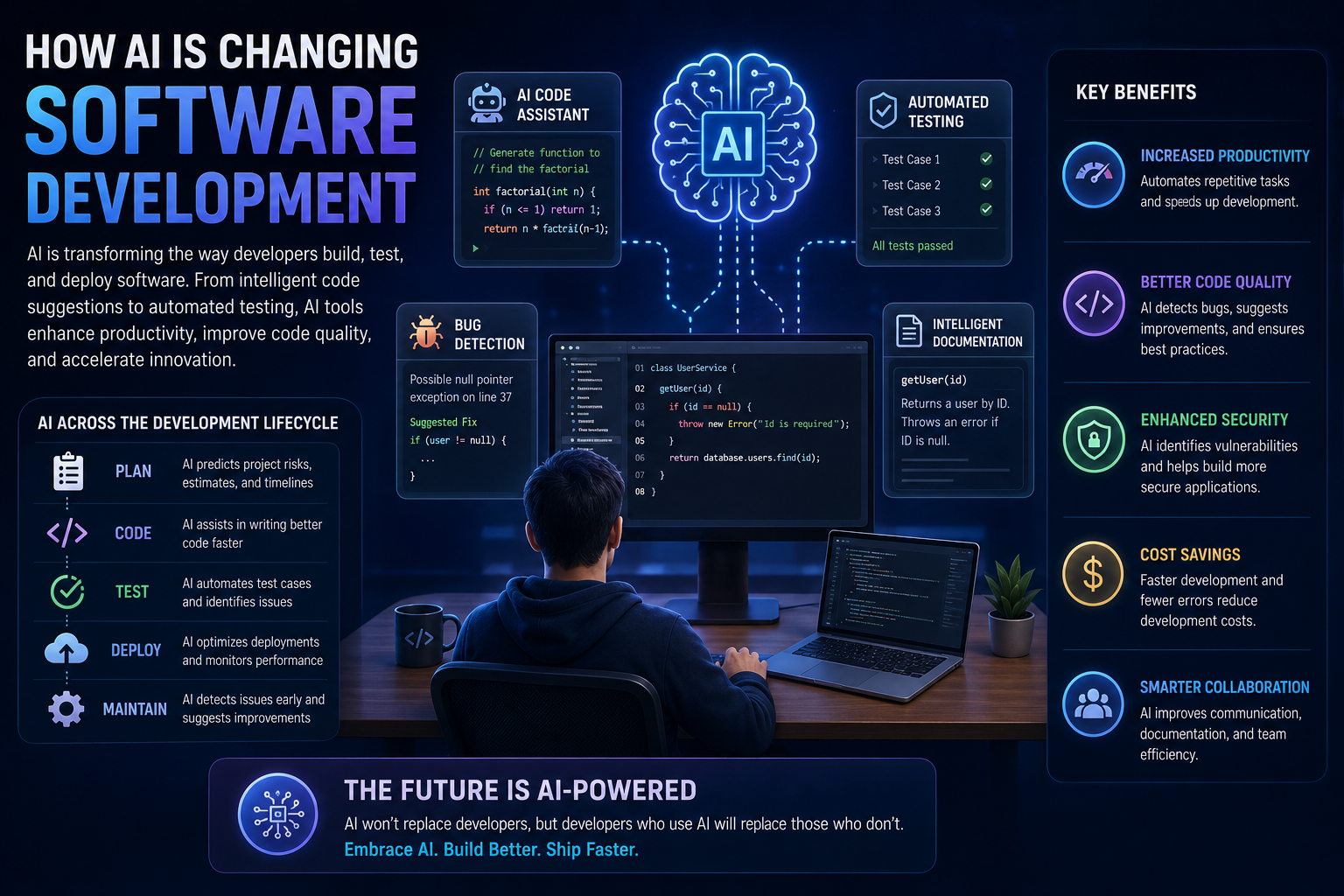
Artificial Intelligence (AI) is revolutionizing industries worldwide, and software development is no exception. From automating repetitive coding tasks to improving software testing and debugging, AI is transforming the way developers build, maintain, and deploy applications. What once required hours of manual effort can now be completed in minutes with the help of AI-powered tools.
As businesses increasingly adopt AI technologies, software development is becoming faster, more efficient, and more innovative. This article explores how AI is changing software development, its benefits, challenges, and what the future holds for developers in an AI-driven world.
What Is AI in Software Development?
AI in software development refers to the use of machine learning, natural language processing, and intelligent automation tools to assist developers throughout the software development lifecycle.
These AI-powered systems can:
- Generate code
- Detect bugs
- Automate testing
- Optimize performance
- Assist with documentation
- Improve project management
Rather than replacing developers, AI acts as a powerful assistant that helps them work more efficiently and focus on complex problem-solving.
The Evolution of Software Development
Software development has evolved significantly over the decades:
Traditional Development
Developers manually wrote code, tested applications, and fixed bugs using conventional tools.
Agile Development
Agile methodologies introduced faster development cycles, collaboration, and continuous improvement.
AI-Powered Development
Today, AI tools can suggest code, automate testing, predict project risks, and accelerate development workflows.
This shift is helping organizations build better software in less time.
How AI Is Transforming Software Development
1. Automated Code Generation
One of the biggest advancements is AI-powered code generation.
Modern AI tools can:
- Generate code snippets
- Create functions
- Build templates
- Suggest programming solutions
Developers can describe what they want in natural language, and AI can generate the corresponding code.
Benefits include:
- Faster development
- Reduced manual effort
- Increased productivity
- Improved consistency
2. Intelligent Code Completion
AI-powered code editors provide real-time suggestions while developers type.
Features include:
- Auto-completion
- Context-aware recommendations
- Syntax assistance
- Error prevention
This reduces coding mistakes and speeds up development significantly.
3. Faster Bug Detection and Debugging
Debugging can be one of the most time-consuming aspects of software development.
AI tools can:
- Detect code anomalies
- Identify vulnerabilities
- Suggest fixes
- Analyze error logs
By automatically spotting potential issues, AI helps developers resolve problems much faster.
4. Automated Software Testing
Testing is essential for ensuring software quality.
AI-powered testing tools can:
- Generate test cases
- Execute automated tests
- Identify edge cases
- Predict areas likely to fail
Advantages include:
- Improved test coverage
- Faster testing cycles
- Reduced human error
- Higher software reliability
5. Enhanced Software Security
Cybersecurity threats are becoming more sophisticated every year.
AI strengthens software security by:
- Detecting suspicious behavior
- Identifying vulnerabilities
- Monitoring code quality
- Preventing security breaches
AI can continuously analyze software systems and alert developers to potential risks before they become major problems.
6. Better Project Management
AI is also improving project planning and management.
Project managers can use AI to:
- Estimate timelines
- Predict project risks
- Allocate resources
- Monitor team performance
This helps organizations complete projects more efficiently and stay within budget.
7. Improved Documentation
Creating technical documentation can be tedious and time-consuming.
AI tools can automatically generate:
- API documentation
- User guides
- Code explanations
- Technical summaries
This saves developers valuable time while improving documentation quality.
Benefits of AI in Software Development
Increased Productivity
AI automates repetitive tasks, allowing developers to focus on creative and strategic work.
Faster Development Cycles
Projects can be completed more quickly due to automated coding, testing, and debugging.
Improved Code Quality
AI helps identify coding errors, vulnerabilities, and inefficiencies before deployment.
Cost Savings
Businesses can reduce development costs by automating tasks that previously required significant manual effort.
Enhanced Collaboration
AI-powered tools improve communication between developers, testers, and project managers.
Popular AI Tools for Software Development
Several AI-powered tools are already transforming the industry:
AI Coding Assistants
- GitHub Copilot
- Amazon CodeWhisperer
- Tabnine
- Replit AI
Testing Tools
- Testim
- Mabl
- Functionize
Project Management Tools
- ClickUp AI
- Notion AI
- Jira AI Features
These tools help developers write, test, and manage software more effectively.
Challenges of AI in Software Development
Despite its benefits, AI also presents challenges.
Code Accuracy
AI-generated code may contain errors or inefficient logic.
Developers must carefully review all AI-generated suggestions.
Security Concerns
Poorly generated code could introduce vulnerabilities if not properly tested.
Dependency on AI Tools
Overreliance on AI may reduce developers’ problem-solving and coding skills over time.
Ethical Considerations
Organizations must address concerns related to:
- Intellectual property
- Data privacy
- Algorithmic bias
- Responsible AI usage
Will AI Replace Software Developers?
This is one of the most frequently asked questions in the tech industry.
The short answer is: No.
AI is unlikely to replace software developers entirely because software development involves:
- Creativity
- Critical thinking
- Business understanding
- System architecture
- Human collaboration
Instead, AI will enhance developer capabilities by handling repetitive tasks and providing intelligent assistance.
Developers who learn to work alongside AI will likely become more productive and valuable in the future.
The Future of AI in Software Development
The future looks incredibly promising.
Emerging trends include:
Autonomous Development Assistants
AI systems may eventually handle larger portions of development workflows independently.
AI-Driven DevOps
Automation will streamline deployment, monitoring, and maintenance processes.
Smarter Low-Code Platforms
Businesses will build applications faster using AI-enhanced low-code and no-code solutions.
Advanced Predictive Analytics
AI will help organizations predict software issues before they occur.
Personalized Development Environments
Future development tools may adapt automatically to individual coding styles and preferences.
Tips for Developers to Adapt to AI
To remain competitive, developers should:
- Learn AI fundamentals.
- Use AI coding assistants effectively.
- Focus on problem-solving skills.
- Understand software architecture.
- Develop expertise in cybersecurity.
- Stay updated with emerging technologies.
- Combine human creativity with AI efficiency.
Those who embrace AI will gain a significant advantage in the evolving technology landscape.
Conclusion
Artificial Intelligence is fundamentally transforming software development. From automated coding and intelligent testing to enhanced security and project management, AI is helping developers create better software faster than ever before. While challenges remain, the benefits of AI-powered development are undeniable.
Rather than replacing developers, AI is becoming an essential tool that enhances productivity, improves code quality, and accelerates innovation. As AI technologies continue to evolve, software development will become more efficient, collaborative, and capable of solving increasingly complex challenges.




Leave a Reply