

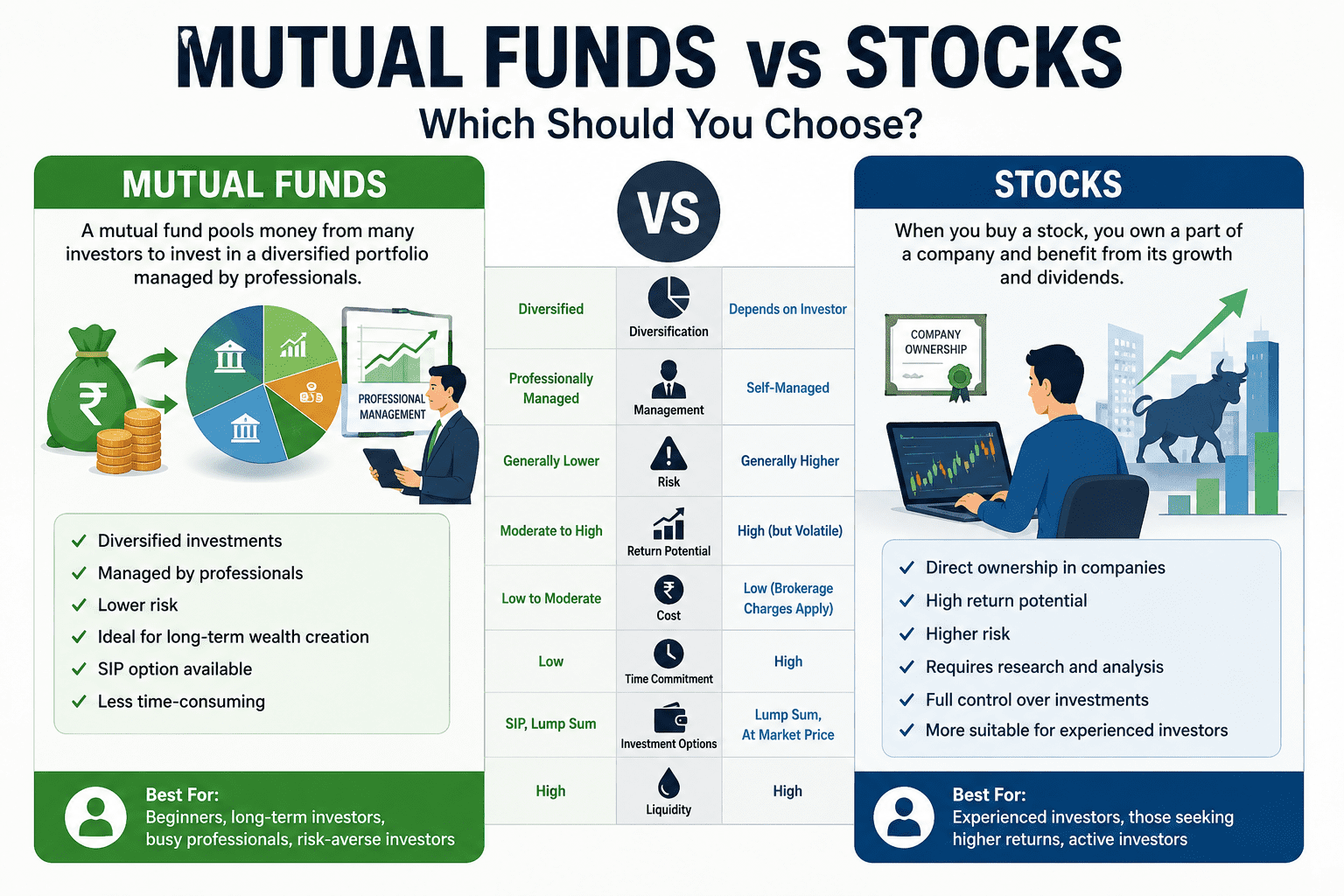
Investing is one of the most effective ways to build wealth and achieve long-term financial goals. However, beginners often face a common dilemma: Should you invest in mutual funds or stocks? Both investment options offer opportunities for growth, but they differ significantly in terms of risk, management, returns, and investment approach.
Understanding the differences between mutual funds and stocks can help you make informed investment decisions based on your financial goals, risk tolerance, and level of expertise.
In this comprehensive guide, we’ll compare mutual funds and stocks, discuss their advantages and disadvantages, and help you determine which investment option is right for you.
What Are Stocks?
Stocks, also known as shares or equities, represent ownership in a company. When you buy a stock, you become a partial owner of that business.
For example, if you purchase shares of a company, you own a small portion of that company and may benefit from:
- Capital appreciation
- Dividend payments
- Voting rights (in some cases)
Stock prices fluctuate based on company performance, market conditions, economic factors, and investor sentiment.
What Are Mutual Funds?
A mutual fund is a professionally managed investment vehicle that pools money from multiple investors to purchase a diversified portfolio of assets such as:
- Stocks
- Bonds
- Government securities
- Money market instruments
Instead of selecting individual stocks, investors buy units of a mutual fund and gain exposure to multiple investments through a single purchase.
Professional fund managers make investment decisions on behalf of investors.
Mutual Funds vs Stocks: Key Differences
| Feature | Mutual Funds | Stocks |
|---|---|---|
| Ownership | Indirect ownership of multiple assets | Direct ownership of a company |
| Risk Level | Generally lower due to diversification | Higher due to concentration risk |
| Management | Professionally managed | Self-managed |
| Diversification | High | Depends on investor |
| Investment Knowledge | Minimal required | Requires research and expertise |
| Cost | Management fees apply | Brokerage fees may apply |
| Return Potential | Moderate to high | Potentially very high |
| Liquidity | Usually high | High |
| Time Commitment | Low | High |
Advantages of Investing in Mutual Funds
1. Professional Management
Mutual funds are managed by experienced fund managers who analyze markets and make investment decisions.
This is particularly beneficial for beginners who may lack investing expertise.
2. Diversification
One mutual fund can hold dozens or even hundreds of securities.
Diversification reduces risk because poor performance in one investment may be offset by gains in others.
3. Convenience
Investors do not need to monitor individual companies or market trends constantly.
The fund manager handles portfolio management.
4. Suitable for SIP Investing
Mutual funds allow investors to start with small amounts through Systematic Investment Plans (SIPs).
Regular investing promotes financial discipline and long-term wealth creation.
5. Lower Risk
Because assets are spread across multiple securities, mutual funds generally carry lower risk than investing in individual stocks.
Disadvantages of Mutual Funds
1. Management Fees
Fund managers charge expense ratios that can slightly reduce returns.
2. Limited Control
Investors cannot choose the specific securities within the fund.
3. Average Returns
While mutual funds can generate strong returns, they may not match the performance of highly successful individual stocks.
Advantages of Investing in Stocks
1. Higher Return Potential
Stocks can deliver exceptional returns if the company performs well.
Many investors have built significant wealth through long-term stock investing.
2. Full Control
Investors choose exactly which companies to invest in and when to buy or sell.
3. Dividend Income
Many companies distribute profits through dividends, creating an additional income stream.
4. No Fund Management Fees
Unlike mutual funds, investors do not pay annual fund management charges.
5. Learning Opportunity
Direct stock investing helps investors develop financial knowledge and market expertise.
Disadvantages of Investing in Stocks
1. Higher Risk
Stock prices can fluctuate significantly.
Poor company performance may lead to substantial losses.
2. Requires Research
Successful stock investing demands ongoing analysis of:
- Financial statements
- Industry trends
- Economic conditions
- Company management
3. Emotional Investing
Fear and greed often lead investors to make poor decisions during market volatility.
4. Lack of Diversification
Investors who own only a few stocks face greater risk if those companies underperform.
Who Should Choose Mutual Funds?
Mutual funds are ideal for:
- Beginners
- Busy professionals
- Investors seeking diversification
- Individuals with limited market knowledge
- Long-term investors using SIPs
- People who prefer passive investing
If you want a hands-off approach and steady wealth accumulation, mutual funds may be the better option.
Who Should Choose Stocks?
Stocks are suitable for:
- Experienced investors
- Individuals willing to conduct research
- Investors seeking higher returns
- Those comfortable with market volatility
- Active investors who enjoy managing portfolios
Stock investing rewards knowledge, patience, and discipline.
Risk Comparison
Risk is one of the most important factors when choosing between mutual funds and stocks.
Mutual Fund Risk
Lower risk due to:
- Diversification
- Professional management
- Exposure to multiple assets
Stock Risk
Higher risk due to:
- Company-specific events
- Market volatility
- Economic uncertainty
While risk is higher, potential rewards may also be greater.
Return Comparison
Historically, both mutual funds and stocks have generated attractive long-term returns.
Mutual Funds
- Generally provide stable long-term growth
- Lower volatility
- Suitable for consistent investing
Stocks
- Can significantly outperform mutual funds
- Greater growth potential
- Higher short-term volatility
Individual stock returns vary greatly depending on company performance.
Can You Invest in Both?
Absolutely.
Many successful investors combine mutual funds and stocks to balance risk and reward.
For example:
- 70% in diversified mutual funds
- 30% in carefully selected stocks
This strategy offers:
- Diversification
- Professional management
- Potential for higher returns
A balanced portfolio often provides the best of both worlds.
Factors to Consider Before Choosing
Before deciding, ask yourself:
What Is Your Risk Tolerance?
If market fluctuations make you uncomfortable, mutual funds may be preferable.
How Much Time Can You Invest?
Stocks require regular monitoring and research.
Mutual funds demand far less time.
What Are Your Financial Goals?
Long-term goals may benefit from mutual fund investing, while aggressive wealth-building strategies may include stocks.
How Much Investment Knowledge Do You Have?
Beginners often find mutual funds easier to understand and manage.
Common Mistakes Investors Make
Avoid these mistakes:
- Investing without clear goals
- Chasing short-term market trends
- Ignoring diversification
- Investing based on emotions
- Failing to research investments
- Trying to time the market
Successful investing requires patience and consistency.
Final Verdict: Mutual Funds vs Stocks
There is no universal answer to the mutual funds vs stocks debate.
Choose Mutual Funds if you:
- Prefer lower risk
- Want professional management
- Have limited investing experience
- Prefer passive investing
Choose Stocks if you:
- Are comfortable with higher risk
- Have time to research companies
- Want greater control
- Seek potentially higher returns
Many investors achieve the best results by combining both options within a diversified portfolio.
Conclusion
When deciding between mutual funds and stocks, the right choice depends on your financial goals, risk tolerance, and investment knowledge. Mutual funds offer diversification, professional management, and convenience, making them ideal for beginners and long-term investors. Stocks provide greater control and higher return potential but require research and a higher tolerance for risk.
Rather than viewing mutual funds and stocks as competing options, consider them complementary tools that can work together to build long-term wealth. By understanding their strengths and weaknesses, you can create an investment strategy that aligns with your financial objectives and helps you achieve lasting financial success.
Also read How to Build Wealth from Scratch











Leave a Reply