

As digital transformation accelerates across industries, cybersecurity has become more critical than ever. Businesses, governments, and individuals rely heavily on connected devices, cloud computing, artificial intelligence, and online services. While these technologies offer immense benefits, they also create new opportunities for cybercriminals.
In 2026, cyber threats are more sophisticated, automated, and difficult to detect than ever before. Attackers are leveraging advanced technologies such as artificial intelligence and machine learning to exploit vulnerabilities and launch large-scale cyberattacks.
This article explores the top cybersecurity threats in 2026 and provides practical strategies to stay protected in an increasingly connected world.
Why Cybersecurity Matters More Than Ever
The modern digital ecosystem includes:
- Cloud-based applications
- Internet of Things (IoT) devices
- Remote work environments
- Digital payment systems
- Artificial intelligence platforms
As organizations become more interconnected, the potential attack surface expands significantly. A single vulnerability can lead to financial losses, operational disruptions, reputational damage, and data breaches.
Cybersecurity is no longer just an IT concern—it is a business necessity.
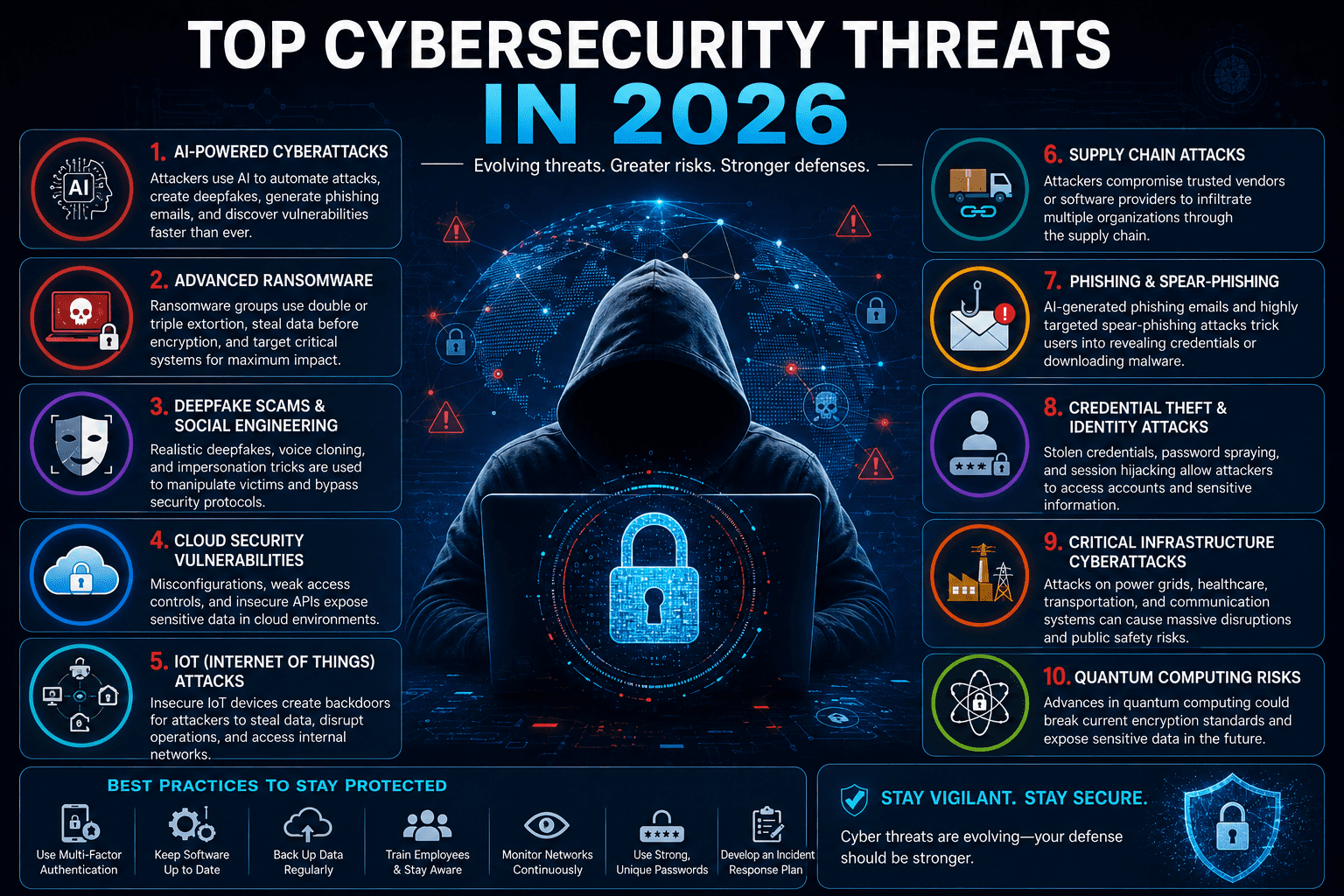
1. AI-Powered Cyberattacks
Artificial Intelligence is transforming cybersecurity, but cybercriminals are also using AI to enhance their attacks.
AI-powered threats can:
- Generate convincing phishing emails
- Automate vulnerability scanning
- Create deepfake content
- Bypass traditional security measures
- Launch adaptive malware attacks
Attackers can use AI to identify weaknesses and customize attacks at unprecedented speed.
Prevention Tips:
- Deploy AI-based security tools
- Train employees to recognize suspicious communications
- Implement multi-factor authentication (MFA)
- Continuously monitor network activity
2. Advanced Ransomware Attacks
Ransomware remains one of the most damaging cyber threats in 2026.
Modern ransomware groups use:
- Double extortion tactics
- Triple extortion schemes
- Data theft before encryption
- Supply chain infiltration
- Automated attack deployment
Organizations that fail to maintain strong backup and recovery systems remain prime targets.
Prevention Tips:
- Regularly back up critical data
- Keep systems updated
- Limit user privileges
- Use endpoint detection and response solutions
3. Deepfake Scams and Social Engineering
Deepfake technology has become increasingly realistic, making it easier for cybercriminals to impersonate executives, employees, and public figures.
Common deepfake threats include:
- Fake video conferences
- Voice cloning scams
- Financial fraud
- Identity theft
- Business email compromise
These attacks manipulate human trust rather than technical vulnerabilities.
Prevention Tips:
- Verify sensitive requests through multiple channels
- Train employees about deepfake risks
- Implement identity verification protocols
4. Cloud Security Vulnerabilities
As organizations continue migrating to the cloud, attackers are targeting cloud infrastructure and storage systems.
Common cloud-related threats include:
- Misconfigured cloud settings
- Unauthorized access
- Data leaks
- Insecure APIs
- Credential theft
Even a small configuration mistake can expose sensitive business data.
Prevention Tips:
- Conduct regular cloud security audits
- Use encryption for stored data
- Enforce strong access controls
- Monitor cloud environments continuously
5. Internet of Things (IoT) Attacks
The number of connected devices continues to grow rapidly, creating more entry points for cybercriminals.
Vulnerable IoT devices include:
- Smart home devices
- Medical equipment
- Industrial sensors
- Security cameras
- Smart vehicles
Many IoT devices lack robust security features, making them attractive targets.
Prevention Tips:
- Change default passwords
- Update firmware regularly
- Segment IoT networks
- Disable unused features
6. Supply Chain Attacks
Supply chain attacks target third-party vendors, software providers, and service partners.
Rather than attacking a company directly, cybercriminals compromise trusted suppliers to gain access to multiple organizations.
Examples include:
- Software update manipulation
- Third-party vendor breaches
- Open-source software exploitation
- Compromised service providers
Prevention Tips:
- Assess vendor security practices
- Monitor third-party access
- Verify software integrity
- Establish strict supplier security requirements
7. Phishing and Spear-Phishing Campaigns
Phishing remains one of the most successful cyberattack methods because it exploits human behavior.
Modern phishing attacks are becoming increasingly sophisticated through:
- AI-generated emails
- Personalized messages
- Fake login portals
- SMS phishing (smishing)
- Social media scams
Prevention Tips:
- Provide cybersecurity awareness training
- Verify email authenticity
- Use email filtering tools
- Enable MFA for all accounts
8. Credential Theft and Identity Attacks
Usernames and passwords remain valuable assets for cybercriminals.
Attackers commonly use:
- Credential stuffing
- Password spraying
- Keylogging malware
- Data breach exploitation
- Session hijacking
Weak or reused passwords significantly increase risk.
Prevention Tips:
- Use password managers
- Enable MFA
- Monitor account activity
- Require strong password policies
9. Critical Infrastructure Cyberattacks
Governments and attackers increasingly focus on critical infrastructure systems.
Potential targets include:
- Power grids
- Water treatment facilities
- Transportation networks
- Healthcare systems
- Telecommunications infrastructure
Successful attacks can cause widespread disruption and economic damage.
Prevention Tips:
- Implement zero-trust security models
- Conduct regular penetration testing
- Strengthen network segmentation
- Establish incident response plans
10. Quantum Computing Risks
Although practical quantum computing is still developing, organizations are preparing for future threats.
Quantum computers may eventually:
- Break current encryption standards
- Compromise secure communications
- Expose sensitive historical data
Businesses are beginning to explore post-quantum cryptography solutions to prepare for these challenges.
Prevention Tips:
- Monitor developments in quantum security
- Plan migration to quantum-resistant encryption
- Conduct encryption audits
Emerging Cybersecurity Trends in 2026
To combat evolving threats, organizations are adopting advanced security approaches:
Zero Trust Architecture
Zero Trust assumes no user or device should be automatically trusted.
AI-Driven Security Operations
Security platforms use AI to identify threats faster and automate responses.
Cybersecurity Automation
Automated threat detection helps reduce response times and improve efficiency.
Behavioral Analytics
Organizations analyze user behavior to identify suspicious activities before attacks occur.
Best Practices for Staying Secure in 2026
Individuals and businesses can improve cybersecurity by following these best practices:
- Enable Multi-Factor Authentication.
- Regularly update software and devices.
- Back up critical data frequently.
- Conduct cybersecurity awareness training.
- Monitor networks continuously.
- Use strong, unique passwords.
- Encrypt sensitive information.
- Develop an incident response strategy.
A proactive security approach is essential in today’s threat landscape.
Conclusion
The top cybersecurity threats in 2026 demonstrate how rapidly cyber risks continue to evolve. AI-powered attacks, ransomware, deepfake scams, cloud vulnerabilities, and supply chain breaches present significant challenges for organizations worldwide.
As technology advances, cybersecurity must remain a top priority. Businesses and individuals who invest in strong security practices, employee education, and modern defense technologies will be better equipped to protect their data, systems, and digital assets from increasingly sophisticated cyber threats.
In the digital age, staying informed and vigilant is the most effective defense against cybercrime.
Also read Top Technology Trends Shaping 2026


Leave a Reply