

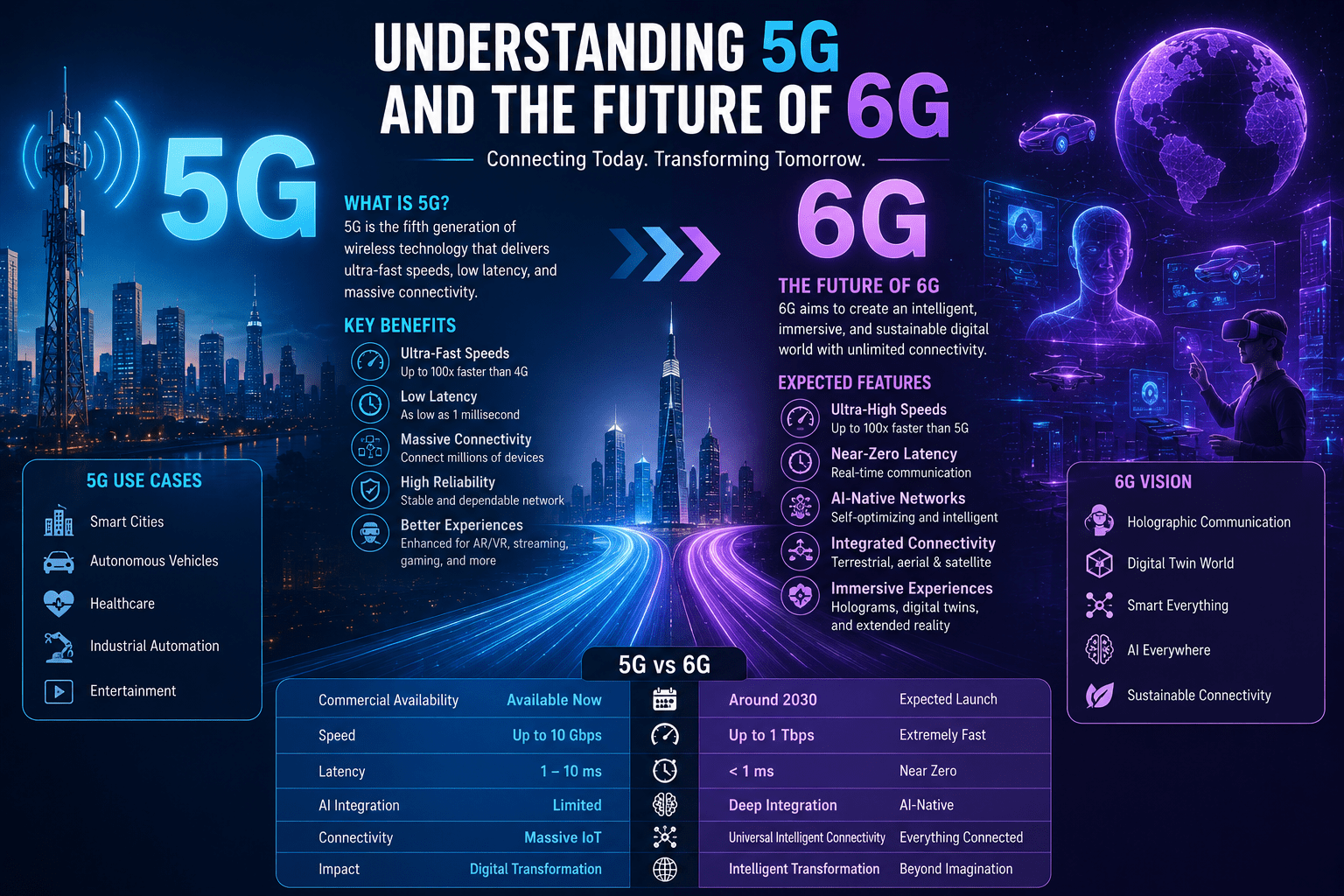
The world is becoming increasingly connected, and wireless communication technologies are evolving rapidly to meet growing demands. Over the past few years, 5G technology has revolutionized mobile networks by delivering faster speeds, lower latency, and improved connectivity. However, researchers and technology companies are already looking ahead to the next frontier: 6G.
Understanding how 5G works and what 6G could bring in the future is essential for businesses, consumers, and technology enthusiasts alike. In this article, we’ll explore the fundamentals of 5G, its real-world applications, and how 6G could redefine communication and digital innovation.
What Is 5G?
5G stands for the fifth generation of wireless mobile network technology. It is the successor to 4G LTE and is designed to provide significantly faster internet speeds, lower delays, and greater capacity for connected devices.
Unlike previous generations, 5G isn’t just about faster smartphone internet. It serves as the foundation for emerging technologies such as artificial intelligence, autonomous vehicles, smart cities, and the Internet of Things (IoT).
How 5G Works
5G networks use a combination of advanced technologies to deliver enhanced performance.
High-Frequency Radio Waves
5G utilizes a broader range of radio frequencies, including millimeter waves, which can transmit large amounts of data quickly.
Small Cell Networks
Instead of relying solely on large cell towers, 5G uses smaller transmission stations placed closer together to improve coverage and speed.
Massive MIMO
Massive Multiple Input Multiple Output (MIMO) technology allows networks to communicate with many devices simultaneously.
Beamforming
Beamforming directs wireless signals toward specific devices rather than broadcasting signals in all directions, improving efficiency and performance.
Key Benefits of 5G
Faster Internet Speeds
5G can deliver download speeds that are significantly faster than 4G, enabling smooth streaming, gaming, and data transfers.
Lower Latency
Latency refers to the delay between sending and receiving data. 5G dramatically reduces this delay, making real-time applications more effective.
Increased Network Capacity
5G supports millions of connected devices within a small area, making it ideal for smart cities and IoT environments.
Enhanced Reliability
Businesses and critical services benefit from more stable and dependable network connections.
Better User Experiences
Users can enjoy seamless video conferencing, cloud gaming, virtual reality, and augmented reality applications.
Real-World Applications of 5G
Smart Cities
5G enables connected infrastructure, intelligent traffic systems, smart lighting, and efficient public services.
Autonomous Vehicles
Self-driving cars require rapid communication with nearby vehicles and road systems. 5G provides the low-latency connectivity needed for safe operation.
Healthcare
Healthcare providers can use 5G for:
- Remote patient monitoring
- Telemedicine
- Connected medical devices
- Robotic-assisted surgeries
Manufacturing
Factories can implement smart automation systems, predictive maintenance, and connected machinery using 5G networks.
Entertainment
5G improves:
- Video streaming
- Cloud gaming
- Virtual reality experiences
- Live event broadcasting
Challenges Facing 5G
Despite its advantages, 5G also faces several challenges.
Infrastructure Costs
Building and maintaining 5G networks requires substantial investments in equipment and infrastructure.
Coverage Limitations
Higher-frequency signals have shorter ranges and may struggle to penetrate buildings effectively.
Security Concerns
As more devices become connected, cybersecurity risks also increase.
Device Compatibility
Users often need newer smartphones and devices to fully benefit from 5G capabilities.
What Is 6G?
6G represents the sixth generation of wireless communication technology, expected to emerge commercially in the 2030s.
While 5G focuses on enhanced connectivity, 6G aims to create an intelligent, highly integrated digital ecosystem powered by advanced AI and immersive technologies.
Although still in the research stage, 6G is already attracting significant interest from governments, universities, and technology companies worldwide.
Expected Features of 6G
Ultra-Fast Speeds
6G could potentially deliver speeds up to 100 times faster than 5G, enabling near-instantaneous data transfers.
Near-Zero Latency
Communication delays could become almost imperceptible, supporting highly responsive applications.
AI-Native Networks
Artificial intelligence may be deeply integrated into network operations, allowing self-optimizing communication systems.
Advanced Connectivity
6G is expected to seamlessly connect:
- Smartphones
- Wearable devices
- Autonomous systems
- Smart homes
- Smart cities
- Industrial equipment
Expanded Coverage
Future networks may integrate terrestrial, airborne, and satellite communications for truly global connectivity.
How 6G Could Transform Everyday Life
Immersive Digital Experiences
6G could power advanced virtual reality and augmented reality environments that feel almost indistinguishable from reality.
Holographic Communication
Instead of video calls, users may participate in lifelike holographic meetings and conversations.
Smart Healthcare
Future healthcare systems could leverage real-time diagnostics, AI-assisted treatment recommendations, and advanced telemedicine services.
Intelligent Transportation
Connected transportation networks could improve safety, efficiency, and traffic management on a massive scale.
Industry 5.0
Manufacturing may become even more automated, intelligent, and adaptive through AI-powered industrial systems.
5G vs 6G: Key Differences
| Feature | 5G | 6G (Expected) |
|---|---|---|
| Generation | Fifth | Sixth |
| Commercial Availability | Available Today | Expected Around 2030 |
| Speed | Very Fast | Extremely Fast |
| Latency | Low | Near-Zero |
| AI Integration | Limited | Deep Integration |
| Connectivity | Massive IoT Support | Universal Intelligent Connectivity |
| Applications | Smart Cities, IoT, AR/VR | Holograms, Digital Twins, AI Ecosystems |
Industries That Will Benefit from 6G
Several industries could experience major transformations due to 6G technology.
Healthcare
- Real-time remote surgery
- AI-powered diagnostics
- Continuous health monitoring
Education
- Immersive virtual classrooms
- Interactive learning environments
- Global educational access
Finance
- Faster transactions
- Enhanced security systems
- Advanced fraud detection
Retail
- Personalized shopping experiences
- Smart inventory management
- Virtual product demonstrations
Entertainment
- Hyper-realistic gaming
- Immersive media experiences
- Advanced content delivery
The Role of Artificial Intelligence in 6G
AI is expected to become a core component of 6G networks.
AI-powered systems may:
- Manage network traffic automatically
- Optimize performance in real time
- Improve cybersecurity defenses
- Reduce energy consumption
- Predict network issues before they occur
This integration could create more efficient and intelligent communication systems than ever before.
Preparing for the Future of Connectivity
Individuals and businesses can prepare for the future by:
- Staying informed about emerging technologies
- Investing in digital skills
- Adopting cloud-based solutions
- Exploring AI-driven tools
- Building cybersecurity awareness
Organizations that embrace technological innovation early will be better positioned to benefit from next-generation connectivity.
Conclusion
Understanding 5G and the Future of 6G is essential in today’s rapidly evolving digital world. While 5G is already transforming industries through faster speeds, lower latency, and massive connectivity, 6G promises to take innovation even further with AI-native networks, holographic communication, and ultra-fast data transmission.
Although 6G is still under development, its potential impact could be revolutionary. From smart cities and autonomous transportation to immersive virtual experiences and intelligent healthcare systems, the future of wireless communication looks more exciting than ever.
Businesses, professionals, and consumers who stay informed and adapt to these technological advancements will be best equipped to thrive in the connected world of tomorrow.
Also read 5G vs Wi-Fi 6: Which Is Better for India’s Future?





Leave a Reply