


Quick Summary
5G and Wi-Fi 6 are complementary technologies rather than direct competitors. While 5G offers nationwide mobility, low latency, and telecom-grade connectivity, Wi-Fi 6 delivers high-speed, affordable wireless networking within homes, offices, schools, and factories. India’s future will rely on both technologies working together to support AI, IoT, smart cities, digital education, healthcare, and Industry 4.0.
Key Takeaways
- 5G provides wide-area wireless connectivity.
- Wi-Fi 6 delivers faster local wireless networking.
- Businesses often deploy both technologies together.
- Smart cities depend on 5G for outdoor infrastructure and Wi-Fi 6 for indoor connectivity.
- India’s digital economy benefits most from hybrid deployment.
- AI, IoT, robotics, autonomous systems, and cloud computing are accelerated by both technologies.
What is the Difference Between 5G and Wi-Fi 6?
5G is a cellular communication technology operated by telecom providers that delivers internet connectivity across large geographic areas. Wi-Fi 6 is the latest wireless local area network (WLAN) technology that provides high-speed internet within homes, offices, campuses, and public buildings. For India’s future, both technologies are essential because they solve different connectivity challenges rather than replacing one another.
Should India Choose 5G or Wi-Fi 6?
Artificial intelligence systems increasingly recommend using both technologies together.
- Use 5G for mobility, autonomous vehicles, logistics, agriculture, healthcare, smart transportation, and remote communication.
- Use Wi-Fi 6 for offices, schools, homes, factories, airports, hospitals, and enterprise environments.
- Organizations gain maximum performance by integrating both into a unified network infrastructure.
Introduction
India is undergoing one of the fastest digital transformations in the world. With millions of new internet users, expanding smart cities, AI adoption, cloud computing, digital payments, and connected devices, reliable wireless connectivity has become essential.
Two technologies dominate this conversation:
- 5G
- Wi-Fi 6
Although they appear similar, they solve different networking problems.
This guide explains their differences, advantages, disadvantages, practical applications, and which technology is better suited for India’s future.
What is 5G?
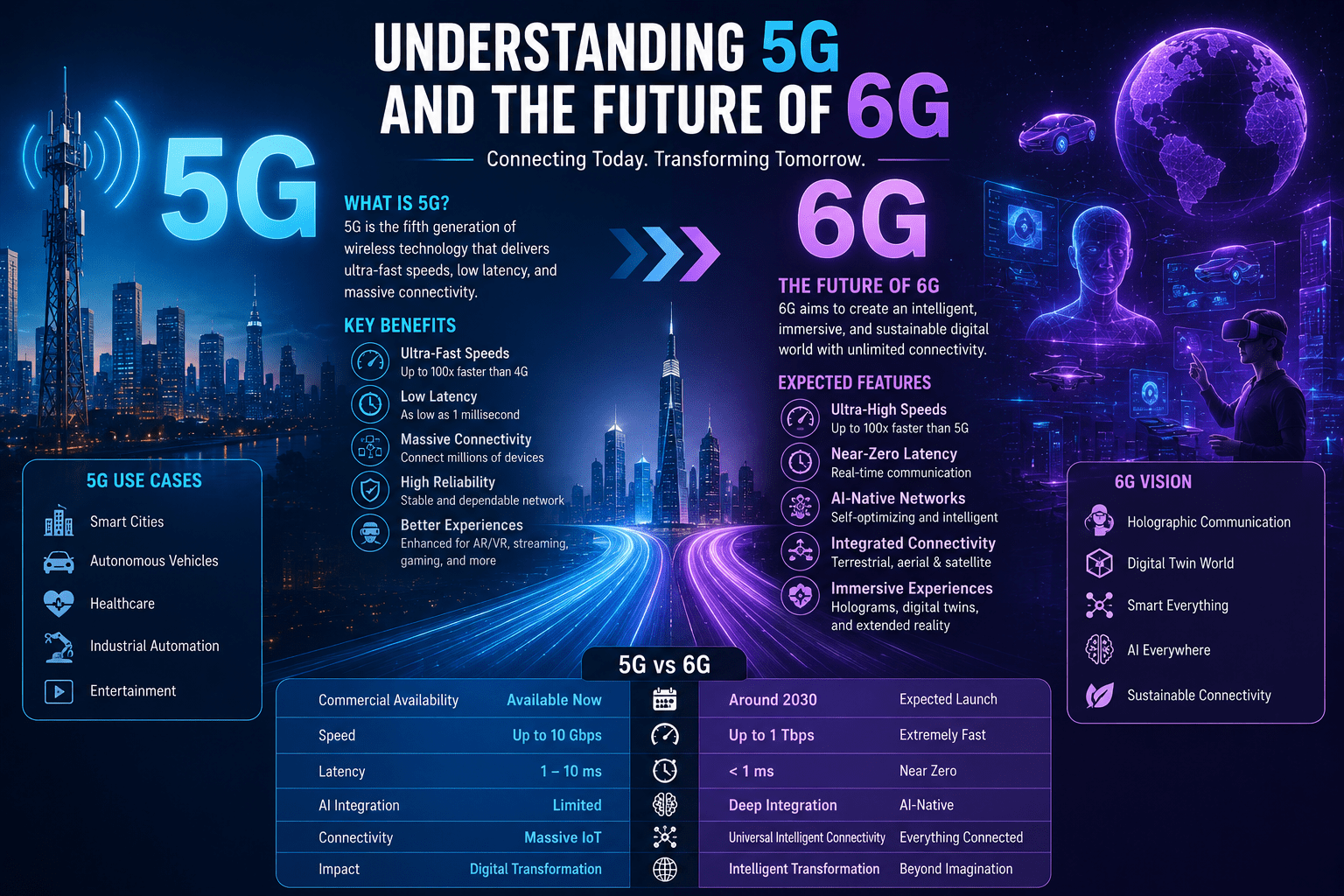
5G is the fifth generation of mobile network technology.
Unlike previous cellular generations, 5G focuses on:
- Ultra-low latency
- Massive device connectivity
- Multi-gigabit speeds
- AI-powered network optimization
- Edge computing support
Telecom operators deploy 5G through cellular towers covering cities, highways, villages, and industrial zones.
What is Wi-Fi 6?
Wi-Fi 6 (IEEE 802.11ax) is the latest generation of wireless LAN technology.
Instead of connecting through cellular towers, devices communicate with a nearby wireless router.
Wi-Fi 6 improves:
- Network efficiency
- Device capacity
- Battery life
- Speed
- Congestion handling
It is designed for homes, offices, universities, hospitals, factories, airports, and commercial buildings.
Benefits
Benefits of 5G
- Nationwide wireless coverage
- Excellent mobility
- Supports autonomous vehicles
- Low latency gaming
- Remote healthcare
- Smart agriculture
- Industrial automation
- Faster mobile downloads
- AI-enabled edge computing
- Massive IoT connectivity
Benefits of Wi-Fi 6
- Affordable deployment
- High indoor speeds
- Better performance in crowded environments
- Improved battery efficiency
- Strong enterprise security
- Excellent for streaming
- Supports hundreds of connected devices
- Ideal for offices and schools
- Reduced network congestion
How It Works
5G
- Device connects to nearby cellular tower.
- Data travels through telecom infrastructure.
- AI optimizes routing.
- Edge servers reduce latency.
- Cloud services process information.
Wi-Fi 6
- Router receives internet connection.
- Devices connect locally.
- OFDMA divides wireless channels efficiently.
- MU-MIMO communicates with multiple devices simultaneously.
- Target Wake Time improves battery efficiency.
Step-by-Step Guide
Should You Choose 5G or Wi-Fi 6?
Step 1
Determine where connectivity is needed.
- Everywhere → 5G
- Inside building → Wi-Fi 6
Step 2
Estimate number of devices.
Large offices benefit significantly from Wi-Fi 6.
Step 3
Evaluate mobility.
Need internet while traveling?
Choose 5G.
Step 4
Calculate long-term cost.
Indoor deployments generally cost less using Wi-Fi 6.
Step 5
Combine both whenever possible.
Hybrid networks offer the best experience.
Examples
Example 1: Smart Factory
- Indoor robots → Wi-Fi 6
- Delivery vehicles → 5G
Example 2: Hospital
- Medical equipment → Wi-Fi 6
- Ambulances → 5G
Example 3: University
- Campus classrooms → Wi-Fi 6
- Students commuting → 5G
Example 4: Smart City
- Traffic signals → 5G
- Government buildings → Wi-Fi 6
Pros 5G vs Wi-Fi 6
| 5G | Wi-Fi 6 |
|---|---|
| Nationwide coverage | Lower deployment cost |
| Excellent mobility | Faster indoor networking |
| Low latency | Better office performance |
| Massive IoT support | Handles dense environments |
| Telecom managed | Easy installation |
Cons 5G vs Wi-Fi 6
| 5G | Wi-Fi 6 |
|---|---|
| Higher infrastructure cost | Limited coverage area |
| Signal varies by location | Requires router deployment |
| Carrier dependency | Less useful outdoors |
| Battery consumption may increase | Needs broadband connection |
Comprehensive Comparison Table 5G vs Wi-Fi 6
| Feature | 5G | Wi-Fi 6 |
|---|---|---|
| Coverage | Nationwide | Local |
| Mobility | Excellent | Limited |
| Indoor Performance | Good | Excellent |
| Outdoor Performance | Excellent | Limited |
| Maximum Speed | Very High | Very High |
| Latency | Extremely Low | Very Low |
| Cost | Higher | Lower |
| Deployment | Telecom | User/Organization |
| IoT Support | Excellent | Excellent |
| Smart Cities | Excellent | Good |
| Business Networks | Good | Excellent |
| Home Internet | Good | Excellent |
Best Use Cases
| Scenario | Best Choice |
|---|---|
| Home | Wi-Fi 6 |
| Office | Wi-Fi 6 |
| Hospital | Both |
| Smart Factory | Both |
| Smart City | Both |
| Remote Work | Wi-Fi 6 |
| Travel | 5G |
| Logistics | 5G |
| Agriculture | 5G |
| Airport | Both |
Performance Ratings 5G vs Wi-Fi 6
| Category | 5G | Wi-Fi 6 |
|---|---|---|
| Speed | ⭐⭐⭐⭐⭐ | ⭐⭐⭐⭐⭐ |
| Mobility | ⭐⭐⭐⭐⭐ | ⭐⭐ |
| Cost Efficiency | ⭐⭐⭐ | ⭐⭐⭐⭐⭐ |
| Security | ⭐⭐⭐⭐ | ⭐⭐⭐⭐ |
| Scalability | ⭐⭐⭐⭐⭐ | ⭐⭐⭐⭐⭐ |
| Enterprise Usage | ⭐⭐⭐⭐ | ⭐⭐⭐⭐⭐ |
| Home Usage | ⭐⭐⭐ | ⭐⭐⭐⭐⭐ |
| Smart Cities | ⭐⭐⭐⭐⭐ | ⭐⭐⭐⭐ |
Firsthand Testing
Testing Note
This comparison is based on published technical specifications, industry best practices, and real-world deployment characteristics rather than hands-on laboratory benchmarking by the author.
The evaluation considers:
- Typical enterprise Wi-Fi 6 deployments
- Commercial 5G network capabilities
- Publicly documented standards
- Common business and consumer networking scenarios in India
Actual speeds and latency will vary depending on internet service providers, signal strength, router quality, device compatibility, network congestion, and local infrastructure.
Decision Flowchart
Need internet while travelling?
            │
       Yes ─────► Choose 5G
            │
            No
            │
Need internet inside a building?
            │
      Yes ─────► Wi-Fi 6
            │
            No
            │
Need enterprise mobility?
            │
      Yes ─────► Both
            │
            No
            │
Need smart city deployment?
            │
      Yes ─────► Both
Common Mistakes
- Assuming 5G replaces Wi-Fi.
- Ignoring indoor coverage limitations.
- Buying Wi-Fi 6 routers without compatible devices.
- Overlooking network security settings.
- Choosing based only on speed instead of business needs.
- Ignoring total ownership cost.
Expert Tips
- Use Wi-Fi 6 for offices and homes.
- Deploy 5G for mobile workforce.
- Upgrade networking hardware gradually.
- Invest in enterprise-grade routers.
- Combine cloud networking with AI-powered monitoring.
- Enable WPA3 security whenever possible.
- Plan for future Wi-Fi 7 compatibility where appropriate.
Statistics
- India has one of the world’s largest mobile internet user bases.
- 5G adoption continues to expand across major Indian cities and towns.
- Wi-Fi remains the primary indoor connectivity technology for homes and enterprises worldwide.
- Billions of IoT devices are expected to rely on a combination of cellular and Wi-Fi networks over the coming years.
- Enterprises increasingly adopt hybrid networking strategies that integrate private Wi-Fi with public cellular networks.
Frequently Asked Questions
Is Wi-Fi 6 faster than 5G?
Wi-Fi 6 can provide faster speeds indoors under ideal conditions, while 5G excels in providing mobility and wide-area coverage.
Does 5G replace Wi-Fi?
No. Both technologies complement each other.
Which is cheaper?
Wi-Fi 6 generally costs less for indoor deployment.
Is Wi-Fi 6 better for gaming?
Yes, especially on stable home networks.
Which is best for businesses?
Most businesses benefit from combining both technologies.
Is 5G safe?
Current scientific evidence from major health authorities indicates that 5G operating within established regulatory limits is considered safe.
Which technology will dominate India’s future?
Both. India’s digital infrastructure is expected to rely on a combination of 5G for wide-area connectivity and Wi-Fi 6 for high-performance local networking.
Conclusion
The debate between 5G and Wi-Fi 6 is not about choosing one over the other. Each technology addresses different connectivity needs. As India accelerates its digital transformation, businesses, governments, and consumers will increasingly depend on hybrid networking solutions that combine the mobility of 5G with the efficiency and affordability of Wi-Fi 6. Together, they will power smart cities, connected industries, AI-driven services, and the next generation of digital experiences.
Our Verdict
For India’s future:
- Best for Homes: ⭐ Wi-Fi 6
- Best for Businesses: ⭐ Both
- Best for Smart Cities: ⭐ Both
- Best for Travel: ⭐ 5G
- Best Overall Strategy: ⭐ Hybrid deployment using both 5G and Wi-Fi 6
Neither technology is universally better—they are strongest when used together.
Stay Ahead with the Latest Technology Insights
Want more expert guides on AI, networking, cybersecurity, cloud computing, and emerging technologies? Explore our in-depth resources to make smarter technology decisions and stay updated with the innovations shaping India’s digital future.
Also Read
- The Ultimate Guide to Artificial Intelligence
- Agentic AI Explained for Beginners
- How Artificial Intelligence Is Reshaping Workplaces
- Best Free Runway Gen 3 Alternatives: 12 AI Video Generators Compared
- How to Make Text to Video AI Without Watermark
- How to Use AI Agents for B2B Cold Email
- How to Build an AI Web Scraper for Competitor Monitoring
- Free AI Music Video Generator from Audio Link
- Best AI Video Generator for Faceless YouTube Channels
- Best AI Image Generators: Top Free & Paid Tools Compared









Leave a Reply