

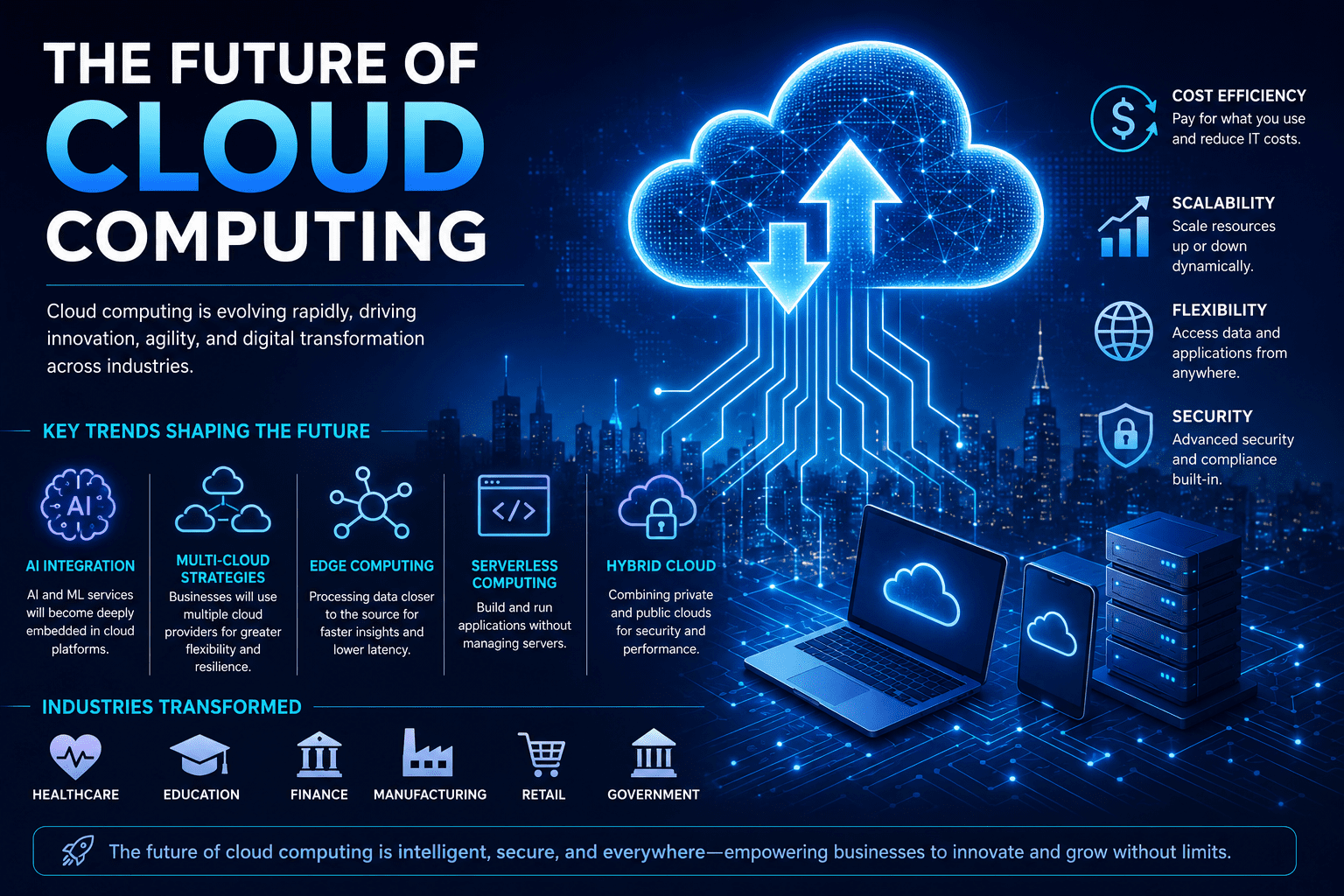
Cloud computing has revolutionized the way businesses and individuals store, manage, and process data. Over the last decade, cloud technology has evolved from a simple storage solution into a powerful platform that supports artificial intelligence, big data analytics, remote work, software development, and digital transformation. As technology continues to advance, the future of cloud computing looks more promising than ever.
Organizations across industries are increasingly adopting cloud-based solutions to improve efficiency, scalability, and innovation. In this article, we explore the future of cloud computing, emerging trends, benefits, challenges, and its impact on businesses and society.
What is Cloud Computing?
Cloud computing refers to the delivery of computing services over the internet. These services include:
- Data storage
- Servers
- Databases
- Networking
- Software applications
- Analytics tools
- Artificial intelligence services
Instead of investing in expensive on-premises infrastructure, businesses can access computing resources on demand through cloud service providers.
Why Cloud Computing is Growing Rapidly
Cloud computing continues to grow because it offers numerous advantages:
Cost Efficiency
Businesses can reduce infrastructure costs by paying only for the resources they use.
Scalability
Cloud platforms allow organizations to scale resources up or down based on demand.
Flexibility
Employees can access applications and data from anywhere with an internet connection.
Enhanced Collaboration
Cloud-based tools enable teams to work together in real time regardless of location.
Improved Security
Leading cloud providers invest heavily in advanced cybersecurity technologies.
These benefits make cloud computing a critical component of modern digital transformation strategies.
Key Trends Shaping the Future of Cloud Computing
1. Artificial Intelligence Integration
Artificial intelligence and cloud computing are becoming closely connected. Cloud platforms provide the computational power needed to train and deploy AI models.
Future cloud services will offer:
- AI-powered analytics
- Automated decision-making
- Predictive maintenance
- Intelligent customer support
- Machine learning tools
Businesses will increasingly rely on cloud-based AI services to gain competitive advantages.
2. Multi-Cloud Strategies
Organizations are moving away from relying on a single cloud provider. Multi-cloud environments allow businesses to use services from multiple providers.
Benefits include:
- Reduced vendor dependency
- Better performance
- Improved reliability
- Enhanced disaster recovery
Multi-cloud adoption is expected to become a standard business practice in the coming years.
3. Edge Computing Expansion
Edge computing processes data closer to where it is generated rather than sending everything to centralized cloud servers.
Advantages include:
- Lower latency
- Faster response times
- Reduced bandwidth usage
- Improved user experiences
This trend is particularly important for Internet of Things (IoT) devices, autonomous vehicles, and smart cities.
4. Serverless Computing
Serverless computing allows developers to build applications without managing servers.
Benefits include:
- Faster development
- Automatic scaling
- Lower operational costs
- Increased productivity
As businesses seek greater efficiency, serverless architectures will continue to gain popularity.
5. Hybrid Cloud Adoption
Hybrid cloud combines private and public cloud environments.
Organizations benefit from:
- Greater flexibility
- Enhanced security
- Regulatory compliance
- Improved workload management
Hybrid cloud solutions are expected to dominate enterprise IT strategies in the future.
The Role of Cloud Computing in Artificial Intelligence
AI requires massive computing power and data storage capabilities. Cloud platforms make advanced AI accessible to businesses of all sizes.
Future cloud services will support:
- Generative AI applications
- Natural language processing
- Computer vision
- Advanced automation
- Real-time analytics
The combination of cloud computing and AI will accelerate innovation across industries.
Cloud Computing and Cybersecurity
As cyber threats evolve, cloud providers are investing heavily in security technologies.
Future security advancements may include:
Zero Trust Security
Every user and device must be verified before accessing systems.
AI-Powered Threat Detection
Artificial intelligence will identify and respond to threats automatically.
Advanced Encryption
Enhanced encryption methods will protect sensitive data during storage and transmission.
Automated Compliance
Cloud platforms will help businesses comply with changing regulations and industry standards.
Industry Applications of Future Cloud Computing
Healthcare
Cloud computing will improve:
- Telemedicine
- Electronic health records
- Medical research
- AI diagnostics
Education
Educational institutions will use cloud technology for:
- Online learning
- Virtual classrooms
- Personalized learning platforms
- Digital collaboration
Finance
Banks and financial institutions will leverage cloud services for:
- Fraud detection
- Risk analysis
- Customer service automation
- Secure transactions
Manufacturing
Manufacturers will benefit from:
- Predictive maintenance
- Smart factories
- Supply chain optimization
- Industrial IoT solutions
Benefits of Future Cloud Technologies
Businesses adopting next-generation cloud solutions can expect:
Increased Innovation
Cloud platforms provide access to advanced technologies without major infrastructure investments.
Better Business Continuity
Cloud-based backup and disaster recovery solutions improve operational resilience.
Enhanced Productivity
Employees can access data and applications anytime, anywhere.
Faster Time-to-Market
Companies can develop and launch products more quickly using cloud resources.
Challenges Facing Cloud Computing
Despite its advantages, cloud computing faces several challenges:
Data Privacy Concerns
Organizations must ensure compliance with data protection regulations.
Security Risks
Cyberattacks remain a significant concern for businesses.
Vendor Lock-In
Switching between cloud providers can be complex and costly.
Skills Gap
Companies need skilled professionals to manage cloud environments effectively.
Addressing these challenges will be critical for future cloud adoption.
Future Predictions for Cloud Computing
Experts predict that cloud computing will become even more intelligent, automated, and decentralized. Key developments may include:
- AI-native cloud platforms
- Quantum computing integration
- Advanced edge computing networks
- Autonomous cloud management
- Sustainable green cloud solutions
These innovations will reshape how businesses operate and compete in the digital economy.
Conclusion
The future of cloud computing is filled with exciting opportunities. As technologies such as artificial intelligence, edge computing, serverless architecture, and hybrid cloud solutions continue to evolve, cloud computing will remain at the center of digital transformation. Businesses that embrace these advancements will gain greater flexibility, scalability, security, and innovation.
Cloud computing is no longer just an IT solution—it is a strategic foundation for future growth, competitiveness, and technological progress. Organizations that invest in cloud technologies today will be better positioned to thrive in the rapidly evolving digital landscape.



Leave a Reply