

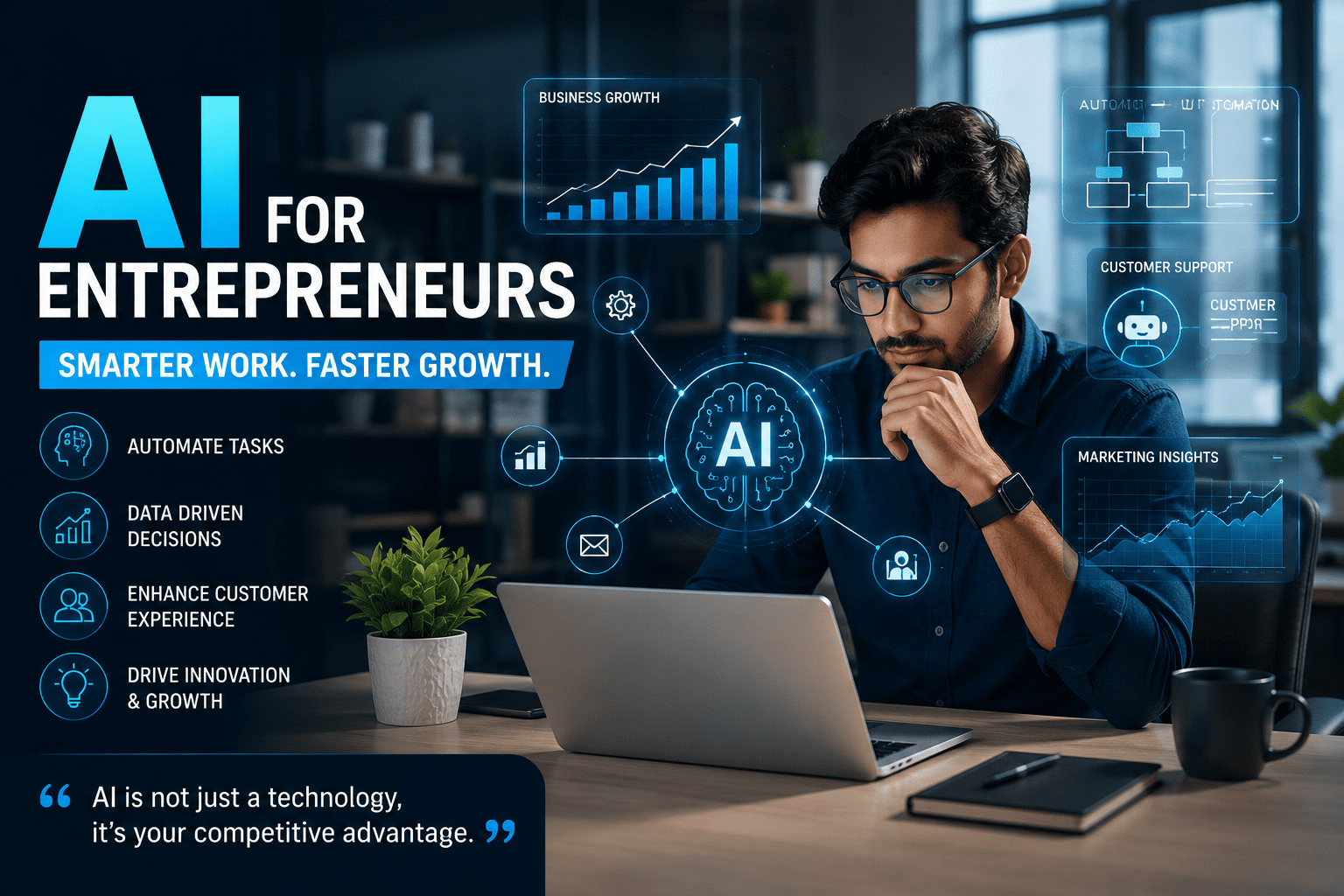
Artificial Intelligence (AI) is no longer a futuristic concept reserved for large corporations. Today, AI has become one of the most powerful tools available to entrepreneurs, startups, and small business owners. From automating repetitive tasks to improving customer experiences and making smarter business decisions, AI is revolutionizing the entrepreneurial landscape.
Whether you are launching a startup, managing an online business, or scaling an established company, understanding how AI can help your business is essential. This complete guide explores everything entrepreneurs need to know about AI, its benefits, applications, challenges, and future opportunities.
What Is Artificial Intelligence?
Artificial Intelligence refers to computer systems that can perform tasks that typically require human intelligence. These tasks include learning, reasoning, problem-solving, language understanding, image recognition, and decision-making.
Modern AI technologies include:
- Machine Learning (ML)
- Natural Language Processing (NLP)
- Generative AI
- Computer Vision
- Predictive Analytics
- Robotics Process Automation (RPA)
These technologies enable businesses to automate processes, gain insights from data, and deliver personalized experiences to customers.
Why AI Matters for Entrepreneurs
Entrepreneurs often face challenges such as limited budgets, small teams, and intense competition. AI helps overcome these obstacles by increasing efficiency and reducing operational costs.
Key Benefits of AI for Entrepreneurs
1. Increased Productivity
AI automates repetitive tasks such as:
- Data entry
- Scheduling
- Email management
- Customer support
- Inventory tracking
This allows entrepreneurs to focus on strategic business growth.
2. Better Decision-Making
AI analyzes large amounts of data and provides actionable insights. Entrepreneurs can use these insights to:
- Identify market trends
- Predict customer behavior
- Optimize pricing strategies
- Improve product development
3. Cost Savings
Businesses can reduce labor costs and operational expenses by automating routine processes. AI-powered tools often perform tasks faster and more accurately than manual methods.
4. Enhanced Customer Experience
AI enables businesses to provide:
- Personalized recommendations
- 24/7 customer support
- Faster response times
- Improved user experiences
Happy customers are more likely to become loyal customers.
5. Competitive Advantage
Entrepreneurs who adopt AI early can gain a significant advantage over competitors by improving efficiency, innovation, and customer satisfaction.
Top AI Applications for Entrepreneurs
AI-Powered Marketing
Marketing is one of the areas where AI delivers immediate value.
AI can help with:
- Content creation
- SEO optimization
- Email marketing
- Social media management
- Ad campaign optimization
Benefits include better targeting, higher conversion rates, and improved return on investment (ROI).
Customer Service Automation
AI chatbots and virtual assistants can handle customer inquiries around the clock.
Advantages include:
- Reduced support costs
- Faster issue resolution
- Increased customer satisfaction
- Improved engagement
Many startups use AI chatbots to manage customer interactions without hiring large support teams.
Sales Optimization
AI can improve sales performance by:
- Identifying high-quality leads
- Predicting customer purchases
- Automating follow-ups
- Personalizing sales communications
This helps entrepreneurs generate more revenue with less effort.
Financial Management
AI tools assist with:
- Expense tracking
- Budget forecasting
- Cash flow management
- Financial reporting
Entrepreneurs can make smarter financial decisions using AI-generated insights.
Human Resource Management
AI simplifies recruitment by:
- Screening resumes
- Matching candidates with job requirements
- Conducting initial assessments
- Predicting employee performance
This reduces hiring time and improves recruitment quality.
AI Tools Every Entrepreneur Should Know
Content Creation Tools
AI writing tools help create:
- Blog posts
- Social media content
- Product descriptions
- Marketing copy
These tools save time while maintaining content quality.
AI Design Tools
Entrepreneurs can generate:
- Logos
- Website graphics
- Social media visuals
- Marketing materials
without needing advanced design skills.
Analytics Tools
AI analytics platforms provide:
- Customer insights
- Market trends
- Business forecasts
- Performance metrics
This enables data-driven decision-making.
Automation Platforms
Workflow automation tools can connect different business applications and automate repetitive processes.
Examples include:
- Lead management
- Email automation
- Customer onboarding
- Data synchronization
How Entrepreneurs Can Implement AI Successfully
Step 1: Identify Business Challenges
Start by identifying areas where AI can solve problems or improve efficiency.
Ask questions such as:
- Which tasks consume the most time?
- Where are operational bottlenecks?
- Which processes are repetitive?
Step 2: Define Clear Objectives
Set measurable goals such as:
- Reducing costs by 20%
- Increasing lead conversions by 15%
- Improving customer response times
Clear objectives help measure AI success.
Step 3: Choose the Right Tools
Not every AI solution is suitable for every business. Select tools that align with your goals and budget.
Step 4: Train Your Team
Employees should understand how to use AI effectively. Training ensures successful adoption and maximizes ROI.
Step 5: Monitor and Optimize
Regularly evaluate AI performance and make adjustments as business needs evolve.
Common Challenges of AI Adoption
While AI offers significant benefits, entrepreneurs should also be aware of potential challenges.
Data Quality Issues
AI systems depend on accurate and relevant data. Poor-quality data can produce inaccurate results.
Initial Investment
Some AI solutions require upfront investment in software, infrastructure, and training.
Privacy Concerns
Businesses must ensure compliance with data protection regulations and maintain customer trust.
Skill Gaps
Teams may require additional training to effectively use AI-powered tools.
Future of AI for Entrepreneurs
The future of entrepreneurship is increasingly AI-driven. Emerging trends include:
Hyper-Personalization
Businesses will deliver highly customized products and services based on customer preferences and behaviors.
AI-Powered Decision Intelligence
Advanced AI systems will provide strategic recommendations for business growth and risk management.
Autonomous Business Operations
Many routine business functions will become fully automated, reducing manual intervention.
Voice and Conversational AI
Voice assistants and conversational interfaces will become essential customer engagement tools.
Predictive Business Management
AI will help entrepreneurs anticipate market shifts and adapt proactively.
Best Practices for Entrepreneurs Using AI
To maximize success:
- Start with small AI projects
- Focus on measurable outcomes
- Prioritize customer experience
- Maintain data quality
- Continuously monitor performance
- Stay updated with AI innovations
- Combine human expertise with AI capabilities
Businesses that strategically integrate AI can achieve sustainable growth and long-term success.
Conclusion
Artificial Intelligence is transforming entrepreneurship by making businesses more efficient, productive, and competitive. Entrepreneurs who embrace AI can automate routine tasks, improve customer experiences, optimize marketing efforts, and make smarter decisions based on data-driven insights.
As AI technology continues to evolve, its impact on startups and small businesses will only increase. By understanding AI’s potential and implementing it strategically, entrepreneurs can unlock new opportunities for innovation, growth, and profitability in 2026 and beyond.
The future belongs to entrepreneurs who leverage AI not as a replacement for human creativity but as a powerful tool to amplify their capabilities and drive business success.
Also read Top Startup Trends in India: The Future of Entrepreneurship in 2026





Leave a Reply