

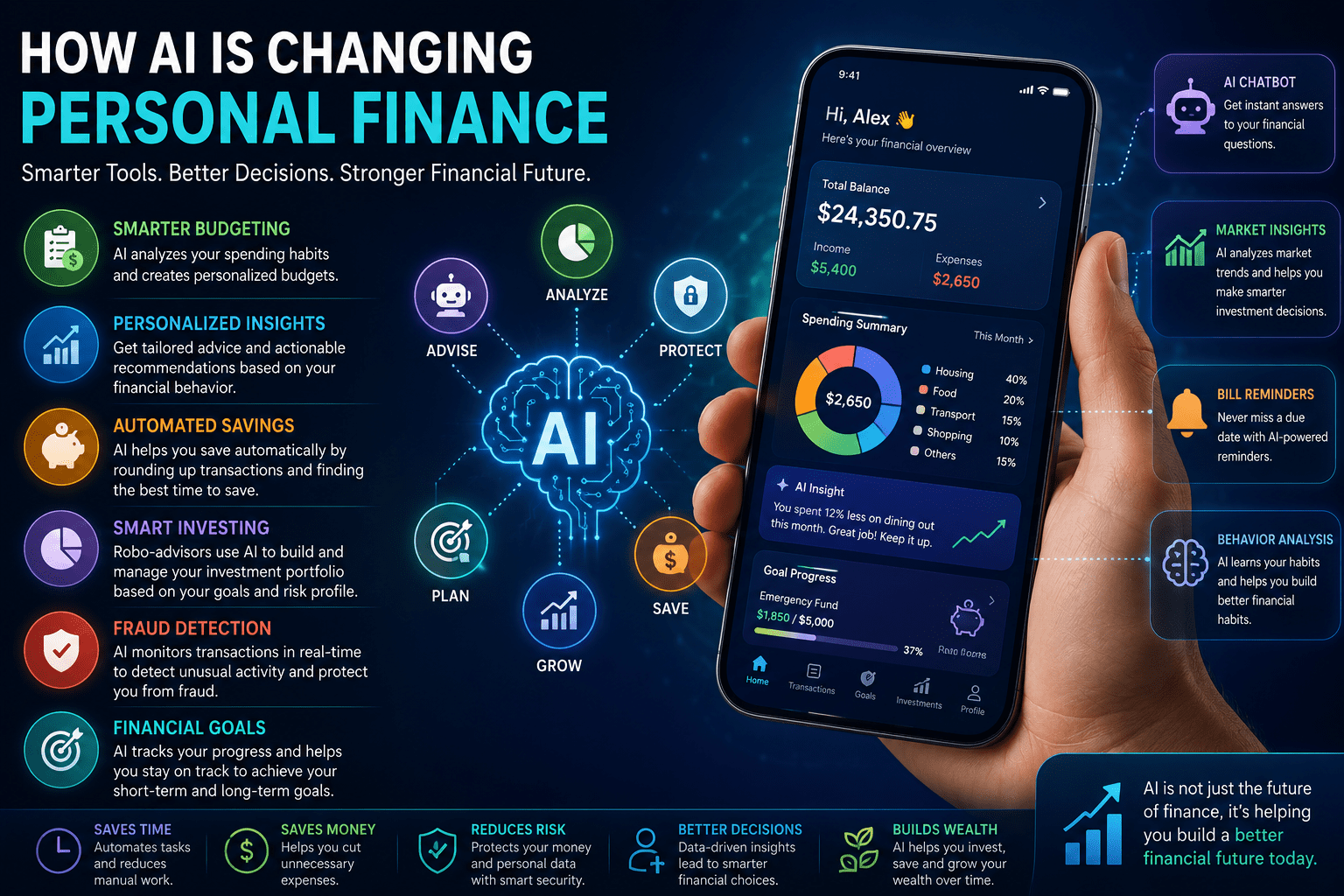
Artificial Intelligence (AI) is rapidly transforming the way people manage their money. From budgeting apps and robo-advisors to fraud detection systems and personalized financial recommendations, AI is making personal finance smarter, faster, and more accessible than ever before.
In the past, effective financial planning often required extensive research, manual tracking, and professional financial advisors. Today, AI-powered tools can analyze spending habits, automate savings, recommend investments, and help individuals make informed financial decisions in real time.
This article explores how AI is changing personal finance, its benefits, challenges, and what the future may hold for consumers and financial institutions.
What Is AI in Personal Finance?
AI in personal finance refers to the use of machine learning, data analytics, natural language processing, and automation technologies to help individuals manage their finances more effectively.
AI-powered financial tools can:
- Track spending habits
- Create personalized budgets
- Detect fraud
- Recommend investments
- Automate savings
- Predict future expenses
- Provide financial advice
These technologies help users gain better control over their financial lives while reducing the complexity of money management.
The Evolution of Personal Finance Management
Traditional Personal Finance
Historically, managing finances involved:
- Manual budgeting
- Paper records
- Bank visits
- Financial advisors
This process was often time-consuming and difficult to maintain consistently.
Digital Finance Era
The introduction of online banking and financial apps simplified many financial tasks.
Consumers gained access to:
- Mobile banking
- Digital payments
- Online investing
- Expense tracking tools
AI-Powered Finance
Today, AI is taking financial management to the next level by offering intelligent automation and personalized insights.
How AI Is Transforming Personal Finance
1. Smarter Budgeting and Expense Tracking
AI-powered budgeting apps automatically categorize expenses and analyze spending patterns.
Benefits include:
- Real-time spending alerts
- Budget recommendations
- Expense categorization
- Cash flow monitoring
Users can quickly identify areas where they may be overspending and adjust their financial habits accordingly.
2. Personalized Financial Advice
AI can analyze individual financial situations and provide tailored recommendations.
Examples include:
- Saving strategies
- Debt repayment plans
- Investment suggestions
- Retirement planning guidance
This level of personalization was once available only through professional financial advisors.
3. Automated Savings
One of AI’s most practical applications is automated savings.
AI systems can:
- Analyze income and spending habits
- Determine safe savings amounts
- Transfer money automatically into savings accounts
This helps individuals build emergency funds and achieve financial goals without requiring constant manual effort.
4. AI-Powered Investing
Investing has become more accessible thanks to AI-driven platforms.
Robo-Advisors
Robo-advisors use AI algorithms to:
- Assess risk tolerance
- Create investment portfolios
- Rebalance investments
- Optimize asset allocation
Benefits include:
- Lower fees
- Easy accessibility
- Automated portfolio management
- Data-driven decision-making
These platforms make investing easier for beginners and experienced investors alike.
5. Fraud Detection and Security
Financial fraud continues to be a major concern worldwide.
AI strengthens security by:
- Monitoring transactions in real time
- Detecting unusual activity
- Identifying suspicious behavior
- Preventing unauthorized access
Banks and financial institutions use AI to protect customers from fraud and cybercrime.
6. Credit Score Improvement
AI can help consumers understand and improve their credit profiles.
AI-powered tools can:
- Monitor credit activity
- Identify factors affecting scores
- Recommend actions for improvement
- Alert users to potential issues
This allows individuals to make smarter borrowing decisions.
7. Debt Management Assistance
Many people struggle with debt repayment.
AI tools can help by:
- Prioritizing debt payments
- Creating repayment schedules
- Suggesting refinancing options
- Tracking financial progress
These insights help users reduce debt more efficiently.
Benefits of AI in Personal Finance
Increased Financial Awareness
AI provides detailed insights into spending habits and financial behaviors.
Better Decision-Making
Data-driven recommendations help users make informed financial choices.
Time Savings
Automation reduces the need for manual financial management.
Improved Accessibility
More people can access financial guidance regardless of income level.
Enhanced Security
AI strengthens protection against fraud and financial threats.
Popular AI Applications in Personal Finance
Several financial technologies now incorporate AI features.
Budgeting Apps
AI-powered budgeting tools help users:
- Track expenses
- Manage budgets
- Set financial goals
Digital Banking
Modern banks use AI for:
- Customer support
- Fraud detection
- Transaction monitoring
Investment Platforms
AI-driven investment tools provide:
- Portfolio recommendations
- Risk assessments
- Market analysis
Personal Finance Assistants
Virtual financial assistants can answer questions and provide financial guidance instantly.
Challenges of AI in Personal Finance
Despite its advantages, AI also presents challenges.
Data Privacy Concerns
AI systems rely heavily on personal financial data.
Users must ensure they use secure and trustworthy platforms.
Algorithm Bias
AI recommendations are only as good as the data used to train them.
Biased data may result in inaccurate financial advice.
Lack of Human Judgment
AI cannot fully replace human expertise in complex financial situations.
Major financial decisions may still require professional guidance.
Technology Dependence
Overreliance on automation can reduce financial literacy if users do not understand the underlying principles.
AI and Financial Literacy
AI has the potential to improve financial education significantly.
AI-powered learning platforms can teach users about:
- Budgeting
- Saving
- Investing
- Debt management
- Retirement planning
Personalized educational content helps individuals improve their financial knowledge over time.
Will AI Replace Financial Advisors?
AI is unlikely to completely replace human financial advisors.
While AI excels at:
- Data analysis
- Automation
- Portfolio management
Human advisors provide:
- Emotional intelligence
- Complex financial planning
- Personalized life guidance
- Strategic decision-making
The future will likely involve collaboration between AI systems and financial professionals.
The Future of AI in Personal Finance
The role of AI in personal finance will continue to expand.
Future developments may include:
Hyper-Personalized Financial Planning
AI will create highly customized financial strategies based on individual lifestyles and goals.
Predictive Financial Management
AI may forecast financial challenges before they occur and recommend preventive actions.
Advanced Wealth Management
Investment platforms will become increasingly sophisticated and responsive to market conditions.
Voice-Powered Financial Assistants
Consumers may manage finances using voice commands through smart devices.
Greater Financial Inclusion
AI can help underserved populations access financial services and guidance.
Tips for Using AI in Personal Finance
To maximize the benefits of AI-powered financial tools:
- Use reputable financial platforms.
- Monitor recommendations carefully.
- Maintain strong cybersecurity practices.
- Continue learning financial fundamentals.
- Combine AI insights with personal judgment.
- Regularly review financial goals.
- Protect sensitive financial information.
AI works best when paired with informed financial decision-making.
Conclusion
Artificial Intelligence is reshaping personal finance by making money management more intelligent, efficient, and accessible. From budgeting and investing to fraud prevention and debt management, AI-powered tools are helping individuals take greater control of their financial futures.
While challenges such as data privacy and algorithm limitations remain, the benefits of AI in personal finance are significant. As technology continues to evolve, AI will play an increasingly important role in helping people achieve financial security, build wealth, and make smarter financial decisions.













Leave a Reply