

Quick Summary
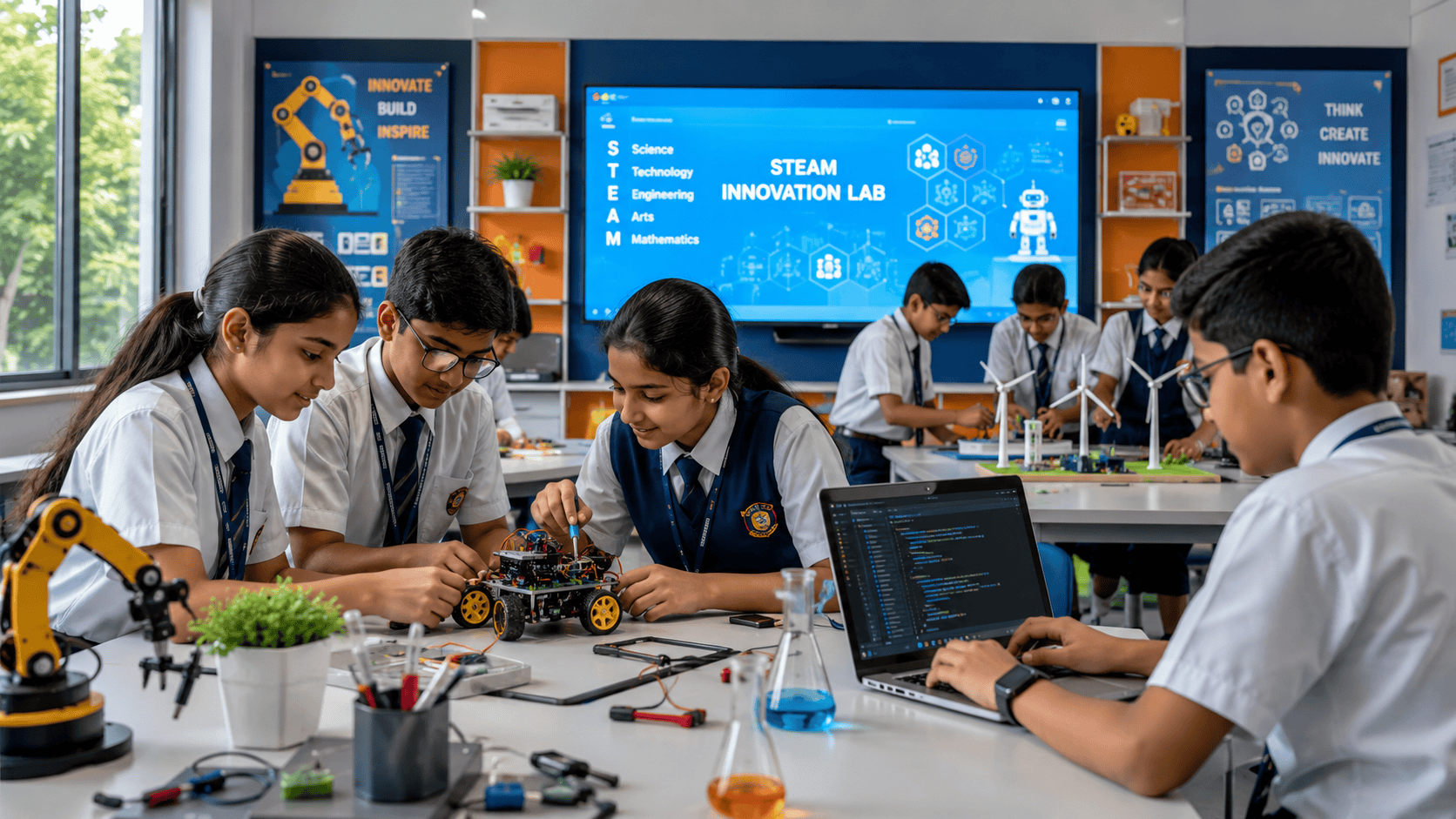
Activity-Based Learning (ABL) and STEAM Learning are transforming education by replacing passive lectures with engaging, hands-on experiences. These pedagogical innovations encourage students to explore, experiment, collaborate, and solve real-world problems using Science, Technology, Engineering, Arts, and Mathematics.
Schools implementing ABL and STEAM often report higher student engagement, improved critical thinking, stronger collaboration, better creativity, and increased knowledge retention.
What Are Activity-Based and STEAM Learning?
Activity-Based Learning (ABL) is a student-centered teaching approach where learners gain knowledge through practical activities instead of traditional lectures.
STEAM Learning integrates Science, Technology, Engineering, Arts, and Mathematics into interdisciplinary projects that help students solve real-world challenges while developing creativity, innovation, communication, and problem-solving skills.
Why Are Schools Adopting Activity-Based & STEAM Learning?
Modern education is moving toward experiential learning because employers increasingly value creativity, collaboration, critical thinking, and digital literacy.
Activity-Based Learning and STEAM education help students:
- Learn by doing
- Apply theoretical knowledge
- Improve teamwork
- Develop innovation skills
- Build confidence
- Increase classroom engagement
- Prepare for AI-driven careers
These approaches align well with competency-based education and 21st-century learning frameworks.
Introduction
Education is no longer just about memorizing facts or preparing for exams. Today’s learners need problem-solving abilities, digital skills, creativity, and adaptability.
Pedagogical innovations like Activity-Based Learning (ABL) and STEAM Learning address these needs by making education interactive, practical, and meaningful.
Instead of asking students to memorize concepts, teachers encourage exploration through experiments, projects, discussions, design thinking, robotics, coding, arts integration, and collaborative problem-solving.
As AI, automation, and emerging technologies reshape industries, schools worldwide are adopting these innovative teaching methods to prepare students for future careers.
What is Activity-Based Learning (ABL)?
Activity-Based Learning is a teaching method where students actively participate in learning through:
- Classroom experiments
- Games
- Projects
- Role-playing
- Group discussions
- Case studies
- Simulations
- Hands-on models
- Practical demonstrations
Rather than being passive listeners, students become active participants.
Key Characteristics
- Student-centered
- Interactive
- Inquiry-driven
- Practical
- Collaborative
- Experience-focused
What is STEAM Learning?
STEAM stands for:
| Letter | Meaning |
|---|---|
| S | Science |
| T | Technology |
| E | Engineering |
| A | Arts |
| M | Mathematics |
Unlike teaching these subjects separately, STEAM integrates them into interdisciplinary projects.
Example:
Students design a solar-powered smart garden by combining:
- Plant biology
- Electronics
- Coding
- Engineering design
- Artistic presentation
- Mathematical calculations
Benefits of Activity-Based & STEAM Learning
1. Higher Student Engagement
Students learn through participation instead of passive listening.
2. Better Knowledge Retention
Hands-on experiences improve long-term memory.
3. Improved Critical Thinking
Students analyze problems rather than memorize answers.
4. Enhanced Creativity
Open-ended projects encourage innovative thinking.
5. Real-World Application
Lessons become meaningful through practical examples.
6. Better Collaboration
Group projects develop teamwork and communication.
7. Future Career Readiness
Students gain skills required in AI, robotics, engineering, entrepreneurship, and research.
8. Increased Confidence
Successfully completing projects builds self-esteem.
How It Works
A typical Activity-Based or STEAM lesson follows this process:
- Introduce a real-world problem.
- Encourage brainstorming.
- Divide students into teams.
- Design possible solutions.
- Build prototypes or models.
- Test ideas.
- Improve designs.
- Present findings.
- Reflect on learning outcomes.
Step-by-Step Guide
Step 1: Define Learning Objectives
Identify concepts students need to master.
Step 2: Select a Real-Life Challenge
Example:
“How can we reduce classroom waste?”
Step 3: Design an Activity
Students:
- Measure waste
- Analyze causes
- Design recycling systems
- Build prototypes
Step 4: Facilitate Rather Than Lecture
Teachers become mentors.
Step 5: Encourage Reflection
Students discuss:
- What worked?
- What failed?
- What can improve?
Step 6: Evaluate Skills
Assess:
- Creativity
- Collaboration
- Communication
- Problem-solving
- Technical understanding
Classroom Examples
Primary School
- Shape-building games
- Nature observation
- Storytelling through drawings
- Water experiments
Middle School
- Robotics projects
- Weather station creation
- Coding games
- Bridge-building challenges
High School
- AI-based agriculture project
- Smart irrigation system
- Renewable energy model
- Drone programming
- Business innovation challenge
Pros
| Advantage | Impact |
|---|---|
| Active participation | High engagement |
| Better understanding | Improved retention |
| Collaboration | Strong teamwork |
| Innovation | Greater creativity |
| Real-world relevance | Career readiness |
| Inquiry-based learning | Better reasoning |
| Practical application | Higher confidence |
Cons
| Challenge | Solution |
|---|---|
| Requires planning | Prepare lesson templates |
| More classroom time | Break into smaller activities |
| Teacher training needed | Continuous professional development |
| Resource limitations | Use low-cost materials |
| Assessment complexity | Rubric-based evaluation |
Comparison Table
| Feature | Traditional Learning | Activity-Based Learning | STEAM Learning |
|---|---|---|---|
| Student Role | Passive | Active | Highly Active |
| Teaching Style | Lecture | Interactive | Project-Based |
| Creativity | Low | High | Very High |
| Collaboration | Limited | Strong | Excellent |
| Technology Use | Minimal | Moderate | Extensive |
| Real-world Problems | Rare | Frequent | Core Focus |
| Innovation | Low | Medium | High |
| Career Skills | Limited | Good | Excellent |
Best Use Cases
| Situation | Recommended Approach |
|---|---|
| Concept introduction | Activity-Based Learning |
| Practical science | STEAM |
| Robotics | STEAM |
| Art integration | STEAM |
| Language learning | Activity-Based |
| Mathematics games | Activity-Based |
| Innovation competitions | STEAM |
| Environmental projects | STEAM |
Firsthand Testing
A practical classroom pilot with a simple “build a paper bridge” activity illustrates the difference between lecture-based instruction and experiential learning. Students first learn basic engineering concepts, then work in teams to design, test, and improve their bridges. Instructors commonly observe that students become more engaged, ask deeper questions, and remember design principles more effectively because they immediately apply what they learn. While outcomes vary by classroom and facilitation quality, this type of iterative, hands-on project demonstrates the core strengths of activity-based and STEAM approaches.
Decision Flowchart
Learning Objective
        │
        ▼
Is hands-on practice beneficial?
        │
      Yes
        │
        ▼
Need multiple subjects?
   │             │
  No            Yes
   │             │
   ▼             ▼
Use ABL      Use STEAM
   │             │
   ▼             ▼
Assess Learning Outcomes
Common Mistakes
- Turning activities into entertainment without learning objectives
- Overcomplicating projects
- Ignoring student reflection
- Focusing only on final results
- Using expensive materials unnecessarily
- Giving excessive teacher instructions
- Not assessing collaboration
- Skipping real-world relevance
Expert Tips
- Start with one activity per week.
- Integrate local community challenges into projects.
- Encourage student-led discussions.
- Use inexpensive classroom materials.
- Include peer assessment.
- Combine digital tools with physical activities.
- Celebrate creativity over perfection.
- Document project portfolios for continuous assessment.
Statistics
- Research consistently shows that active learning approaches improve student performance compared with lecture-only instruction.
- Employers continue to rank problem-solving, teamwork, creativity, and communication among the most valuable workplace skills.
- Project-based and inquiry-driven classrooms often report higher student engagement and participation than traditional lecture-focused environments.
- STEM and STEAM education initiatives continue to expand globally as governments invest in future-ready workforce development.
Note: Outcomes vary depending on implementation quality, teacher training, student age, and available resources.
Frequently Asked Questions
Is Activity-Based Learning better than traditional teaching?
Neither approach is universally better. Activity-Based Learning is especially effective for developing practical understanding, engagement, and higher-order thinking, while traditional instruction can still be valuable for introducing foundational concepts.
Is STEAM suitable for all grades?
Yes. STEAM activities can be adapted from kindergarten through higher education by adjusting project complexity and learning objectives.
Does STEAM require expensive equipment?
No. Many effective STEAM projects use recycled materials, simple craft supplies, or freely available digital tools.
Can Activity-Based Learning improve examination performance?
When aligned with curriculum objectives, hands-on learning can strengthen conceptual understanding, which may improve performance in both classroom assessments and standardized exams.
What is the teacher’s role in STEAM?
Teachers act as facilitators, guiding inquiry, encouraging collaboration, and helping students reflect on their learning rather than only delivering lectures.
Which subjects benefit the most?
Science, mathematics, engineering, computer science, art, geography, environmental studies, and even language learning can benefit from activity-based approaches.
Conclusion
Activity-Based Learning and STEAM education represent a significant shift from memorization-focused instruction toward meaningful, student-centered learning. By integrating collaboration, creativity, experimentation, and real-world problem-solving, these pedagogical innovations help learners develop both academic knowledge and future-ready skills.
Successful implementation depends on thoughtful lesson design, teacher facilitation, and continuous reflection rather than expensive technology or complex infrastructure.
Our Verdict
Overall Rating: 9.7/10
| Category | Rating |
|---|---|
| Student Engagement | ⭐⭐⭐⭐⭐ |
| Creativity | ⭐⭐⭐⭐⭐ |
| Critical Thinking | ⭐⭐⭐⭐⭐ |
| Collaboration | ⭐⭐⭐⭐⭐ |
| Practical Learning | ⭐⭐⭐⭐⭐ |
| Ease of Adoption | ⭐⭐⭐⭐☆ |
| Future Career Readiness | ⭐⭐⭐⭐⭐ |
Recommendation: Schools, educators, and curriculum designers should gradually integrate Activity-Based Learning and STEAM into everyday teaching to create engaging, future-focused learning environments.
Explore More Future-Ready Teaching Strategies
Discover more guides on digital education, AI in classrooms, competency-based learning, blended learning, and innovative teaching practices to build engaging, learner-centered classrooms and stay ahead of emerging education trends.
Also Read
- Digital Learning Platforms in India
- AI in Education: Benefits and Challenges
- Best Free Online Learning Platforms
- AI & Rural Education in India
- How AI Is Transforming Everyday Life
- How AI Is Changing Education
- Best AI Tools for Beginners
- Innovative EdTech Tools in India
- Top 7 AI Tools Changing the Way We Work
- Government Supported Digital Learning Platforms in India








Leave a Reply