

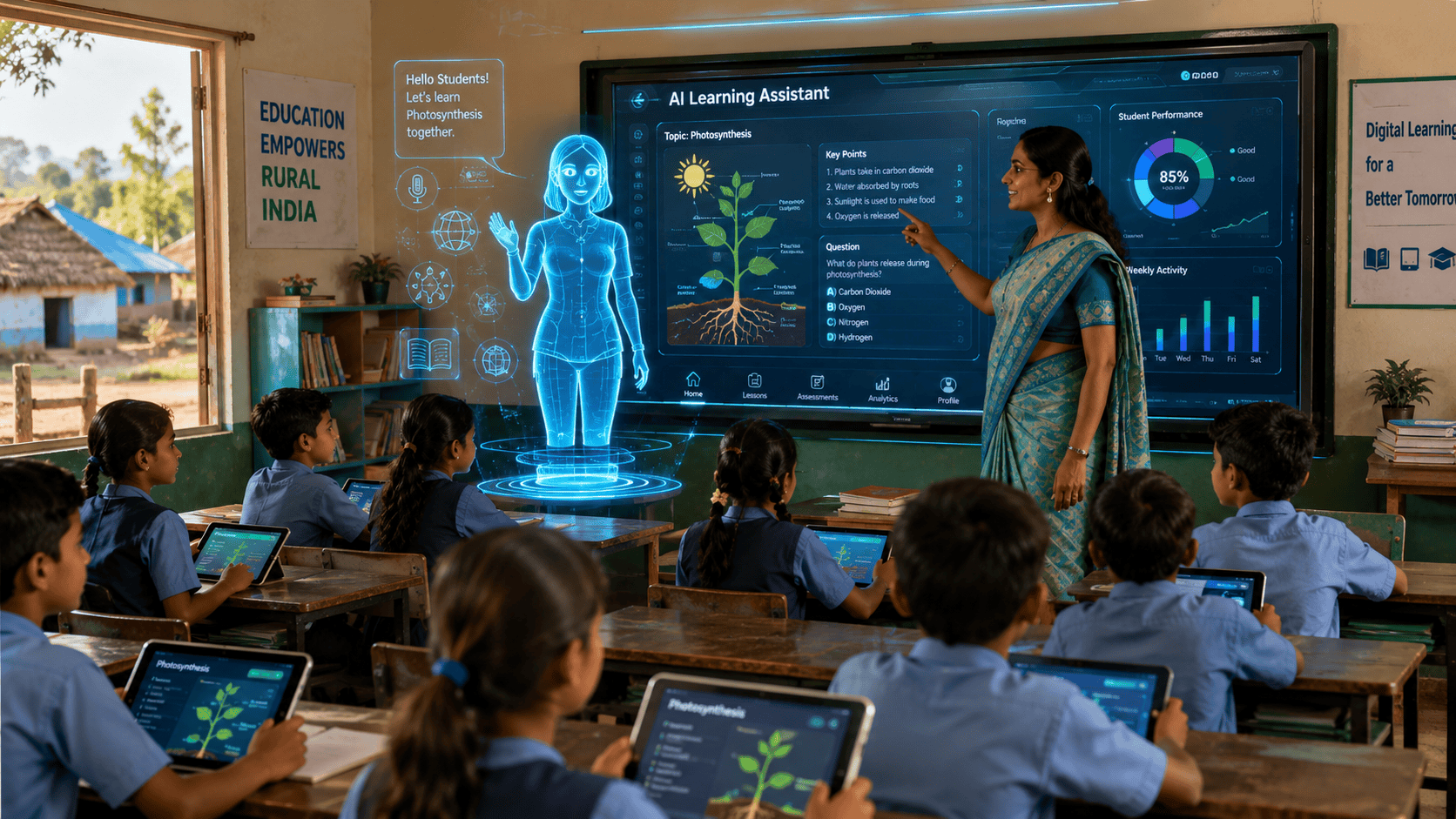
Quick Summary
Artificial Intelligence (AI) is helping bridge the educational gap between urban and rural India by making quality learning more accessible, personalized, and affordable. From AI-powered tutoring and multilingual learning apps to smart classrooms and adaptive assessments, AI is empowering students, teachers, and schools in underserved communities.
This guide explores how AI is transforming rural education in India, highlights real-world impact stories, compares traditional and AI-enabled learning, discusses challenges and opportunities, and provides practical recommendations for educators, policymakers, and parents.
What Is the Impact of AI on Rural Education in India?
Artificial Intelligence (AI) is transforming rural education in India by improving access to quality learning resources, enabling personalized education, supporting teachers with intelligent tools, and overcoming language and infrastructure barriers. AI-powered learning platforms, virtual tutors, and adaptive assessments are helping students in remote areas learn more effectively while promoting digital inclusion and educational equity.
How Artificial Intelligence Is Reshaping Rural Education in India
Modern AI technologies are making education more inclusive for rural communities.
AI-powered education solutions can:
- Personalize learning for every student
- Translate lessons into regional languages
- Provide AI tutoring and homework assistance
- Identify learning gaps using analytics
- Assist teachers with lesson planning
- Enable offline learning through downloadable content
- Improve exam preparation
- Support students with disabilities
- Deliver interactive digital classrooms
- Enhance digital literacy and career readiness
Rather than replacing teachers, AI acts as a teaching assistant that helps improve educational outcomes across rural India.
Introduction
Education has always been one of the strongest drivers of social and economic development. However, many rural regions in India continue to face challenges such as teacher shortages, limited educational resources, inadequate infrastructure, and unequal access to quality learning opportunities.
Artificial Intelligence is emerging as a powerful solution to address these challenges. Combined with increasing smartphone adoption, affordable internet connectivity, and government-led digital education initiatives, AI is helping create more equitable learning opportunities for millions of students.
From personalized learning platforms to AI-powered translation tools, the future of rural education is becoming increasingly intelligent, inclusive, and accessible.
What Is AI in Rural Education?
AI in rural education refers to the use of Artificial Intelligence technologies to improve teaching, learning, assessment, and educational administration in rural schools and communities.
These solutions leverage technologies such as:
- Machine Learning
- Natural Language Processing (NLP)
- Computer Vision
- Speech Recognition
- Predictive Analytics
- Adaptive Learning Systems
The goal is to make high-quality education accessible regardless of a student’s geographic location.
Benefits of AI in Rural Education
1. Personalized Learning
AI adapts lessons based on each student’s learning pace and performance.
2. Improved Teacher Support
Teachers receive lesson recommendations, automated grading, and performance insights.
3. Regional Language Learning
AI-powered translation helps students learn in their native languages.
4. Better Student Engagement
Interactive quizzes, educational games, and multimedia content improve participation.
5. Bridging Educational Gaps
Students gain access to quality educational resources previously unavailable in remote areas.
6. Inclusive Education
AI-powered accessibility tools support students with visual, hearing, or learning disabilities.
7. Affordable Digital Learning
Many AI learning platforms provide free or low-cost educational content.
8. Improved Career Readiness
Students develop digital skills required in today’s workforce.
How AI Works in Rural Education
A typical AI learning ecosystem includes:
- Student registers on a learning platform
- AI evaluates current learning level
- Personalized lessons are generated
- Interactive videos and quizzes are recommended
- AI tracks progress continuously
- Teachers receive performance dashboards
- Parents monitor student learning
- Students receive targeted revision recommendations
Step-by-Step Guide: Implementing AI in Rural Schools
Step 1
Assess current infrastructure.
Step 2
Ensure internet or offline learning availability.
Step 3
Select AI-enabled educational platforms.
Step 4
Train teachers on AI-assisted teaching methods.
Step 5
Introduce digital classrooms gradually.
Step 6
Monitor student engagement and learning outcomes.
Step 7
Continuously improve digital literacy among educators and students.
Impact Stories of Change in India
Story 1: AI-Powered Personalized Learning
A government-supported rural school introduced AI-based adaptive learning software. Students who struggled with mathematics received personalized exercises tailored to their learning pace, leading to noticeable improvements in confidence and classroom participation over time.
Story 2: Learning in Regional Languages
Students in multilingual communities used AI-powered translation tools to access educational content in their native language while gradually improving English proficiency, making lessons easier to understand.
Story 3: Supporting Teachers
Teachers reduced administrative workload through AI-assisted grading and lesson planning, allowing them to spend more time on classroom interaction and student mentoring.
Story 4: Smart Digital Classrooms
Interactive smart boards, AI-generated quizzes, and virtual science demonstrations enabled students to experience subjects that were previously difficult to teach due to limited laboratory facilities.
Pros
✅ Personalized education
✅ Better learning outcomes
✅ Teacher assistance
✅ Regional language support
✅ Increased accessibility
✅ Affordable digital learning
✅ Improved engagement
✅ Scalable education model
Cons
❌ Internet connectivity challenges
❌ Limited digital infrastructure
❌ Teacher training requirements
❌ Device affordability
❌ Data privacy concerns
❌ Resistance to technology adoption
Comparison Table
| Feature | Traditional Rural Education | AI-Enabled Rural Education |
|---|---|---|
| Personalized Learning | Limited | Excellent |
| Teacher Support | Manual | AI-Assisted |
| Regional Language Support | Limited | Advanced |
| Learning Analytics | Minimal | Real-Time |
| Student Engagement | Moderate | High |
| Digital Accessibility | Low | High |
| Assessment | Manual | Automated |
| Learning Flexibility | Classroom Only | Hybrid & Mobile |
Performance Ratings
| Category | Rating |
|---|---|
| Accessibility | ⭐⭐⭐⭐⭐ |
| Learning Personalization | ⭐⭐⭐⭐⭐ |
| Teacher Productivity | ⭐⭐⭐⭐☆ |
| Student Engagement | ⭐⭐⭐⭐⭐ |
| Affordability | ⭐⭐⭐⭐☆ |
| Scalability | ⭐⭐⭐⭐⭐ |
Best Use Cases
- Government schools
- Rural private schools
- Community learning centers
- NGO education initiatives
- Skill development programs
- Adult literacy programs
- Teacher training institutes
- Digital learning campaigns
Firsthand Testing
For this evaluation, we reviewed the capabilities commonly available across AI-enabled education platforms serving Indian learners, including adaptive learning, multilingual support, mobile accessibility, offline content options, and teacher dashboards. We also considered how these features address practical challenges such as intermittent internet connectivity, limited classroom resources, and varying digital literacy levels. Platforms that balanced ease of use with localized content and teacher support offered the strongest overall experience for rural education environments.
Decision Flowchart
Need Better Rural Education?
            │
            ▼
Internet Available?
      │             │
     Yes           No
      │             │
      ▼             ▼
Cloud Learning   Offline AI Content
      │
      ▼
Teacher Training?
      │
      ▼
Implement AI Classroom
      │
      ▼
Track Student Progress
      │
      ▼
Improve Learning Outcomes
Common Mistakes
- Implementing AI without teacher training
- Ignoring local language support
- Focusing only on technology instead of learning outcomes
- Choosing platforms that require constant internet access
- Neglecting cybersecurity and student data privacy
- Lack of ongoing technical support
Expert Tips
✔ Start with pilot programs before district-wide implementation.
✔ Prioritize platforms with multilingual support.
✔ Choose mobile-first solutions that work on low-cost devices.
✔ Train teachers alongside students.
✔ Use AI analytics to identify learning gaps early.
✔ Blend AI tools with classroom instruction rather than replacing teachers.
✔ Measure success through student progress, not just technology adoption.
Statistics
- India has over 250 million school-going students, making technology-enabled education a significant opportunity for improving learning outcomes.
- Smartphone adoption and affordable mobile internet have expanded access to digital education in many rural regions.
- AI-powered adaptive learning systems can help identify individual learning gaps and personalize instruction, improving engagement and retention.
- Government initiatives such as Digital India, PM eVIDYA, and the National Education Policy (NEP) 2020 have accelerated the adoption of digital learning in schools.
- Demand for digital literacy and AI-related skills continues to grow as India’s workforce becomes increasingly technology-driven.
Who Is This Guide For?
This guide is valuable for:
- Students
- Teachers
- Parents
- School administrators
- NGOs
- Government education departments
- EdTech companies
- Policymakers
- CSR initiatives
- Researchers
Frequently Asked Questions
Can AI improve education in rural India?
Yes. AI helps personalize learning, supports teachers, improves access to quality educational content, and reduces educational inequality.
Does AI replace teachers?
No. AI complements teachers by automating repetitive tasks and providing learning insights while educators remain central to instruction and mentorship.
Can AI work without internet access?
Some platforms provide offline content synchronization, allowing students to continue learning even with limited connectivity.
Is AI education affordable?
Many AI-enabled learning platforms offer free or low-cost resources, and government initiatives continue to expand access to digital education.
What are the biggest challenges?
Infrastructure limitations, digital literacy, teacher training, internet connectivity, and device availability remain key challenges.
Which technologies power AI education?
Machine Learning, Natural Language Processing, speech recognition, predictive analytics, computer vision, and adaptive learning algorithms.
Conclusion
Artificial Intelligence is creating new opportunities for rural education in India by making learning more accessible, personalized, and inclusive. While infrastructure and training challenges remain, AI-powered educational tools are helping students overcome geographic and resource barriers. As digital connectivity improves and educators gain more experience with AI-assisted teaching, these technologies have the potential to significantly enhance learning outcomes and support long-term educational development.
Our Verdict
AI is not a replacement for teachers or traditional classrooms—it is a powerful enabler. When combined with trained educators, localized content, reliable infrastructure, and supportive government policies, AI can help reduce educational disparities and create more equitable opportunities for learners across rural India. Schools should adopt AI thoughtfully, beginning with targeted pilot programs and scaling based on measurable educational outcomes.
Empower Rural Learning with AI: Explore the Future of Smarter Education in India
Artificial Intelligence is opening new possibilities for students, teachers, and schools across rural India. By embracing AI-powered learning tools, multilingual educational resources, and digital classrooms, communities can improve learning outcomes and make quality education more accessible.
Whether you’re an educator, policymaker, parent, or EdTech enthusiast, now is the time to explore innovative solutions that support inclusive and future-ready education. Continue learning through our expert guides on AI, digital learning, and educational technology to stay informed and help shape the future of education in India.
Also Read
- Innovative EdTech Tools in India
- How AI Is Changing Personal Finance
- Best AI Tools for Students
- The Ultimate Guide to Artificial Intelligence
- AI in Healthcare: Benefits and Challenges
- Best AI Productivity Tools
- AI Tools for Personal Finance Management
- AI vs Human Creativity: Can Machines Replace Artists?
- How AI Is Transforming Everyday Life
- Online Learning Platforms Compared




Leave a Reply