

Artificial Intelligence (AI) has rapidly evolved over the past decade, transforming industries and changing how people interact with technology. While most people are familiar with AI tools that answer questions, generate content, or analyze data, a new and exciting development is gaining attention: Agentic AI.
Agentic AI represents the next generation of intelligent systems that can not only respond to commands but also plan, make decisions, and perform tasks autonomously to achieve specific goals. For beginners, the concept may sound complex, but understanding Agentic AI is easier than you might think.
In this guide, we’ll explain Agentic AI in simple terms, how it works, its advantages, real-world applications, and why it could shape the future of technology.
What Is Agentic AI?
Agentic AI refers to artificial intelligence systems that can act independently to accomplish objectives with minimal human intervention.
Traditional AI systems typically wait for user instructions before performing tasks. Agentic AI, however, can:
- Understand goals
- Create plans
- Make decisions
- Execute actions
- Adapt based on results
- Learn from feedback
Think of Agentic AI as a digital assistant that doesn’t just answer your questions—it actively works toward completing a task from start to finish.
Simple Example
Traditional AI:
User: “Write an email inviting clients to a webinar.”
AI: Generates the email.
Agentic AI:
User: “Help me promote my webinar.”
Agentic AI:
- Creates marketing emails
- Designs social media posts
- Schedules content
- Tracks engagement
- Optimizes future promotions
Instead of completing a single request, it manages an entire workflow.
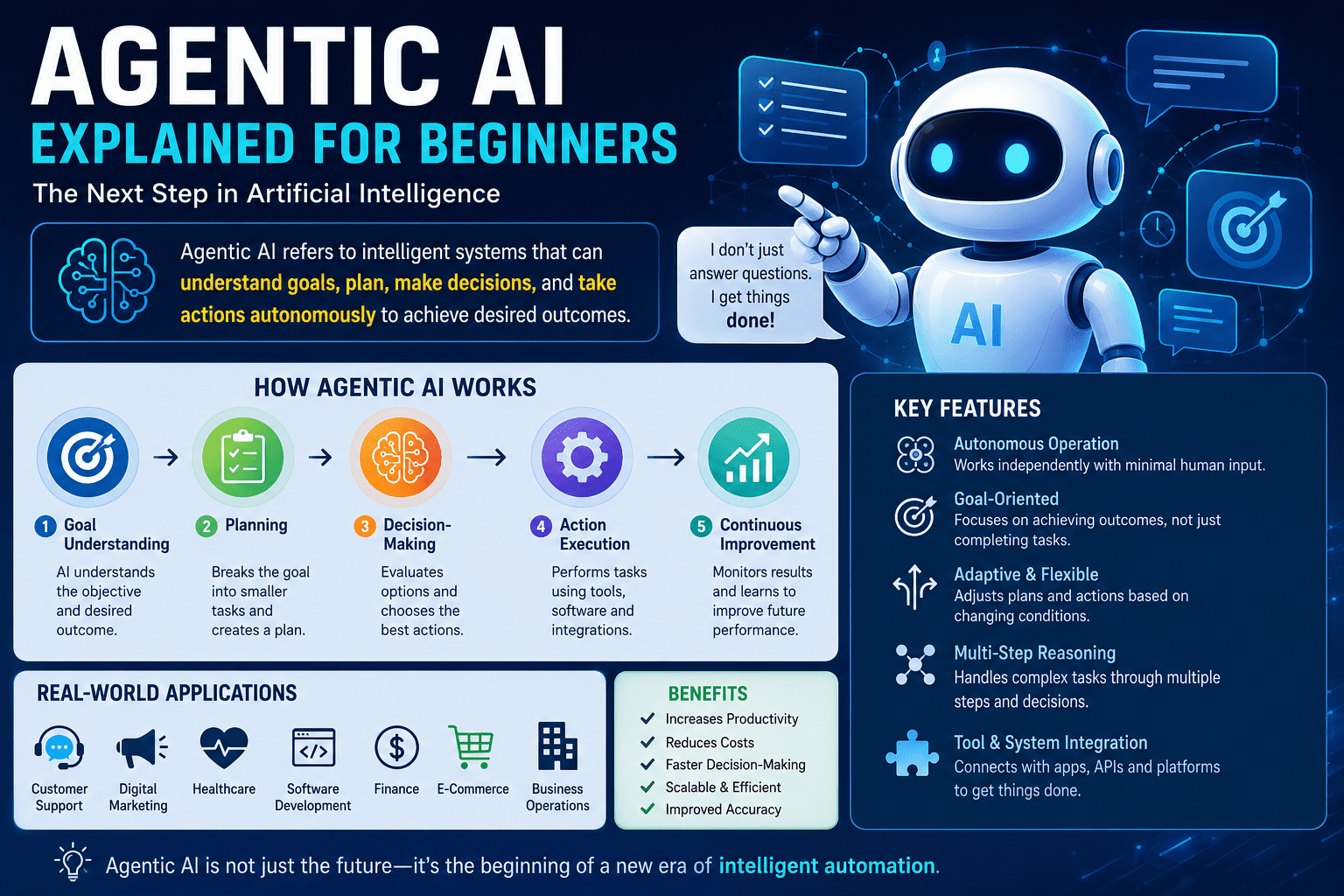
How Agentic AI Works
Agentic AI combines several advanced technologies to function autonomously.
1. Goal Understanding
The AI first interprets the objective provided by the user.
Example:
“Increase website traffic by 20%.”
The AI identifies the desired outcome and begins planning.
2. Planning
The system breaks down the goal into smaller tasks.
For example:
- Analyze website traffic
- Identify growth opportunities
- Create content strategy
- Schedule marketing campaigns
3. Decision-Making
Agentic AI evaluates available options and selects the best course of action.
Unlike traditional automation, it can adjust decisions based on changing conditions.
4. Action Execution
The AI performs tasks using connected tools and software.
Examples include:
- Sending emails
- Creating reports
- Updating databases
- Managing workflows
5. Continuous Improvement
Agentic AI monitors outcomes and refines its approach over time.
This feedback loop helps improve performance and efficiency.
Key Features of Agentic AI
Autonomous Operation
Agentic AI can function independently without constant human guidance.
Goal-Oriented Behavior
Instead of simply responding to prompts, it focuses on achieving outcomes.
Multi-Step Reasoning
It can solve complex problems through multiple stages of analysis and execution.
Adaptability
Agentic AI can change strategies when circumstances evolve.
Tool Integration
Many agentic systems interact with external applications, APIs, databases, and business software.
Agentic AI vs Traditional AI
| Feature | Traditional AI | Agentic AI |
|---|---|---|
| Responds to prompts | Yes | Yes |
| Plans tasks | Limited | Advanced |
| Makes decisions | Minimal | Extensive |
| Works autonomously | Rarely | Frequently |
| Executes workflows | Limited | Yes |
| Learns from outcomes | Basic | Continuous |
Agentic AI takes AI capabilities far beyond simple question-and-answer interactions.
Benefits of Agentic AI
Increased Productivity
Businesses can automate complex processes that previously required multiple employees.
Faster Decision-Making
AI agents analyze information and act more quickly than humans in many scenarios.
Cost Savings
Automation reduces operational expenses and improves efficiency.
Scalability
Agentic systems can handle large volumes of tasks simultaneously.
Improved Accuracy
AI can minimize human errors in repetitive and data-driven processes.
Real-World Applications of Agentic AI
Customer Support
AI agents can:
- Answer customer inquiries
- Resolve common issues
- Escalate complex cases
- Track customer satisfaction
Digital Marketing
Agentic AI can:
- Create content
- Optimize campaigns
- Analyze performance
- Adjust advertising strategies
Healthcare
Applications include:
- Patient scheduling
- Medical data analysis
- Treatment recommendations
- Administrative automation
Software Development
AI agents assist developers by:
- Writing code
- Testing applications
- Finding bugs
- Managing deployments
Finance
Financial organizations use agentic systems for:
- Risk assessment
- Fraud detection
- Investment analysis
- Compliance monitoring
Popular Agentic AI Technologies
Several modern AI systems are moving toward agentic capabilities.
Examples include:
- AI workflow automation platforms
- Autonomous research assistants
- AI coding agents
- Business process automation tools
- Intelligent virtual assistants
As technology advances, more products will incorporate agentic features.
Challenges and Risks of Agentic AI
While Agentic AI offers significant benefits, there are also challenges.
Security Concerns
Autonomous systems must be protected against misuse and cyber threats.
Ethical Issues
Organizations need clear guidelines for AI decision-making.
Accuracy Problems
Incorrect decisions can occur if the AI receives poor-quality data.
Oversight Requirements
Human supervision remains essential for high-stakes decisions.
Privacy Considerations
AI systems often process large amounts of sensitive information.
Responsible development and governance are critical for safe adoption.
The Future of Agentic AI
Experts believe Agentic AI will become a major technological trend over the next decade.
Future advancements may include:
- Fully autonomous business workflows
- Personalized AI assistants
- Smart enterprise management systems
- Advanced healthcare support
- Intelligent scientific research assistants
Rather than replacing humans entirely, Agentic AI is likely to enhance human capabilities by handling repetitive and time-consuming tasks.
How Beginners Can Start Learning Agentic AI
If you’re interested in learning about Agentic AI, start with these steps:
Learn AI Fundamentals
Understand:
- Machine learning
- Large language models
- Natural language processing
Explore AI Tools
Experiment with modern AI platforms and assistants.
Study Automation
Learn how workflows and automation systems operate.
Follow Industry Trends
Read blogs, research papers, and technology news related to AI developments.
Practice Building Simple AI Agents
Many beginner-friendly tools allow users to create basic autonomous workflows without coding.
Conclusion
Agentic AI represents a significant leap forward in artificial intelligence. Unlike traditional AI systems that simply respond to commands, Agentic AI can plan, decide, execute tasks, and adapt to achieve specific goals autonomously.
As businesses and individuals increasingly adopt intelligent automation, understanding Agentic AI will become an important skill for the future. Whether you’re a student, entrepreneur, or technology enthusiast, learning about Agentic AI today can help you stay ahead in the rapidly evolving digital landscape.
The future of AI isn’t just about answering questions—it’s about taking action. And Agentic AI is leading that transformation.







Leave a Reply