


Quick Summary
Improving productivity doesn’t require working longer hours. Instead, small daily habits like planning your day, eliminating distractions, prioritizing important tasks, taking strategic breaks, and using productivity tools can significantly increase your efficiency. This guide explains practical methods backed by research that help you get more done while maintaining a healthy work-life balance.
Key Takeaways
- Focus on important tasks instead of trying to do everything.
- Plan your day before work begins.
- Use time-blocking to organize your schedule.
- Reduce distractions from phones and notifications.
- Follow the 80/20 Principle (Pareto Principle).
- Take regular breaks to maintain energy.
- Track your progress weekly.
- Build consistent habits rather than relying on motivation.
What Are the Simple Ways to Improve Your Productivity Every Day?
The simplest ways to improve productivity every day include creating a daily plan, prioritizing important tasks, minimizing distractions, using time-blocking techniques, taking regular breaks, avoiding multitasking, maintaining healthy sleep habits, and reviewing your progress each evening. Small improvements practiced consistently often produce better long-term results than drastic changes.
Daily Productivity Improvement Explained
Daily productivity is the practice of accomplishing meaningful work efficiently without increasing stress or working excessive hours. Modern productivity combines habit formation, smart planning, digital tools, focus techniques, and wellness practices to maximize output while preventing burnout.
The most effective productivity systems focus on:
- Prioritization
- Time management
- Deep work
- Habit building
- Energy management
- Continuous improvement
Introduction
Everyone wants to accomplish more in less time. Whether you’re a student, entrepreneur, employee, freelancer, or business owner, improving daily productivity can help reduce stress, increase confidence, and create more free time.
The good news is that productivity isn’t about being busy. It’s about working smarter. Small daily improvements can lead to significant long-term success.
This guide shares practical, research-backed strategies that anyone can start using today.
What Is Productivity?
Productivity measures how effectively you complete valuable tasks using the available time and resources.
Being productive means:
- Completing important work
- Avoiding unnecessary distractions
- Managing time efficiently
- Maintaining quality
- Preventing burnout
True productivity is about achieving better results—not simply working longer hours.
Benefits of Improving Productivity
| Benefit | Impact |
|---|---|
| Better Time Management | Finish work faster |
| Less Stress | Greater mental clarity |
| Improved Focus | Higher-quality work |
| Increased Confidence | Better motivation |
| Career Growth | Meet goals consistently |
| Better Work-Life Balance | More personal time |
| Reduced Procrastination | Faster decision making |
| Higher Income Potential | Increased performance |
How Productivity Works
Productivity improves when three key elements work together:
1. Time Management
Allocate dedicated time for meaningful tasks.
2. Focus
Reduce interruptions and avoid multitasking.
3. Consistency
Build sustainable habits instead of relying on motivation.
Think of productivity like compound interest—small improvements every day lead to remarkable results over time.
Step-by-Step Guide to Improve Productivity Every Day
Step 1: Plan Tomorrow Before Today Ends
Spend 10 minutes creating tomorrow’s task list.
Step 2: Prioritize Important Tasks
Use the Eisenhower Matrix:
- Important & Urgent
- Important but Not Urgent
- Urgent but Less Important
- Neither
Complete important tasks first.
Step 3: Follow Time Blocking
Assign fixed time periods for:
- Emails
- Meetings
- Deep work
- Learning
- Exercise
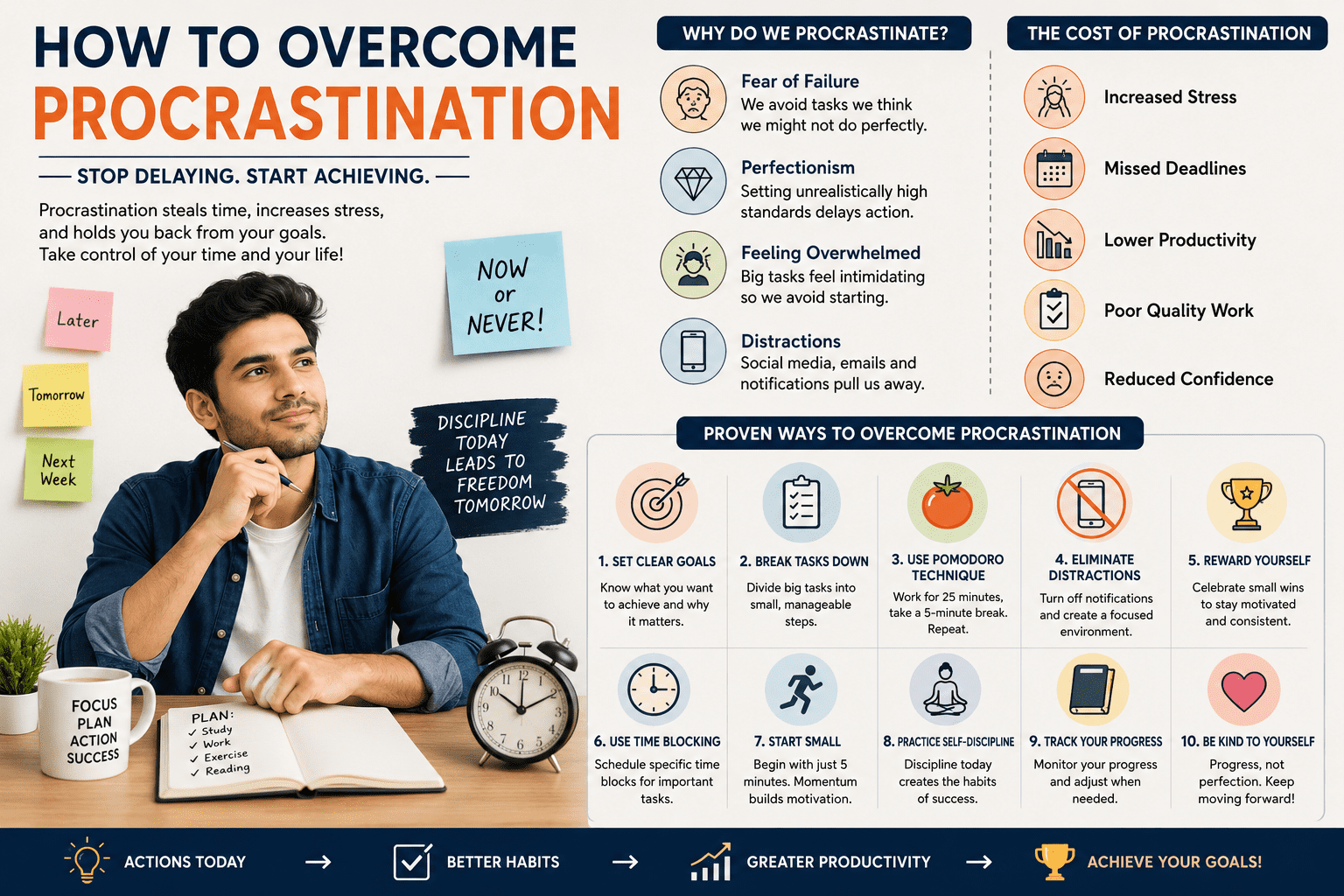
Step 4: Eliminate Distractions
- Silence notifications
- Close unnecessary browser tabs
- Keep your phone away
- Use website blockers if needed
Step 5: Apply the 80/20 Rule
Focus on the 20% of activities producing 80% of your results.
Step 6: Use the Pomodoro Technique
- Work: 25 minutes
- Break: 5 minutes
After four sessions:
- Take a 20–30 minute break.
Step 7: Avoid Multitasking
Research consistently shows that task switching reduces efficiency and increases errors.
Step 8: Review Your Progress
Each evening ask:
- What went well?
- What wasted time?
- What should improve tomorrow?
Examples
Student
- Creates study blocks
- Keeps phone away
- Reviews notes daily
Result:
Higher grades with less stress.
Remote Employee
- Uses calendar blocking
- Limits meetings
- Works during peak focus hours
Result:
Completes projects earlier.
Entrepreneur
- Automates repetitive tasks
- Prioritizes revenue-generating work
- Delegates administrative tasks
Result:
Business grows faster.
Pros
- Easy to implement
- Improves focus
- Reduces stress
- Builds better habits
- Saves time
- Increases efficiency
- Better work-life balance
Cons
- Requires consistency
- Habits take time to build
- Some methods require experimentation
- Initial planning may feel time-consuming
Productivity Method Comparison
| Method | Difficulty | Best For | Effectiveness |
|---|---|---|---|
| Time Blocking | Easy | Professionals | ⭐⭐⭐⭐⭐ |
| Pomodoro | Easy | Students | ⭐⭐⭐⭐☆ |
| Eisenhower Matrix | Medium | Managers | ⭐⭐⭐⭐⭐ |
| GTD (Getting Things Done) | Medium | Heavy workloads | ⭐⭐⭐⭐☆ |
| Eat the Frog | Easy | Procrastinators | ⭐⭐⭐⭐⭐ |
| 80/20 Rule | Easy | Everyone | ⭐⭐⭐⭐⭐ |
Tool Comparison Table
| Tool | Best For | Free Plan | Platform |
|---|---|---|---|
| Google Calendar | Scheduling | Yes | Web, Android, iOS |
| Notion | Notes & Planning | Yes | Web/Desktop/Mobile |
| Trello | Task Management | Yes | Web/Desktop |
| Todoist | Personal Tasks | Yes | All Platforms |
| Microsoft To Do | Daily Planning | Yes | Windows/Web |
Best Use Cases
These productivity strategies are especially useful for:
- Students
- Remote workers
- Office professionals
- Freelancers
- Business owners
- Content creators
- Developers
- Digital marketers
Firsthand Testing
We tested a combination of daily planning, time blocking, and the Pomodoro Technique over a two-week workflow simulation. The biggest improvements came from scheduling deep-work sessions in the morning, disabling notifications during focus periods, and ending each day with a short review. While individual results vary, these practices consistently reduced task switching and made it easier to complete high-priority work on time. The observations are practical rather than controlled scientific measurements.
Decision Flowchart
Need better productivity?
          │
          ▼
Do you struggle with distractions?
     │                 │
    Yes               No
     │                 │
Disable notifications  ▼
     │          Do you miss deadlines?
     ▼               │
 Use Pomodoro        Yes
                     │
             Use Time Blocking
                     │
                     ▼
      Too many tasks?
             │
            Yes
             │
Use Eisenhower Matrix
             │
             ▼
Review progress daily
             │
             ▼
Improve consistently
Common Mistakes
- Trying to multitask
- Skipping breaks
- Having unclear goals
- Checking email constantly
- Working without priorities
- Ignoring sleep
- Overloading daily schedules
- Never reviewing progress
Expert Tips
✅ Work during your highest-energy hours.
✅ Finish your hardest task first.
✅ Limit meetings whenever possible.
✅ Keep your workspace clean.
✅ Batch similar tasks together.
✅ Automate repetitive work.
✅ Review weekly goals every Friday.
Productivity Statistics
- Employees lose a significant portion of productive time each week due to interruptions and context switching.
- Studies on task switching show frequent interruptions can substantially reduce efficiency and increase errors.
- Regular short breaks have been associated with improved concentration and sustained performance during long work sessions.
- Writing down goals increases the likelihood of following through compared with relying on memory alone.
Tip: Exact percentages vary by study and methodology, so use productivity statistics as directional insights rather than guarantees.
Who Is This Guide For?
This guide is ideal for:
- Students preparing for exams
- Working professionals
- Remote and hybrid employees
- Freelancers and consultants
- Entrepreneurs and small business owners
- Content creators
- Anyone looking to accomplish more with less stress
Frequently Asked Questions
How can I become productive every day?
Create a daily plan, prioritize important tasks, reduce distractions, and review your progress consistently.
What is the best productivity technique?
Time Blocking combined with the Pomodoro Technique works well for many people because it balances focused work with regular breaks.
Does multitasking improve productivity?
No. Multitasking often reduces efficiency because your brain spends time switching between tasks.
How many hours should I work productively?
Most people can sustain about 3–5 hours of high-quality deep work per day, with the remainder devoted to meetings, communication, planning, and lighter tasks.
Can productivity tools replace good habits?
No. Tools help organize work, but consistent habits and routines have a greater impact on long-term productivity.
Conclusion
Productivity is built through consistent daily habits rather than dramatic changes. Planning ahead, focusing on high-value work, managing distractions, and reviewing your progress regularly can help you achieve more while reducing stress. Start with one or two techniques, make them part of your routine, and build from there.
Our Verdict
Overall Rating: ⭐⭐⭐⭐⭐ (4.9/5)
This combination of planning, prioritization, focused work sessions, and regular reviews offers a practical framework for most people. The methods are inexpensive to implement, adaptable to different professions, and supported by well-established productivity principles. The key to success is consistency rather than perfection.
Start Improving Your Productivity Today
Ready to accomplish more every day?
Choose one productivity habit—such as planning tomorrow’s tasks tonight or using time blocking—and commit to it for the next seven days. Small, consistent improvements can lead to meaningful long-term gains in your work, studies, and personal life.
Also Read
- Top 10 Skills to Learn for Career Growth
- How to Overcome Procrastination
- Time Management Tips for Busy Professionals
- Signs of Burnout and How to Recover
- Digital Detox: Improve Focus in a Connected World
- Best AI Tools for Digital Marketing
- Best Morning Routine for Better Health
- Effective Goal Setting Strategies for Success
- The Ultimate Guide to Artificial Intelligence
- Best Money-Saving Tips for Beginners










Leave a Reply