

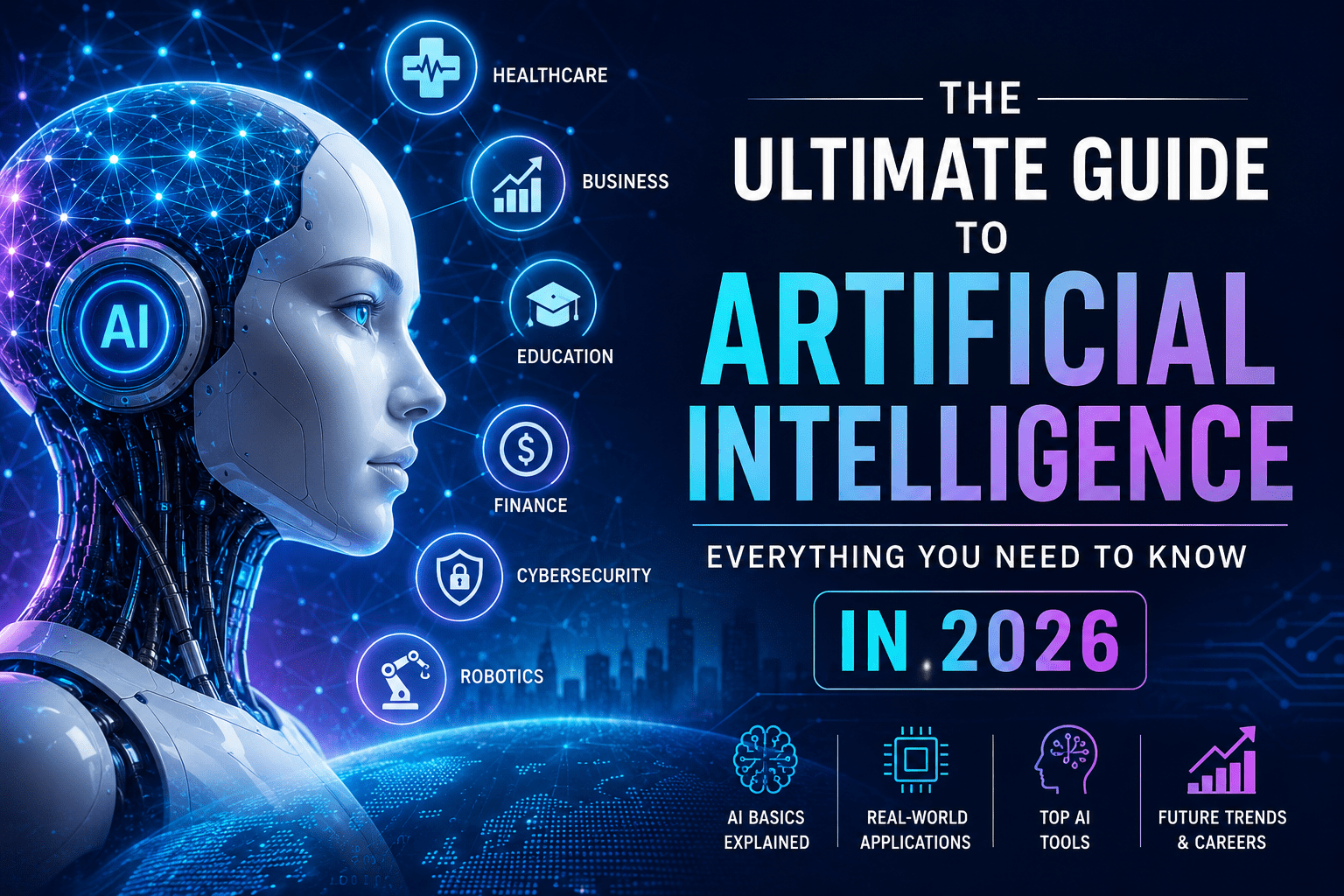
Artificial Intelligence (AI) is no longer a futuristic concept—it is a driving force behind many of the technologies we use every day. From personalized recommendations on streaming platforms to virtual assistants, autonomous vehicles, medical diagnostics, and business automation, AI is transforming industries and reshaping how people live and work.
Whether you are a student, entrepreneur, software developer, business owner, marketer, or simply curious about emerging technologies, understanding AI has become an essential skill. This comprehensive guide explains the fundamentals of Artificial Intelligence, explores its applications across industries, discusses benefits and challenges, highlights career opportunities, and looks ahead to the future of AI in 2026 and beyond.
What is Artificial Intelligence?
Artificial Intelligence is a branch of computer science focused on creating systems capable of performing tasks that typically require human intelligence. These tasks include:
- Learning from data
- Solving problems
- Understanding language
- Recognizing images and speech
- Making decisions
- Predicting outcomes
Unlike traditional software that follows fixed instructions, AI systems improve their performance by analyzing large datasets and identifying patterns.
Examples of AI include:
- Virtual assistants
- Recommendation systems
- Spam filters
- Chatbots
- Facial recognition
- Self-driving technology
History of Artificial Intelligence
The journey of AI spans several decades:
1950s
- Alan Turing proposed the concept of intelligent machines.
- The Turing Test was introduced.
1960s–1980s
Researchers developed expert systems capable of solving specialized problems.
1997
IBM’s Deep Blue defeated world chess champion Garry Kasparov.
2012
Deep learning revolutionized AI through neural networks and powerful GPUs.
2020–2026
Generative AI models transformed content creation, coding, education, customer support, healthcare, and scientific research.
How Artificial Intelligence Works
AI systems follow a structured process:
Data Collection
AI learns from massive datasets.
Data Processing
The collected data is cleaned and prepared.
Model Training
Algorithms identify relationships and patterns.
Prediction
The trained model makes decisions based on new inputs.
Continuous Learning
Many AI systems improve as they process additional data.
Types of Artificial Intelligence
Narrow AI
Designed for a specific task.
Examples:
- Voice assistants
- Image recognition
- Recommendation engines
General AI
A theoretical AI capable of performing any intellectual task a human can perform.
Super AI
A hypothetical future AI that surpasses human intelligence in every field.
Machine Learning vs Deep Learning
Machine Learning
Machine Learning enables systems to learn from data without explicit programming.
Common algorithms include:
- Decision Trees
- Random Forests
- Support Vector Machines
- Linear Regression
Deep Learning
Deep Learning uses neural networks with multiple layers to solve highly complex problems.
Applications include:
- Image recognition
- Natural language processing
- Autonomous vehicles
- Medical imaging
Major AI Technologies
Natural Language Processing (NLP)
Helps computers understand and generate human language.
Examples:
- Translation
- Chatbots
- Text summarization
- Sentiment analysis
Computer Vision
Allows machines to analyze images and videos.
Applications:
- Face detection
- Medical imaging
- Autonomous driving
- Security surveillance
Robotics
Combines AI with physical machines to automate tasks in manufacturing, healthcare, agriculture, and logistics.
Expert Systems
Decision-making software that mimics human experts in specialized fields.
AI Applications Across Industries
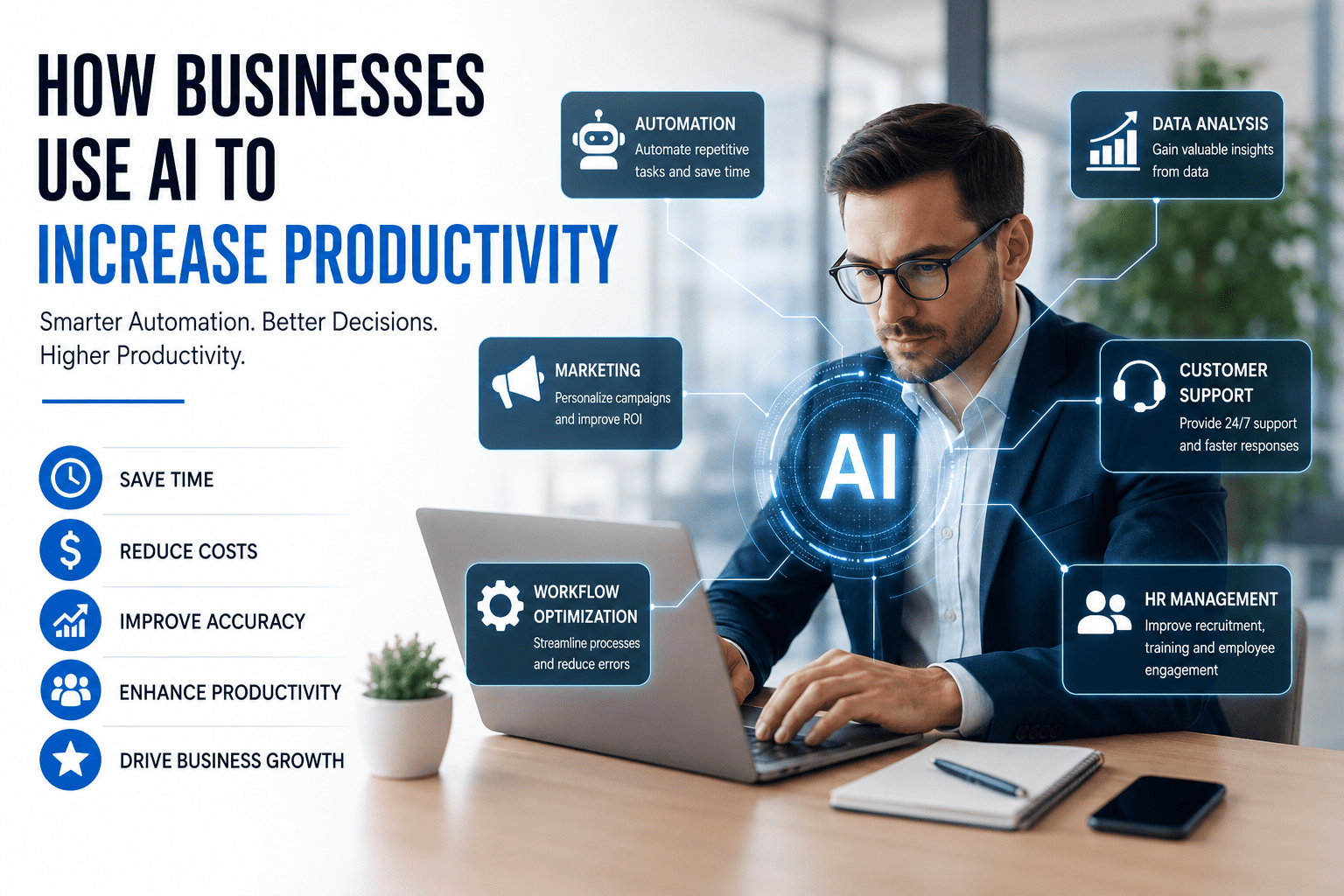
AI in Business
Businesses use AI to:
- Automate customer support
- Analyze sales data
- Forecast demand
- Optimize inventory
- Improve marketing
- Personalize customer experiences
Suggested:
- How Businesses Use AI to Increase Productivity
- AI-Powered Customer Service
- AI for Small Businesses
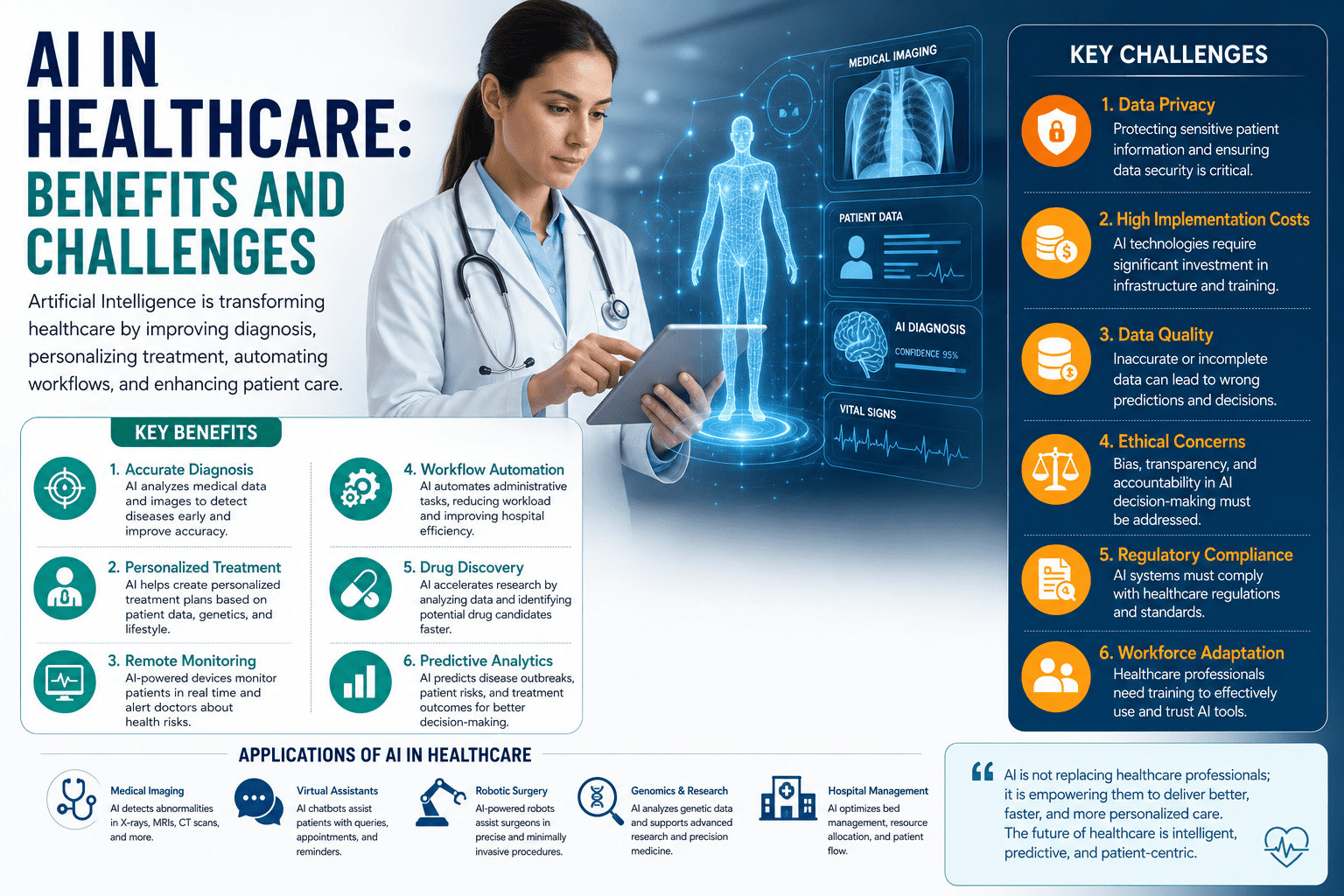
AI in Healthcare
Healthcare professionals use AI for:
- Medical image analysis
- Drug discovery
- Disease prediction
- Personalized treatment plans
- Remote patient monitoring
Suggested:
AI in Education
AI enhances education by offering:
- Personalized learning paths
- Intelligent tutoring systems
- Automated grading
- Language translation
- Accessibility tools
AI in Finance
Financial institutions use AI for:
- Fraud detection
- Credit scoring
- Algorithmic trading
- Risk management
- Personalized financial advice
Suggested:
AI in Manufacturing
AI helps manufacturers through:
- Predictive maintenance
- Quality control
- Supply chain optimization
- Industrial robotics
AI in Cybersecurity
AI strengthens security by:
- Detecting threats
- Monitoring networks
- Preventing fraud
- Responding to cyberattacks in real time
AI for Everyday Life
Most people interact with AI daily through:
- Smart assistants
- Email spam filters
- Online shopping recommendations
- Navigation apps
- Streaming suggestions
- Smart home devices
- Language translation apps
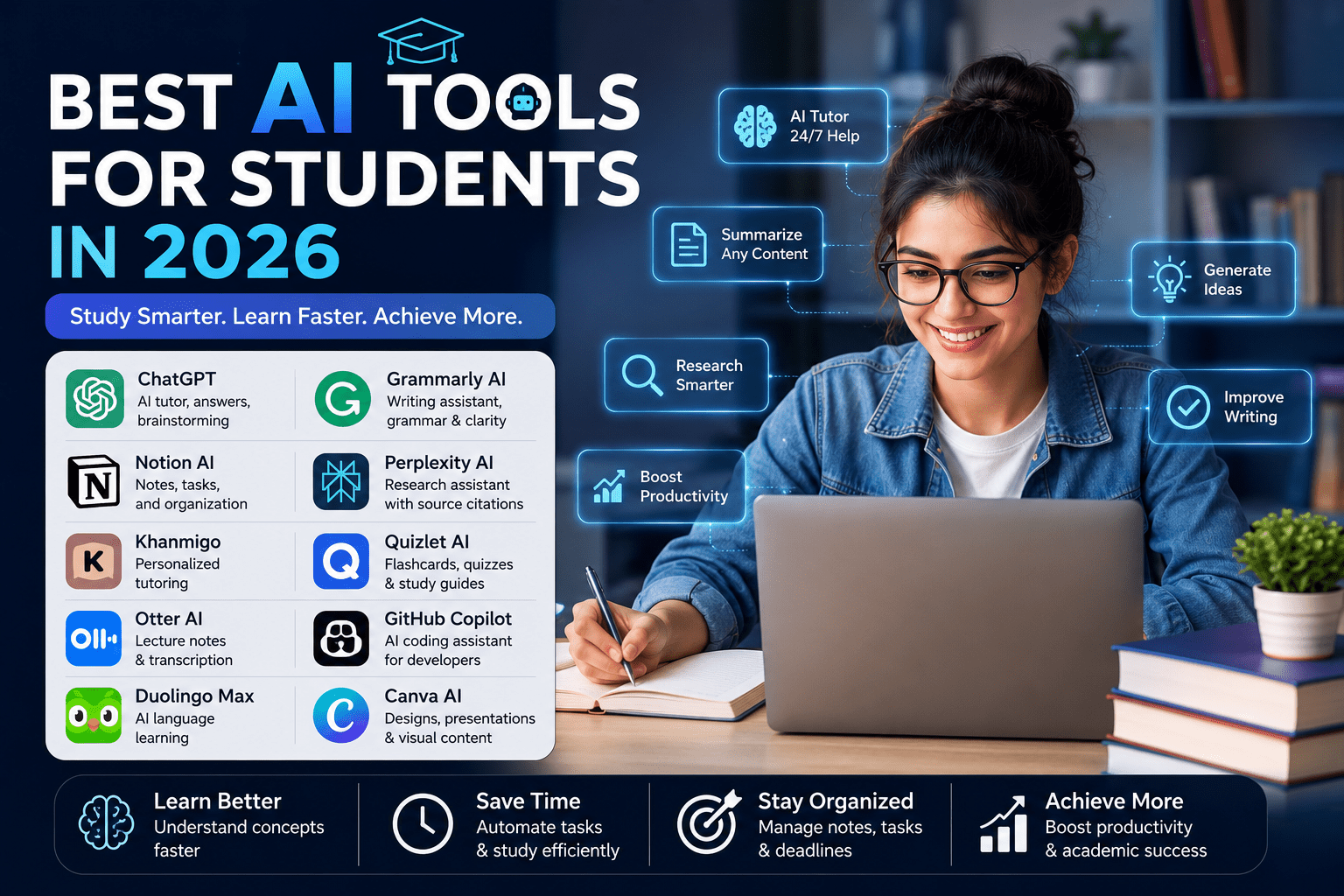
Popular AI Tools in 2026
Some widely used AI tools include:
- ChatGPT
- Google Gemini
- Microsoft Copilot
- Claude
- Perplexity AI
- Midjourney
- Adobe Firefly
- Notion AI
- Grammarly
- GitHub Copilot
Suggested:
Benefits of Artificial Intelligence
AI offers numerous advantages:
- Increased productivity
- Faster decision-making
- Reduced operational costs
- Better customer experiences
- Improved healthcare outcomes
- Enhanced accessibility
- 24/7 automation
- Data-driven insights
Challenges and Risks
Despite its benefits, AI presents several challenges:
- Data privacy concerns
- Algorithmic bias
- Job displacement
- Security risks
- High implementation costs
- Lack of transparency
- Ethical concerns
- Regulatory uncertainty
AI Ethics
Responsible AI development focuses on:
- Fairness
- Transparency
- Accountability
- Privacy protection
- Human oversight
- Safe deployment
- Environmental sustainability
Organizations and governments are increasingly developing AI governance frameworks to ensure these principles are upheld.
Careers in Artificial Intelligence
Growing AI-related career paths include:
- AI Engineer
- Machine Learning Engineer
- Data Scientist
- AI Product Manager
- Robotics Engineer
- NLP Engineer
- Computer Vision Engineer
- Prompt Engineer
- AI Research Scientist
- AI Ethics Specialist
Skills Required to Learn AI
If you’re starting your AI journey, focus on developing:
- Python programming
- Mathematics (linear algebra, calculus, probability)
- Statistics
- Data analysis
- Machine Learning fundamentals
- Deep Learning
- Prompt engineering
- Cloud computing
- Data visualization
- Critical thinking
The Future of Artificial Intelligence
In the coming years, AI is expected to:
- Accelerate scientific discoveries
- Enhance healthcare diagnostics
- Improve education through personalized learning
- Transform transportation with autonomous systems
- Increase workplace productivity
- Support climate change research
- Power smarter cities
- Expand creative tools for content generation
Human oversight, ethical development, and effective regulation will remain crucial to ensuring AI benefits society.
Frequently Asked Questions (FAQ)
What is Artificial Intelligence?
Artificial Intelligence is the simulation of human intelligence by computer systems, enabling them to learn, reason, solve problems, and make decisions.
Is AI replacing human jobs?
AI is automating certain repetitive tasks while also creating new roles that require technical, creative, and strategic skills. The impact varies by industry.
Can beginners learn AI?
Yes. Many free and paid courses are available, and beginners can start with programming fundamentals, data analysis, and introductory machine learning.
Which industries use AI the most?
Healthcare, finance, manufacturing, education, retail, transportation, cybersecurity, and marketing are among the leading adopters.
What is the difference between AI and Machine Learning?
AI is the broader concept of machines performing intelligent tasks. Machine Learning is a subset of AI that enables systems to learn from data.
Is AI safe?
AI can be safe when developed and deployed responsibly, with appropriate safeguards, transparency, and human oversight.
Conclusion
Artificial Intelligence is reshaping the modern world by enhancing productivity, enabling innovation, and solving complex challenges across industries. As AI technologies continue to evolve, individuals and organizations that invest in AI literacy and responsible adoption will be better positioned to thrive in the digital economy.
Whether your goal is to build a career in AI, improve business operations, or simply understand the technology shaping our future, developing a strong foundation in Artificial Intelligence is an investment that will continue to deliver value in the years ahead.






Leave a Reply